Why Remote Verification Matters
Sourcing a hair dryer factory from another country means relying on information the supplier chooses to share. That creates an obvious asymmetry: the supplier knows exactly what their facility looks like, and the buyer sees only what appears on a website or in a catalogue.
The good news is that a meaningful portion of verification can be done without visiting. Not all of it, and not with the same confidence as an in-person audit, but enough to separate a genuine manufacturer from a trading company presenting itself as one.
This guide sets out seven checks that can be run remotely, in the order that produces the most useful information fastest.
Check 1: The Business Licence and Unified Social Credit Code
Every legally operating company in China holds a business licence issued by the market regulator. The document carries a unified social credit code, a registration number that identifies the entity.
Request a copy of the licence, and read it rather than filing it. Four fields matter:
- Company name, which should match the name on the quotation and the invoice
- Registered address, which should correspond to the facility location
- Business scope, which should include manufacturing of the relevant product category
- Registration status, which should be active rather than revoked or abnormal
A trading company will typically hold a licence whose business scope covers sales rather than manufacturing. That is not inherently a problem, since many buyers deliberately work with trading companies that aggregate factories, but the buyer should know which they are dealing with.
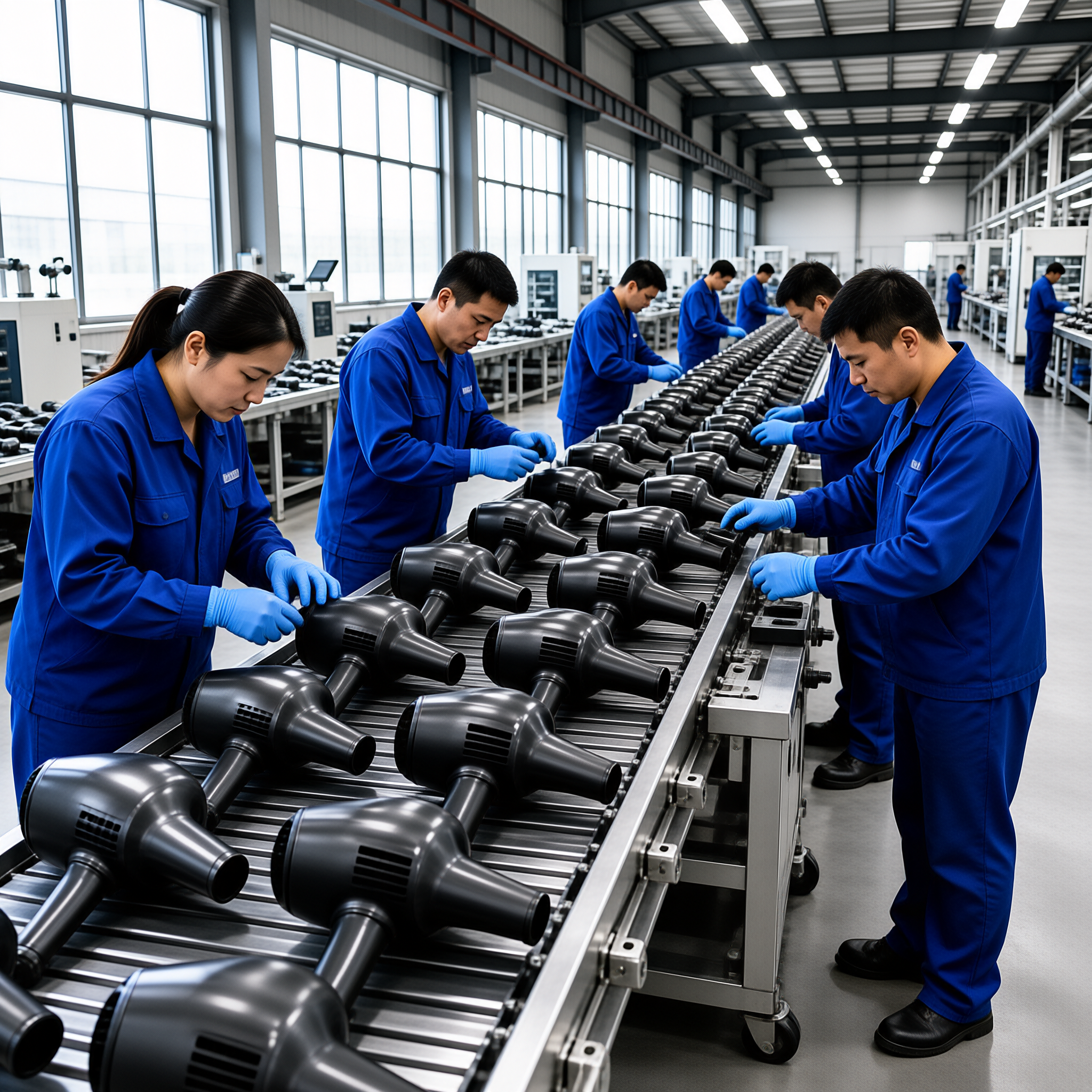
Check 2: Live or Time-Stamped Production Footage
Photographs of a factory are easy to obtain from any source. Video is harder to fake at scale, and live video harder still.
A reasonable request is a short video call in which the supplier walks through the production area, shows the assembly line running, and answers questions while the camera is moving. Static video with no live element can be pre-recorded at another facility.
Pay attention to what is visible rather than what is described. Assembly stations, testing equipment, incoming material storage and finished goods packing areas each tell you something about how the operation is actually organised.
Check 3: Certificate Lookup at the Issuing Body
CE, FCC, RoHS, UKCA, ETL, CB and ISO certificates are issued by identifiable organisations, and most of them can be checked.
When a supplier provides a certificate, extract three details: the certificate number, the issuing body, and the certificate holder name. Then verify them at the issuing body rather than accepting the PDF.
Two specific things to confirm:
- The certificate holder should be the supplier you are dealing with, or a party they can explain
- The product model listed should match the model you intend to order
A certificate that is genuine but issued for a different model does not cover your product.
Check 4: Inspection Records and AQL Practice
A factory that ships regularly will have inspection records. Ask to see a completed inspection report for a recent shipment, with sensitive commercial details removed.
The report should show the sampling plan used, the defect classification applied, the accept and reject criteria, and the outcome. AQL-based inspection is a recognised methodology, and a report structured around it is more credible than a page of adjectives.
Ask also how defects found in inspection are handled, and what happens to rejected lots. The answer describes the real quality system more accurately than the certification wall does.
Check 5: Packing Lists, Loading Records and Shipping History
Shipping documentation for past orders demonstrates that the supplier has actually exported. Ask for a recent packing list and, where possible, a bill of lading with commercial terms redacted.
What to look for:
- Volume and frequency of shipments
- Destination markets
- Product mix per shipment
A supplier that has shipped to several markets in the past year is demonstrating a level of operational experience that a first-time exporter cannot.
Check 6: Sample and Bulk Consistency
The most common disappointment in sourcing is not a bad sample but a good sample followed by different bulk production.
Ask explicitly what mechanism keeps bulk production aligned with the approved sample. Common answers include a retained signed sample kept at the line, a golden sample with documented tolerances, and inspection against the sample rather than against the drawing alone.
A supplier who cannot describe the mechanism is unlikely to have a reliable one.
Check 7: Performance Metrics and Staffing
Finally, ask for numbers that a real factory tracks. Typical examples are monthly output, production line count, headcount, and on-time delivery rate for recent periods.
These figures are self-reported and cannot be independently verified remotely. Their value lies in consistency: if the stated output is compatible with the stated number of lines and staff, the picture holds together; if the numbers conflict, one of them is wrong.
What Remote Verification Cannot Do
It is worth being clear about the limits. Remote checks cannot confirm that the equipment on the line is what you were shown, cannot assess working conditions, and cannot verify that a specific production run met specification.
For high-value or high-risk orders, a third-party inspection at the factory before shipment remains the most reliable single measure. Remote verification is a filter, not a replacement.
Putting the Checks in Order
A practical sequence for a new supplier:
- Business licence and business scope
- Live video walkthrough
- Certificate lookup at issuing bodies
- A recent inspection report
- Packing list and shipping history
- Sample consistency mechanism
- Output and staffing figures
Each check takes minutes to request and considerably less time to assess than the cost of a wrong order.
FAQ
Q: Can a trading company pass these checks? Yes, and that is not necessarily disqualifying. The checks are designed to establish what the supplier actually is, so the buyer can make an informed decision rather than relying on an unverified claim.
Q: Are certificate numbers safe to check online? Generally yes. Most issuing bodies provide a lookup facility that confirms the certificate exists and shows the holder and covered models. Avoid publishing full certificate copies on public pages.
Q: What if the supplier refuses to provide a live video call? Treat refusal as information. There may be legitimate reasons, but a supplier unable to show live production should be considered unverified rather than verified.
Q: Is a factory audit always necessary? Not always. For low-value trial orders, remote checks plus a pre-shipment inspection are often proportionate. For larger orders or first-time suppliers in unfamiliar markets, an on-site audit usually justifies its cost.