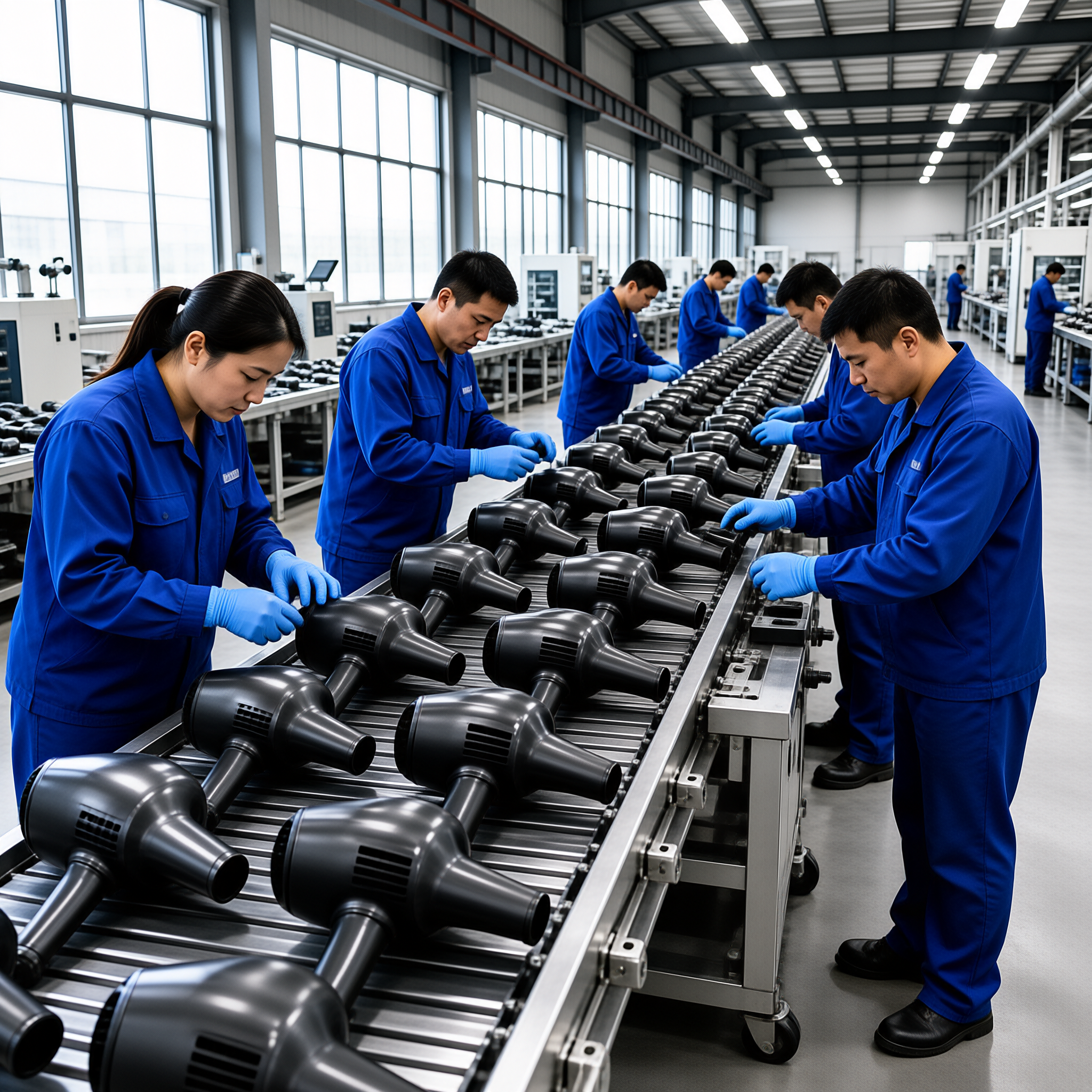
When our customers place a hair dryer on a retail shelf or ship a pallet to an overseas warehouse, the box does two jobs at once: it sells the product and it protects it. Buyers who treat packaging as an afterthought usually discover the cost later, in crushed cartons, damaged nozzles and returns. This guide walks through the decisions we help importers, brand owners and marketplace sellers make before a single carton is printed.
Definition
Hair dryer packaging design is the process of specifying the outer shipping carton, the retail box or case, the internal insert, the labels and the printed documentation that carry a hair dryer from the production line to a store shelf or a customer's door.
Key Points
Format follows channel: color boxes suit e-commerce and mid-tier retail, rigid gift boxes suit premium sets, and tool cases suit markets that value reusable storage.
Accessories cause most transit damage, so the insert design matters as much as the outer board grade.
Multilingual manuals and market-specific labels are usually decided early, because late changes reset artwork approvals and tooling.
Packaging cost should be assessed against damage rates and return rates, not against unit price alone.
Sampling before mass production is the cheapest way to catch fit, print and drop-test issues.
Choosing the Right Format: Gift Box, Color Box, EVA Insert or Tool Case
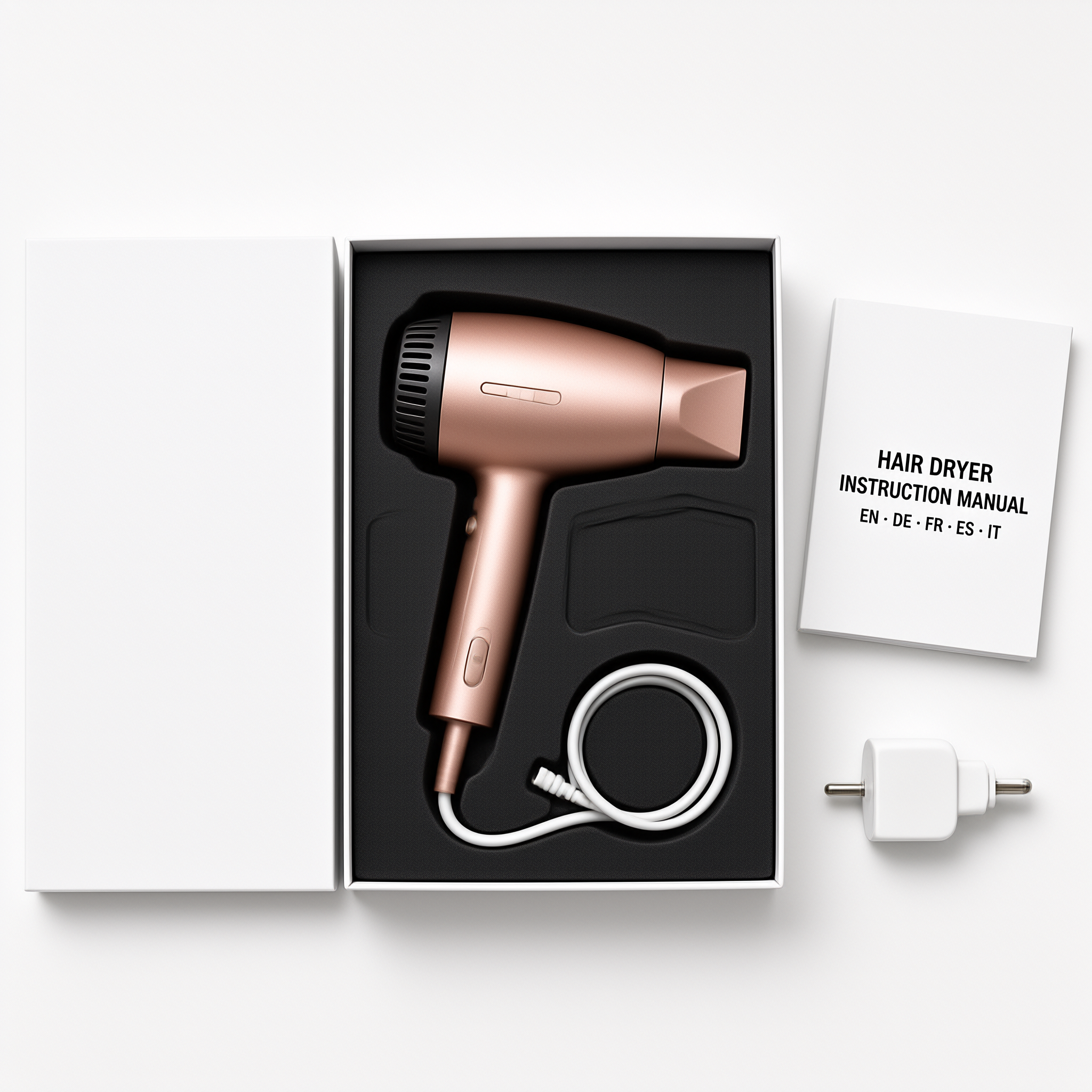
Four formats cover most of the category. A printed color box is the workhorse for e-commerce and open-shelf retail. A rigid gift box with magnetic closure suits premium positioning and seasonal gift sets. An EVA or molded pulp insert holds the dryer and its attachments so nothing shifts in transit. A blow-molded tool case doubles as storage, which reads as added value in markets where buyers keep the box. Each choice changes tooling cost, carton cube and the damage profile, so the format should be locked before artwork begins.
| Element | Economy approach | Export-ready approach |
|---|---|---|
| Outer structure | Single-wall corrugated mailer | Double-wall carton sized to the retail box with edge clearance |
| Internal protection | Folded cardboard divider | Custom EVA or molded pulp insert with cavities for dryer and attachments |
| Retail box | One-color print, thin board | Printed board with consistent color proofing across production runs |
| Documentation | Single-language leaflet | Multilingual manual plus market-specific safety and recycling marks |
| Damage control | Visual check at packing | In-house drop and compression testing before shipment |
| Customization | Stock sizes with a sticker | OEM tooling, structural sampling and print proofing |
Protecting the Product from Carton to Doorstep
In our experience, damage rarely starts with the dryer body. It starts with the concentrator nozzle, the diffuser or the cord, which move inside a loosely fitted box and crack the housing or scuff the finish. The insert should hold every accessory in its own cavity, with a defined clearance between the retail box and the shipping carton so corners absorb impact.
We run cartons through internal drop and compression checks that follow widely used transit-testing logic before a production order leaves the line. Buyers can also request third-party laboratory testing where their retail channel requires it. The point is not a certificate on a wall; it is knowing how the pack behaves when a pallet is restacked three times or a parcel is dropped at a sorting hub.
Labels, Manuals and Multilingual Compliance
Labeling is where retail packaging and export compliance meet. For the European Union, the outer packaging normally carries the importer or responsible person address, material identification symbols, and the electrical and EMC markings that apply to the model. The EU Packaging and Packaging Waste Directive sets the framework for material and heavy-metal requirements that packaging must meet.
For the United States, buyers typically confirm electrical safety marks for the model and check whether environmental claims on the box fall within the FTC Green Guides. Manuals should be written in the languages the destination market requires, and the safest approach is to define the language set at the quotation stage rather than adding inserts later.
Custom OEM Packaging Workflow: From Brief to Mass Production
Step 1: Share product dimensions, accessory list, target channels and required languages so the format can be proposed.
Step 2: Confirm structure and insert material, then receive a structural sample for fit and handling checks.
Step 3: Approve artwork and print proofs against a physical color reference, not a screen image.
Step 4: Validate drop and compression performance on a filled sample carton.
Step 5: Set the order quantity against the tooling MOQ, then schedule production and inspection.
MOQ for custom packaging is usually driven by tooling and print setup rather than by the box itself, which is why a heavier insert or a multi-color print can shift the minimum order quantity. Sampling typically runs ahead of mass production and is the stage where fit corrections are cheapest. Buyers planning several models can share one insert platform to keep tooling to a single set. Broader research on how packaging shapes purchase decisions is collected in this Google Scholar search on packaging design and purchase intention.
How Packaging Influences Shelf Appeal, Damage Rates and Repeat Purchase
A buyer standing in front of a shelf decides quickly, mostly from the front panel and how the box feels in hand. Clean hierarchy, an honest product image and a window or insert that shows the dryer in place do more than a busy graphic layout. When the pack also survives shipping intact, the customer receives an undamaged product in a box that still looks presentable, and that combination is what turns a first order into a second one.
Frequently Asked Questions
- How to choose between a color box and a gift box?
- Choose a color box when the product competes on open shelf or ships mainly through e-commerce, because it is lighter and cheaper to freight. Choose a rigid gift box when the dryer is sold as a premium or seasonal gift set and the unboxing experience carries part of the value. Both can use the same internal insert.
- What is MOQ in custom hair dryer packaging?
- MOQ is the minimum quantity a factory will run for a custom structure or print job, set by tooling, plate and setup costs. Simpler structures and fewer print colors generally allow a lower minimum, while custom inserts or special finishes raise it.
- How to protect a hair dryer during international shipping?
- Fix every accessory in its own cavity, keep a defined clearance between the retail box and the shipping carton, and test a filled carton with drop and compression checks before production. Double-wall cartons are usually required for sea freight consolidation.
- What labels are required for hair dryer exports to the EU?
- Packaging normally carries the importer or responsible person details, material identification symbols and the electrical and EMC markings that apply to the model. Language requirements for the manual and safety text vary by member state, so the language set should be confirmed before artwork is finalized.
- How long does packaging sampling usually take?
- Structural samples are typically produced quickly once dimensions are confirmed, while printed samples need additional time for artwork proofing and plate setup. Scheduling the sample round well before the production window avoids rushed approvals.
- Why does packaging design affect repeat purchases?
- A pack that arrives undamaged and opens cleanly tells the customer the brand manages quality. If the box is crushed or the accessory is loose, the product is judged the same way, and that impression follows the buyer into the next purchase decision.
- How to plan multilingual manuals for multiple markets?
- Group markets that share a language into one manual version, keep the layout modular so pages can be added without redesign, and confirm the required language list at the quotation stage. This keeps print runs efficient across several destinations.