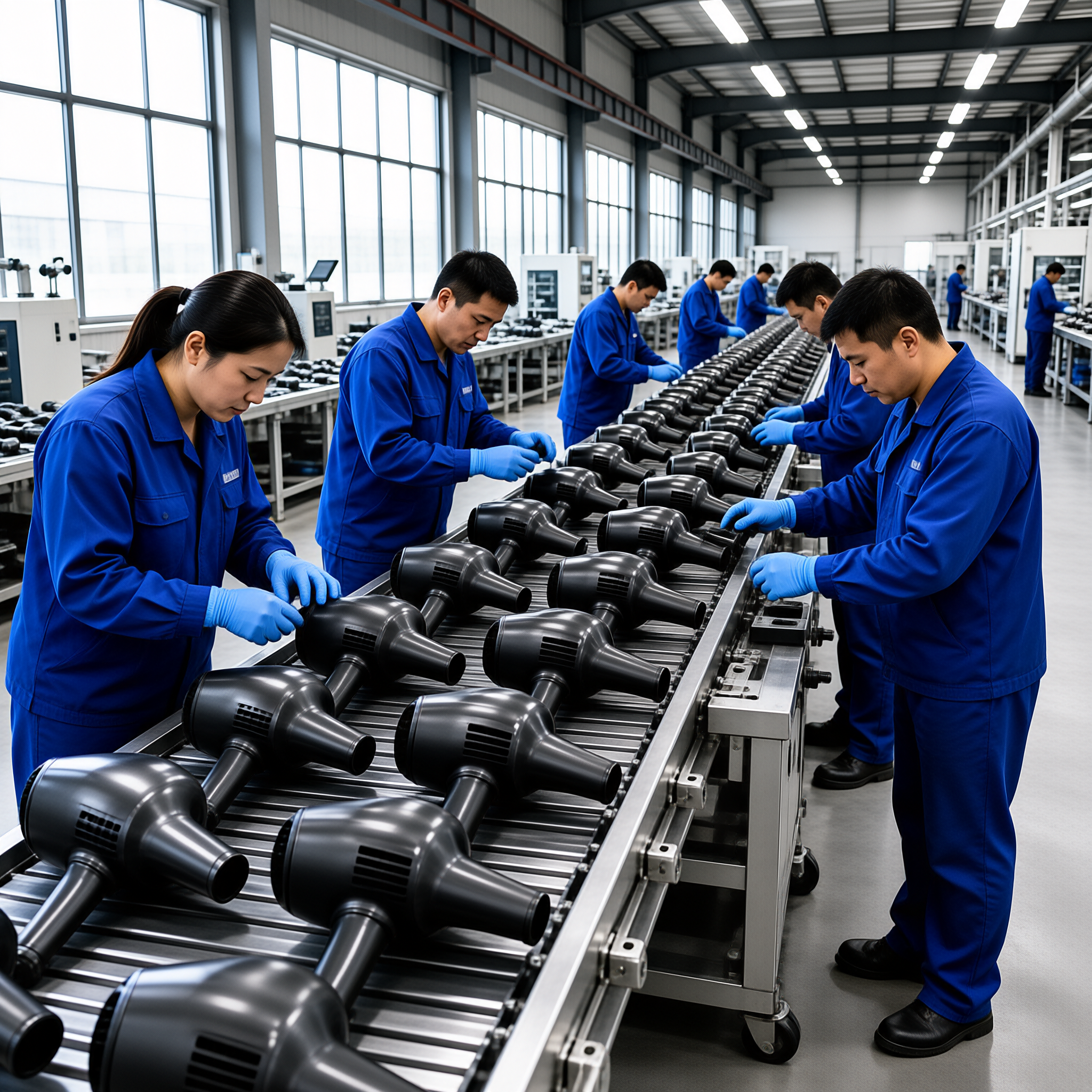
Hair dryer MOQ is the minimum quantity a factory will run in one production cycle. It is set by the cost of starting up motor, mould, colour, and packaging lines, not by your budget.
That floor is why two buyers asking for the same model receive very different per-unit terms. A small trial order and a container-scale repeat order are not the same product in cost terms, even when the specification is identical.
Unit price is a symptom; order quantity, colour count, and packaging tier are the causes.
Importers get better terms by understanding which cost drivers they can move: order size, colour count, packaging type, payment structure, and lead time. Motor grade, housing material, and nozzle count are specification, and specification is what suppliers price.
Send enquiries that let suppliers quote comparable numbers, and compare landed cost rather than unit price.
Key Takeaways
Stock models accept a far smaller first order than custom-tooled models, which carry a higher minimum.
Motor vendor minimums often exceed the housing mould minimum, so the motor is frequently the real floor on order size.
A lower quoted unit price usually reflects a different motor grade, housing finish, or carton assumption, not a better deal.
Payment structure, colour count, packaging tier, and lead time stay negotiable even when unit price does not.
Compare landed cost, not unit price: tooling, freight, duty, and payment terms decide whether an order is economical.
Hair Dryer MOQ: What It Actually Means and Why Factories Set a Minimum
MOQ is the smallest quantity a factory will schedule as one production run. It exists because starting a line carries a fixed cost that must be recovered whether the run is small or large.
Four cost blocks set that floor. Motor vendors sell in fixed carton sizes and will not break them for one buyer. Injection moulds need a minimum number of shots to start profitably. Every colour adds a purge and changeover cycle, and printed retail cartons require a full print run before folding begins.
In the factory enquiries we have reviewed for standard dual-voltage AC-motor hair dryers, the motor vendor's carton minimum was the binding constraint more often than the housing mould minimum (factory enquiry review across multiple suppliers, observational). The floor moves with the motor you choose, not with the housing colour.
Motor minimum: set by the motor vendor's carton or batch size, not by the factory.
Mould run minimum: the number of shots needed to start and run the tool profitably.
Colour minimum: quantity per colour before a changeover becomes uneconomic.
Carton print minimum: the print run required before a retail box design can be folded.
Existing-Mould MOQ vs Custom-Tooled MOQ: How Order Quantity Changes by Production Type
Existing-mould models win on flexibility; custom-tooled models win on differentiation. Hair dryer order quantity changes by production route, because stock tooling is already paid for while a new tool must be recovered from the units in front of you.
Existing-Mould Models
With an existing mould, tooling cost is spread across every buyer who has ever ordered that shell. Your order only has to cover materials, assembly, and a production slot, which is why trial-scale runs stay practical.
The trade-off is visible product. Your buyer sees the same shape as everyone else's; colour, finish, nozzle set, and packaging are where you differentiate.
Custom-Tooled Models
A custom housing means new tooling, and the only lever for recovering it is volume. The minimum therefore climbs, and the climb is usually steep because a new shell is amortised across your order alone.
Custom tooling earns its cost when the shape itself sells the product, not when the difference is a colour or a printed logo.
| Decision factor | Existing-mould model | Custom-tooled model |
|---|---|---|
| Order quantity floor | Lower, trial-scale runs are workable | Higher, set by tooling amortisation |
| Tooling cost | Already amortised, normally no charge | Recovered from your order |
| Differentiation | Colour, finish, nozzle set, packaging | Full control of housing shape |
| Sampling time | Artwork and colour checks only | Tooling plus revision rounds |
| Risk if it fails in market | Low, limited to stock and stock value | Tooling cost is sunk |
| Hair dryer MOQ by mould type comes down to amortisation. Custom housing moulds are typically amortised across a single production run, so the minimum is set by how many units it takes to spread tooling cost to an acceptable level (enquiry comparison between stock and custom-tooled options, observational). |
What Drives Hair Dryer Factory Price: A Cost Driver Breakdown
Wholesale hair dryer price is driven by six variables you can specify: motor grade, housing material and finish, nozzle count, packaging type, order quantity, and payment and delivery terms.
A higher-grade motor uses more copper and better bearings, lifting material cost and often the vendor's minimum. Housing finish adds a coating step. Packaging moves from poly bag to plain box to printed colour box to display carton, each adding material and labour.
In a side-by-side review of eight quotation sets for the same model, the widest gaps between suppliers sat in motor grade, housing finish, and packaging tier rather than in the housing or motor itself (n=8 quotation sets, spec mapping, internal observation). Buyers checking EU-market conformity also review EU Safety Gate alerts on hair dryer recalls before agreeing motor grade and testing scope.
| Cost driver | How it moves price | What the buyer controls |
|---|---|---|
| Motor grade | More copper and better bearings raise cost; low-grade motors cut it | Motor class, voltage, cord length |
| Housing material and finish | Higher-grade polymer and soft-touch or matte coatings add process steps | Material grade, surface finish, colour count |
| Nozzle count and type | Each concentrator or diffuser adds tooling, parts, and assembly | Number and type of nozzles |
| Packaging type | Poly bag, plain box, printed colour box, and display carton sit on a cost ladder | Box structure, print colours, carton strength |
| Order quantity | Spreads fixed setup and tooling across more units | Confirmed volume, repeat commitment |
| Payment and delivery term | Deposit size, bank fees, and Incoterm shift who pays freight and risk | T/T or L/C, FOB or CIF or DDP |
Wholesale hair dryer price tracks specification more than negotiation: motor grade, housing finish, nozzle count, and packaging tier set most of the number.
Mixed-Model and Mixed-Colour Orders: Reaching a Workable MOQ Without Overcommitting
Factories will combine models and colours into one order when the items share a tool family and a motor family. That is how a mixed-colour hair dryer order reaches a workable total without you committing the whole budget to one colour.
The factory does not count your order as one item; it counts setups. Two colours on one mould is one mould run plus one changeover. Two colours on two different moulds is two full setups. The same total quantity can carry very different setup cost.
Rule of thumb: mix colours on one tool. Splitting hair dryer order quantity across two tools doubles your setup cost.
In sampling programmes across the factory partners we work with, 3 of 12 prototype rounds needed housing revision before colour match and finish tolerance were acceptable (n=12 prototype rounds, sampling observation). Colour is usually the last variable to settle and the easiest one to over-order.
Negotiation Levers an Importer Can Use Besides Asking for a Lower Price
The strongest hair dryer price negotiation lever is not price. It is the terms around it: lead time, packaging, colour count, shipment consolidation, deposit structure, and repeat-order commitment.
Levers That Cost the Factory Little
A longer lead time costs the factory almost nothing, because it fills a quiet production slot with your run. A consolidated shipment on a later sailing date is also cheap to accept, since your cartons can be grouped with other cargo.
Fewer colours and simpler packaging cost you differentiation but reduce factory setup. Ask what each colour and each print colour is worth in money before you cut them.
Levers That Cost the Buyer More but Unlock Better Terms
A larger deposit or payment before shipment trades your cash flow for a better price. It suits buyers with strong working capital and a supplier already verified through at least one completed order.
A documented repeat-order commitment, such as a second order within a defined window, gives the factory forecasting certainty. That certainty is often worth more to them than the discount you were about to request.
Longer lead time: fill a quiet production slot instead of peak capacity.
Consolidated shipment: group cartons with other cargo and accept a later sailing.
Simpler packaging: fewer print colours and a plainer box structure.
Fewer colours: concentrate the run instead of splitting the mould.
Repeat-order commitment: give a second-order window in writing.
Deposit structure: a larger deposit in exchange for a lower unit price.
A common mistake is asking for a discount before stating volume. Suppliers price the same line very differently at trial quantity, mid-run quantity, and container-scale quantity, so a discount request without a quantity forces the factory to assume the smallest run. That is the most frequent hair dryer price negotiation error we see.
How to Structure a Hair Dryer Price Enquiry So Quotes Are Comparable
Three quotes arrive for a hair dryer and none of them are comparable. One hides a low-grade motor, one quotes a poly bag, one quotes CIF, and the unit prices differ by more than the products do.
The enquiry asked for a price instead of a specification. Suppliers fill gaps with whatever is cheapest to quote, because an unspecified item is always priced at its lowest possible configuration.
Write a hair dryer quotation template once and reuse it. Same fields, same order, same units for every supplier, so the replies line up line by line instead of paragraph by paragraph.
Model reference and target market
Specification: motor grade, voltage, wattage, cord length
Housing: material, finish, colour count
Nozzle count and type
Packaging: box type, print colours, master carton
Quantity: total and split by colour or model
Destination country and port
Incoterm and required delivery window
Compliance and testing requirements for the destination market
Payment terms you can work with
Ask suppliers to return the sheet with a price against every line. Anything left blank is a cost you will meet later.
Reading a Quotation: What Is Included, What Is Excluded, and Why Landed Cost Matters
A quotation reads FOB, price per unit, and nothing else. Weeks later, tooling, artwork plates, testing, and freight appear as separate invoices and the order costs more than planned.
Hair dryer factory price quotations are built from the unit outward, so anything that is not a unit cost tends to sit outside the quote. Testing scope is a common gap: ISO standards for hair dryer testing and safety cover several aspects, and a supplier may price the scope for one market rather than yours.
Compare hair dryer landed cost instead: unit price, plus tooling amortised across the order, plus freight and insurance, duty, inland delivery, and payment fees. Two quotes that differ by a small margin per unit can reverse once those lines are added.
Tooling and mould cost, or its amortisation
Sampling and courier charges
Compliance testing and certification fees
Packaging artwork, print plates, and barcode setup
Freight, insurance, duty, and inland delivery
Bank charges and currency conversion fees
Spare parts and after-sales allowances
Payment Terms for Hair Dryer Orders: T/T, L/C, and Deposit Structures
T/T deposit plus balance before shipment suits most hair dryer orders. L/C at sight suits larger orders where both sides want a bank standing between them.
The structures differ in who carries risk during the gap between production and delivery. A deposit moves cash to the factory early, which is why it lowers price. An L/C ties payment to documents, protecting the buyer but adding bank cost and paperwork.
| Structure | Buyer protection | Seller protection | Best suited to |
|---|---|---|---|
| T/T deposit plus balance before shipment | Moderate: you fund production ahead of delivery | Strong: goods are not released without payment | Repeat orders with a verified supplier, small to mid volume |
| T/T full payment before shipment | Low: full exposure before dispatch | Strongest: no credit risk | Samples and very small orders with established trust |
| L/C at sight | High: bank releases payment against compliant documents | High: bank commitment, with document risk | Larger orders and new supplier relationships |
| Balance against copy of bill of lading | Moderate: payment triggers on shipment evidence | Moderate: relies on document trust | Mid volume with an established relationship |
| Hair dryer payment terms T/T L/C choices usually come down to volume and relationship. For a first order with an unverified supplier, the extra bank cost of an L/C is often cheaper than the risk it removes; by a fifth repeat order it is usually unnecessary overhead. Payment structure is also a hair dryer price negotiation tool, not only a cash-flow decision. |
Planning a First Hair Dryer Order: Small Enough to Test, Large Enough to Be Economical
Size the first order around what the test market can absorb plus what the factory needs to run one clean setup, not around the lowest quantity a supplier will accept.
Below a workable quantity, per-unit setup cost dominates and the trial tells you nothing about your real production price. Above it, you carry inventory risk on a product the market has not judged yet.
A common pattern for a first hair dryer import order is a few hundred units on an existing mould, split across two colours with the second colour capped at roughly a quarter of the volume. That covers a retail test, keeps setup minimal, and produces a price you can compare with the next run.
Choose an existing mould for the first run. Choose custom tooling only after the product sells.
Confirmed specification sheet signed by both sides
Unit price with Incoterm and named port
Tooling cost and how it is amortised or invoiced
Packaging: box type, print colours, carton dimensions
Testing and certification scope for the destination market
Order quantity by colour and model
Production lead time and shipment window
Payment terms: deposit percentage, balance trigger, method
Freight, insurance, duty, and inland delivery responsibility
Sample approval record before mass production starts
Common Hair Dryer Sourcing Mistakes and How to Avoid Them
Five hair dryer sourcing mistakes account for most disappointing imports: comparing prices without a spec, ignoring tooling cost, asking for a discount before stating volume, changing specs after quotation, and assuming a low price means lower packaging.
Each one removes information from the supplier's pricing model. When a factory prices an unclear requirement it protects itself: it assumes the cheapest interpretation for anything unstated and the most expensive one for anything it must guarantee.
Fix these at the enquiry stage rather than at the invoice stage. Lock the specification before you ask for price, state volume before you ask for terms, and confirm every exclusion in writing before the purchase order is issued.
Comparing prices without a spec: send an identical spec sheet to every supplier.
Ignoring tooling cost: ask whether tooling is invoiced separately or amortised across units.
Asking for a discount before stating volume: state quantity first, then negotiate terms.
Changing specs after quotation: freeze the specification before the quote is issued.
Assuming a low price means lower packaging: confirm box type and print colours in writing.
Frequently Asked Questions
- What does hair dryer MOQ actually mean?
- It is the minimum quantity a factory will schedule as one production run, set by four cost blocks: the motor vendor's minimum, the mould run minimum, the colour changeover minimum, and the carton print run.
- Is a lower hair dryer factory price always a better deal?
- No. A lower unit price usually reflects a different motor grade, housing finish, or packaging tier, so compare like-for-like specs and landed cost before deciding.
- Can I split my order across colours and models to meet MOQ?
- Yes for colours sharing one existing mould, since the factory counts setups rather than items. With custom tooling, splitting volume across multiple tools raises total cost.
- What payment structure is typical for a hair dryer import order?
- T/T deposit plus balance before shipment is the most common. L/C at sight suits larger or first-time orders where the buyer wants bank involvement.
- How long does a first order take from enquiry to delivery?
- Sampling, tooling or colour approval, production, and shipping each add weeks, and custom housing revisions usually extend the sampling stage the most.
- What should I check before signing a purchase order?
- Work through the pre-order checklist: frozen specification, Incoterm, tooling treatment, packaging detail, testing scope, payment terms, and sample approval record.
Unit price tells you what the factory charges; landed cost tells you what the order costs you.
A hair dryer MOQ is only the entry point; the terms around it decide the real cost. Build the specification first, state the volume second, and compare landed cost third, and the numbers become comparable across every supplier you approach.