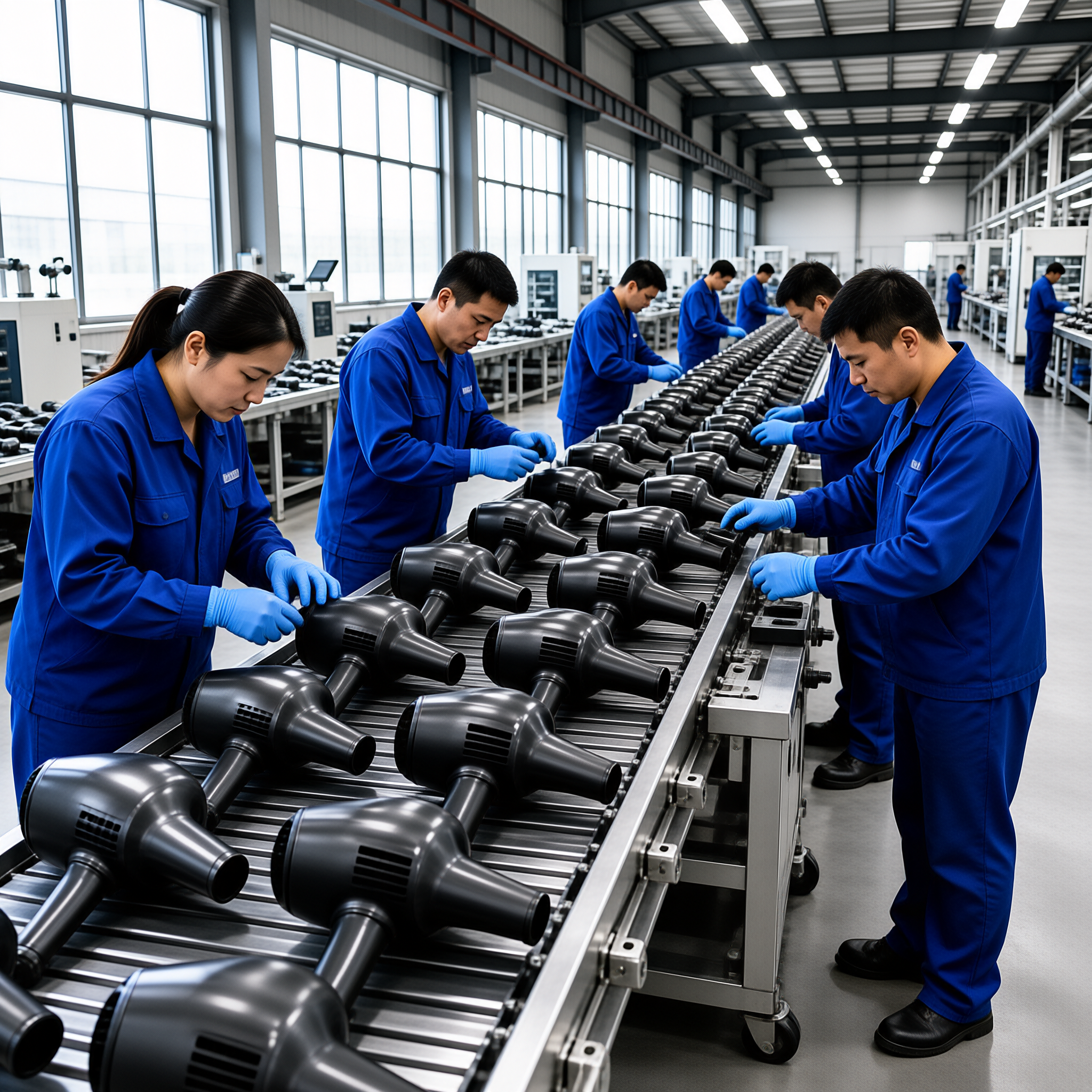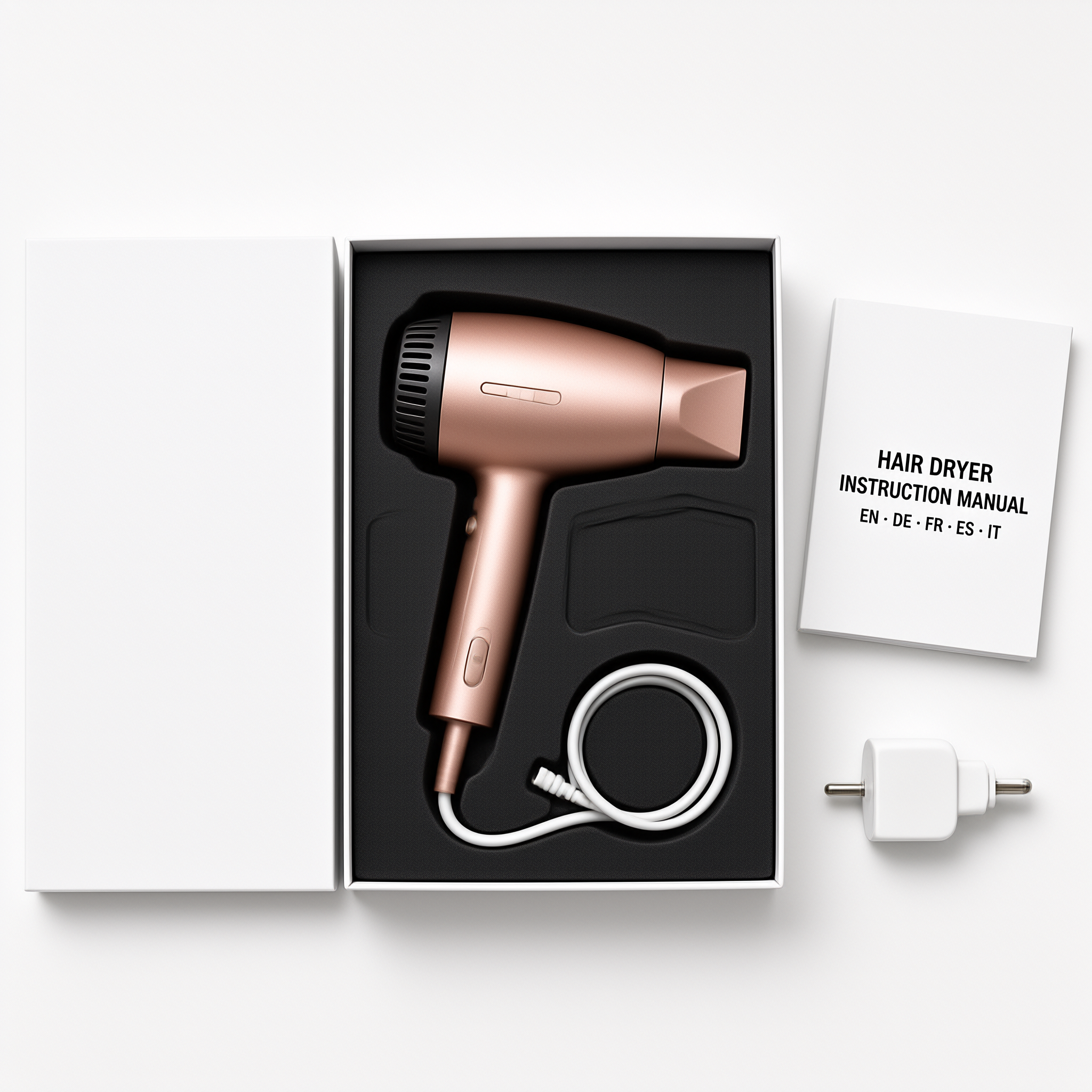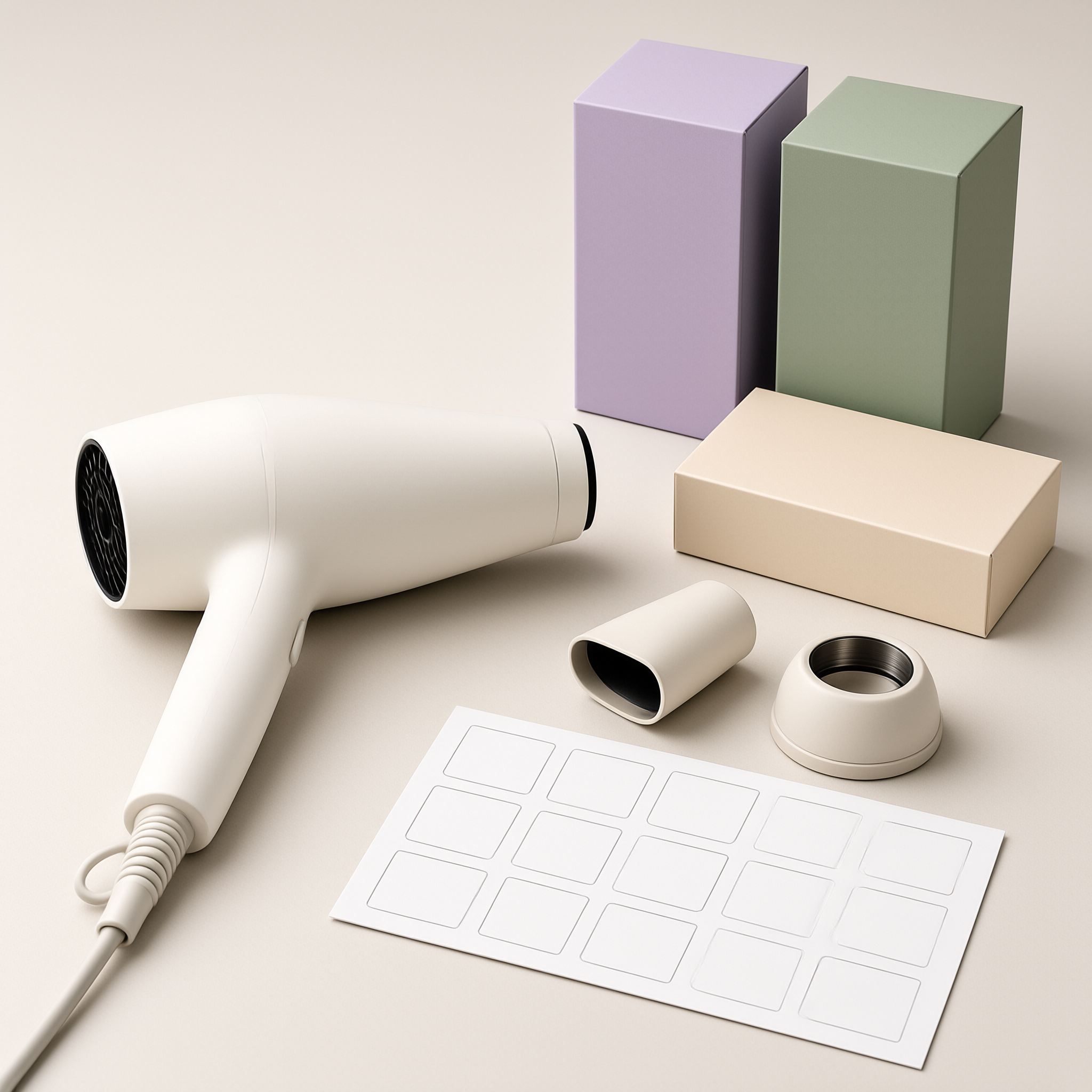
A private label hair dryer is a stock or semi-custom appliance that a factory produces and an importer sells under their own brand, usually with their own logo, packaging, and manual.
The factory supplies the product and the manufacturing capability. The importer controls the brand, the labelling, and the retail relationship. The model sits between pure wholesale reselling and a fully custom OEM or ODM project.
In this model, the importer owns the brand on the carton — and the legal responsibility that comes with it.
Key Takeaways
Private label sells an existing factory product; OEM builds to your design; ODM means the factory designed it.
Existing-mould private label shortens lead time; custom tooling buys a housing shape no competitor shares.
The importer, not the factory, is the responsible person for a branded hair dryer sold in the EU.
A signed golden sample is the strongest acceptance standard for logo, finish, plug, and colour.
Fixed costs — tooling, testing, artwork, print plates — dominate low-volume orders.
What Private Label, OEM, and ODM Actually Mean for a Hair Dryer
Private label sells an existing factory product under your brand. OEM builds a product to your specification. ODM means the factory designed the product and you brand it.
The dividing line is ownership of the design and the tooling. In private label, the mould belongs to the factory and other buyers can use the same housing. In OEM or ODM, the buyer usually funds the tooling, so the shell stays exclusive to that brand.
Buyers comparing private label vs OEM vs ODM usually start with one question: who owns the mould? A single existing 1,800W AC-motor housing can serve many brands at once. The variables that change are limited to colour, surface finish, logo method, cord length, switch layout, and packaging.
| Model | Who designs | Who owns tooling | Who owns brand | Differentiation |
|---|---|---|---|---|
| Private label | Factory | Factory | Importer | Logo, colour, packaging |
| OEM | Importer | Usually importer | Importer | Design and housing |
| ODM | Factory | Factory, sometimes importer | Importer | Factory platform plus branding |
Private label and OEM differ mainly in who pays for the mould — and that decides who controls the product shape.
Why Importers Choose Private Label Over Wholesale Reselling
Private label gives an importer margin control, shelf identity, and a brand asset. Reselling generic wholesale stock gives none of the three.
Two importers who both buy from the same wholesale hair dryer supplier compete on identical listings, so price falls toward the lowest landed cost. Branding the unit changes the comparison: the carton, the logo, and the manual make the listing unique, and a unique listing is not compared line by line against a clone.
A mid-tier ionic unit sold as generic stock sits beside dozens of near-identical offers. The same unit with a branded retail carton, a market-specific plug, and a translated manual produces a listing no other seller can match exactly.
Margin: the importer sets the price instead of matching a marketplace floor.
Shelf control: packaging, colour, and product claims are decided by the brand, not the factory.
Brand building: repeat buyers search for the brand name rather than a generic product code.
Range building: one platform can be released in several colourways and price tiers.
The 6-Step Process From Product Brief to Shelf-Ready Stock
Step 1-2: Spec, Sample, and Tooling Decision
Step one is the written brief; step two is the physical sample. The brief fixes wattage, motor type, airflow, heat and speed settings, cord length, plug type, and target market. The sample proves whether the hair dryer OEM factory can hit that brief consistently.
A written brief stops sampling from drifting. Without a fixed specification, two prototype rounds can differ on heater element, switch layout, and airflow while looking identical in a photograph. The tooling decision belongs in this step too — it is the single biggest fork in the project.
An existing-platform brief normally changes a defined set of about five to eight items: wattage, motor class, ionic function, cable, plug, colour, and packaging. Each change resets the sampling clock, so buyers who lock the brief before the first round reach tooling sign-off sooner.
Step 3-4: Logo Printing and Packaging Design
Steps three and four run in parallel. Logo printing is agreed with the factory; packaging artwork is agreed with a designer or the factory's packaging partner.
Print method follows the surface. Silk screen suits flat panels and larger blocks of colour; pad printing handles curved barrels; laser marking resists heat and wear but limits colour. A position too close to a vent seam or a high-heat surface distorts the print over time.
Packaging artwork has to be finalised before print plates or cutting dies are made, because plate changes are billed again. Manual translation, barcode data, and the importer address all sit on this artwork, so a late change touches three documents at once.
Step 5-6: Certification, Labelling, and First Production Run
Step five is testing and labelling; step six is the first mass production run. Certification is booked with an accredited lab, and the labels are proofed against the chosen market before the line starts.
Lab queues, not factory capacity, usually set this stage's duration. A test report is issued per model or per technical family, so adding a variant after the report is issued can trigger a fresh booking. Choosing a hair dryer OEM factory that already holds a current report for the base platform shortens this stage considerably.
A first run normally needs a signed pre-production sample before the line starts and a pre-shipment inspection before the balance payment releases. Buyers who schedule both into the timeline avoid the common situation where the goods are finished but not shippable.
Certification is issued per model or technical family — a late variant change can trigger a new lab booking.
Existing-Mould Private Label vs Custom Tooling: Cost and Timeline Compared
Existing-mould private label is faster and cheaper to start. Custom tooling costs more and takes longer, but it is the only route to a housing shape that is yours alone.
Tooling cost is fixed and amortised across order volume. The mould is a one-time capital item, so its share of the unit cost falls as the first order grows; at low volumes the same figure sits on very few units.
In practice, an existing-mould private label hair dryer manufacturer can usually quote from a standard mould and standard certification, while a new housing adds a tooling phase before the first saleable run. That phase sits on the critical path, not beside it.
| Factor | Existing-mould private label | Custom tooling |
|---|---|---|
| Tooling cost | None or minimal | One-time mould investment borne by the buyer |
| Lead time to first shipment | Shorter — no tooling phase | Longer — tooling must be built and validated |
| Housing exclusivity | Shared with other buyers of the same mould | Exclusive to your brand |
| Change flexibility | Limited to colour, finish, logo, cable, packaging | Shape, airflow path, controls, ergonomics |
| Minimum order | Lower, because there is no tooling to amortise | Higher, to spread tooling across units |
| Certification scope | Often reuse of existing family reports | New model, usually a new test report |
When Existing-Mould Private Label Is the Right Fit
Choose the existing mould if the priority is speed to market, a smaller first order, and a lower risk profile. The product still has to look competitive on shelf, which is achievable through colour, finish, and packaging.
The advantage is not only price. Reusing a proven mould also reuses an already-validated airflow path and an existing test report, which removes a whole engineering phase from the schedule. The limit is differentiation: when several brands pull from the same housing, only colour, finish, logo, and accessories separate the SKUs.
When Custom Tooling Justifies the Investment
Choose custom tooling if the housing shape, the airflow design, or the control layout is the reason a customer would pick your brand. That decision only pays back over volume.
A custom housing changes the airflow path, the noise profile, and the hand feel at the same time. Those are the attributes buyers notice before they read a wattage figure, which is why they can carry a listing on their own. The tradeoff is commitment: a new mould fixes the geometry for the life of the tool, and any later change means a mould modification, a new sample round, and usually a new test report.
Choose existing-mould private label to test a market fast; choose custom tooling only when the housing itself is the reason customers buy.
Retail-Ready Packaging: Barcode, SKU, Importer Details, and Multilingual Manual
Retail-ready means the carton can go straight to a shelf or an inbound dock with no rework. For a custom logo hair dryer, that means a scannable barcode, a SKU, importer contact details, and a manual in the market's languages.
Retail systems read data before they read design. On a custom logo hair dryer, the barcode has to match the seller's listing record before the carton leaves the factory, because a mismatch is rejected at inbound regardless of print quality. Barcode verification therefore belongs in artwork approval, not in quality inspection.
An EAN-13 or UPC-A code needs enough quiet zone and contrast to scan on the first pass. Codes printed on curved, glossy, or dark surfaces fail more often, so the artwork file should be tested on the actual carton stock before plate approval rather than assumed correct.
GTIN barcode (EAN-13 or UPC-A) that matches the marketplace listing
Internal SKU plus colour or variant code
Importer or responsible-person name and postal address
Country of origin and rated voltage, frequency, and wattage
Hair dryer multilingual user manual covering every market language in the shipment
Safety warnings and symbols required by the destination market
Certification and Labelling Responsibility When the Brand Is Yours
The brand owner is the responsible person. Even when the factory supplies a valid test report, the legal duty for correct labelling, instructions, and market compliance sits with the importer.
The CE mark is a manufacturer's declaration of conformity, not a lab-issued certificate. The economic operator that places the product on the market signs that declaration and must be identifiable on the packaging with a contact address — the core of the responsible-person rule described in the EU General Product Safety Regulation (GPSR) summary. A hair dryer CE LVD EMC RoHS ErP suite is assessed at model or technical-family level, covering safety, electromagnetic compatibility, hazardous substances, and energy-related requirements together.
In one existing-mould private label hair dryer order, a buyer approved a sample at 220V with an EU plug, but the bulk shipment was built to a mixed-plug specification. The mismatch surfaced at pre-shipment inspection, not at golden sample sign-off. Reviewing EU Safety Gate notifications on unsafe electrical appliances before a launch shows how often plug, voltage, and labelling issues drive recalls.
A factory test report supports your CE declaration; it does not replace it.
Common Mistakes Importers Make With Private Label Hair Dryers
Five failures cause most first-order problems: no signed golden sample, unclear logo placement, the wrong plug or voltage for the market, a missing manual language, and an unverified certificate.
Each failure comes from the same gap: something agreed in conversation that never became a written or physical reference. A certificate is equally hollow if the test method cannot be traced to a recognised framework such as ISO standards for electrical appliance safety and testing, or if the report does not name your exact model.
Across multiple private label sampling rounds, the most common cause of artwork re-sampling was logo placement rather than logo design — positions too close to a vent seam or a high-heat surface distorted the print over time. Hair dryer golden sample approval works as an acceptance standard only when the signed sample carries colour, finish, and tolerance notes attached.
No signed golden sample — acceptance arguments begin after the goods are already built.
Unclear logo placement — position, size, and print method left open to interpretation.
Wrong plug or voltage for the market — a 110V build shipped into a 230V market.
Missing manual language — the carton is compliant but the instructions are not.
Unverified certificate — a report that does not name your model or the lab's test scope.
A hair dryer OEM factory will match a signed sample, not a conversation — which is why sample approval outweighs a spec sheet.
Cost Factors at Each Stage and How to Control Them
Cost concentrates in four places: tooling, testing, packaging artwork and print, and order volume. The unit price quoted on a spreadsheet is only the visible part.
Fixed costs do not shrink with small orders. Moulds, print plates, manual artwork setup, and lab fees are incurred once and then spread across however many units are ordered, so a smaller order carries a larger share of the same fixed total. A private label hair dryer manufacturer quoting a single blended unit price hides which of these costs are actually fixed.
Quote templates usually break out unit cost, tooling, and packaging separately. Asking for that breakdown is what makes the amortisation visible. A common misconception is that a lower MOQ saves money — in practice it usually raises the per-unit share of tooling, test fees, and print setup.
| Stage | What Drives Cost | How to Control It |
|---|---|---|
| Spec and sample | Number of sample rounds, courier costs, changes after sign-off | Lock the brief before sampling; batch all comments into one round |
| Tooling | New mould cost, amortisation volume, mould validation | Use an existing mould unless housing shape drives the purchase |
| Logo printing | Print method, number of positions, plate or screen setup | One position, one method; keep print away from heat and seam lines |
| Packaging design | Artwork rounds, print plates, carton structure, inserts | Approve barcode and manual text before plates are cut |
| Certification and labelling | Model scope, lab bookings, retests after changes | Freeze the model before testing; keep variants inside one family |
| First production run | Order quantity, inspection type, freight mode | Combine colourways into one run; book inspection before balance payment |
Pre-Production Checklist and FAQ for Private Label Hair Dryer Orders
A pre-production checklist is the document that turns an agreed project into a shippable order. It lists every item that must be signed, verified, or paid before the line starts.
Checklists work because they force decisions into a fixed order. A carton approved before the barcode is verified, or a sample signed before the plug is confirmed, moves the error downstream to a stage where it costs more to fix.
The highest-value items are the signed golden sample, the written plug and voltage confirmation, approved carton artwork with a scannable barcode, a test report naming the exact model, and a booked inspection. Whether the partner is a private label specialist or a general wholesale hair dryer supplier, those five items are identical.
Signed golden sample with colour, finish, and tolerance notes
Final written specification: wattage, motor, voltage, frequency, plug type
Tooling decision confirmed in writing (existing mould or new mould)
Logo artwork approved with position, size, and print method
Carton artwork approved, including GTIN, SKU, importer address, country of origin
Manual approved in every required market language
Test report reviewed — model name, lab scope, and standard numbers verified
Responsible person named on packaging and documentation
Inspection type and timing agreed before balance payment
Transport or drop test result confirmed for the carton
Frequently Asked Questions
- What is the difference between private label, OEM, and ODM for a hair dryer?
- Private label sells a factory product under your brand; OEM builds to your design; ODM means the factory designed the product and you brand it. Tooling ownership is the practical dividing line.
- How long does a private label hair dryer order take from sample to shipment?
- Timeline is driven by sample rounds, the tooling decision, and lab queues. Existing-mould projects skip the tooling phase entirely; custom housings add it before the first saleable run.
- What is the typical MOQ for a private label hair dryer from a Chinese factory?
- MOQ depends on the path. Existing-mould orders start lower because there is no tooling to amortise, while a new housing needs a larger first order so the mould cost spreads across more units.
- Which certifications does a private label hair dryer need for the EU or US market?
- In the EU the usual set is LVD, EMC, RoHS, and ErP, declared under CE marking with an identified responsible person. The US market generally works through UL or ETL listing rather than CE.
- Can a factory add my logo to an existing hair dryer without new tooling?
- Yes. Silk screen, pad printing, or laser marking can be applied to a standard housing. What changes is the print position, method, and durability — not the mould.
- Who is responsible for the user manual and warnings on a private label hair dryer?
- The brand owner. The factory supplies content and translation, but the importer placing the product on the market is accountable for language, voltage wording, and warning accuracy.
Before committing to a first production run, verify the model scope of the test report and confirm the responsible person is printed on the carton. Those two checks, plus a signed golden sample, resolve most of the risk in a private label hair dryer launch. The EU Safety Gate and GPSR references above are the right starting points for checking market-side obligations before the purchase order is issued.