Choose a hair straightener manufacturer by freezing the specification first, verifying capability and sample performance second, and comparing complete landed cost third. The lowest quotation is one input in that decision, never the decision itself.
Standard private-label models start from 100 units per model, and models and colours can be combined in one order. A new housing or airflow design is a different project: higher MOQ, tooling-dependent, and slower to approve.
MOQ starts from 100 units per model, and models and colours can be combined in one order.
Key Takeaways
Freeze plate type, temperature range, controls, plug and packaging before comparing quotes; unmatched quotations are not comparable.
MOQ starts from 100 units per model, and models and colours can be combined in one order.
Certification names alone prove nothing; confirm the exact model and destination market are covered.
Budget landed cost per sellable unit, not unit price — packaging, freight and duty usually exceed the quote gap.
Approve a signed golden sample before bulk release; every inspection is measured against it.
How to Choose a Hair Straightener Manufacturer: A Direct Answer
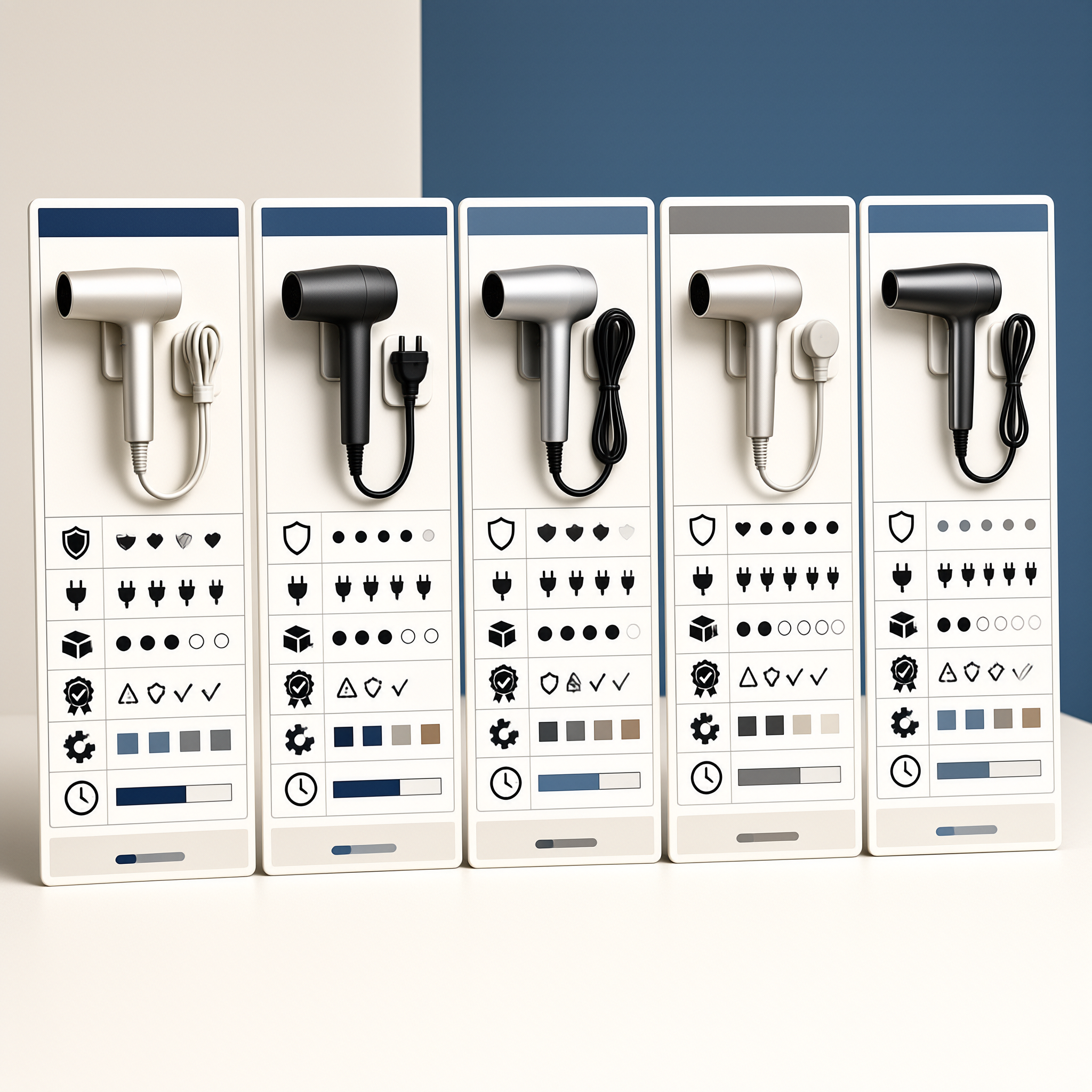
Run three filters in order: specification fit, documented capability, then landed cost. Choosing a private label hair straightener manufacturer this way removes the price-first trap before it starts.
Quotations priced against different specifications describe different products. When plate material, cord length or packaging changes, the gap between two unit prices reflects configuration rather than efficiency. That is why an apparent saving disappears once the specification is matched.
IEC 60335-2-23 sets the safety requirements for appliances used on skin and hair. A supplier who cannot name which model version and configuration was tested leaves you comparing quotes on nothing except price.
| Your situation | First priority | Verify this first |
|---|---|---|
| First order on standard models | Specification clarity | Written spec sheet: plate, temperature range, plug, packaging |
| Existing product, new branding | Colour and packaging accuracy | Dieline, Pantone reference, artwork file, logo method |
| New housing or airflow design | Engineering and tooling | Tooling ownership, DFM feedback, sample revision rounds |
| Small quantity, tight budget | Landed cost | Freight, duty, inspection and packaging on one cost sheet |
Define Your Private-Label Product Before Approving a Factory
A private-label hair straightener is an existing or semi-custom platform built to your written specification and sold under your brand. You own the specification, branding and packaging; the factory owns the platform, the process and the compliance evidence.
Because the platform already exists, your leverage sits in the variables a factory can change without new tooling: plate coating, temperature curve, control layout, colour, cord set and packaging. Those variables are also exactly what a quotation must itemise.
Performance and Plate Specification
Specify plate material and dimensions, heat-up target, working temperature range and allowed deviation. Ceramic-coated aluminium, solid ceramic and tourmaline-coated plates behave differently at the same setpoint, so the coating belongs in the specification.
Plate alignment matters more than plate marketing. A small gap changes contact pressure along the strand, and contact pressure decides how evenly the hair is heated.
Branding, Colours, and Packaging
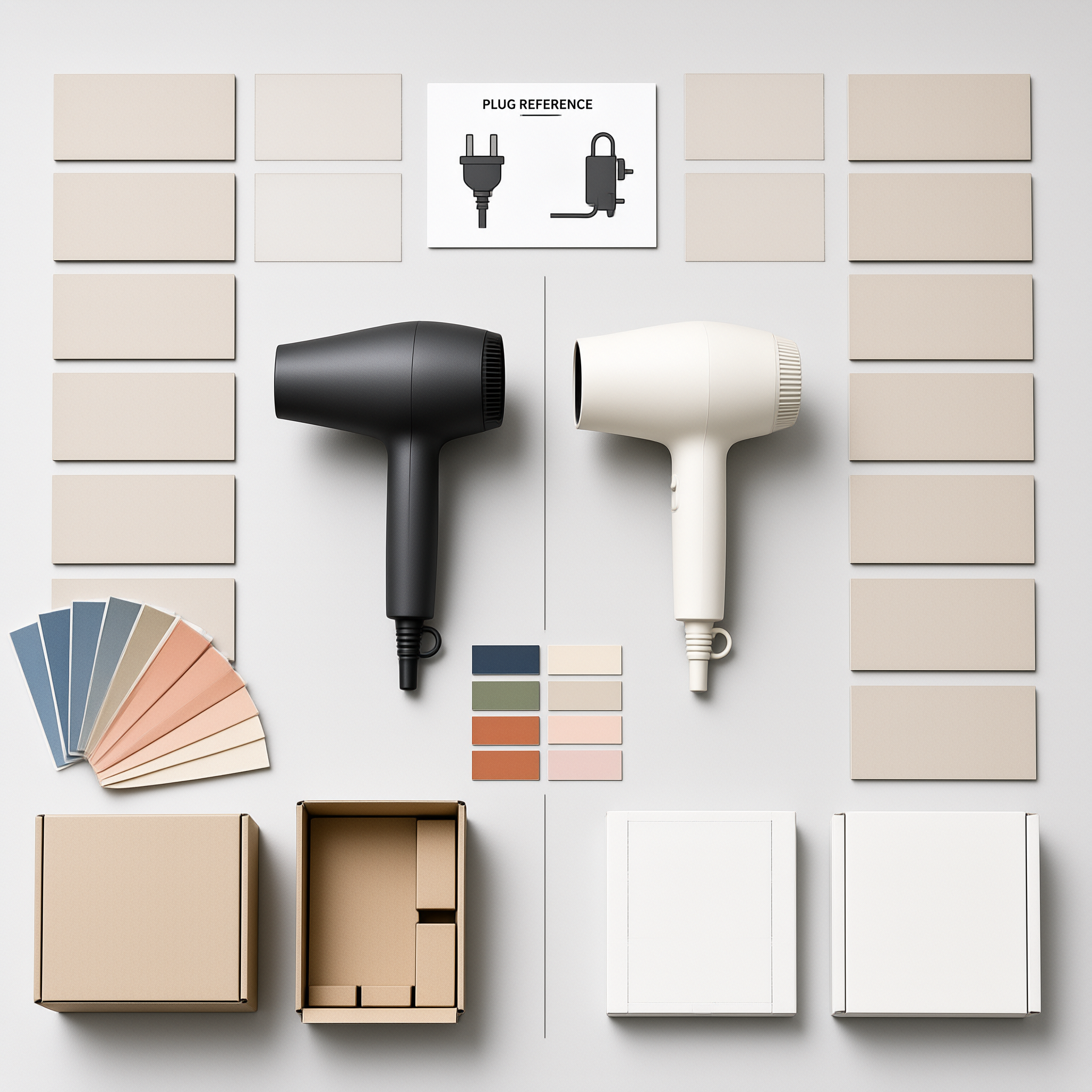
Lock the colour reference before sampling: Pantone number, gloss level and surface finish. Black is not a specification, and two black housings from different batches rarely match under retail lighting.
Most custom hair straightener OEM projects start with colour, logo and packaging, because those changes are visible fastest. Provide the dieline and artwork file, and state the languages required on the carton.
Plug, Cord, and Destination-Market Requirements
Specify plug type, cord length and strain-relief style for each destination. One SKU sold into several markets usually needs separate cord sets, not a travel adapter in the box.
State marking and language requirements at specification stage. Re-labelling after assembly is a rework line, not a printing job.
Compare Factory Capabilities Instead of Relying on Unit Price
Compare factories on four capabilities: engineering control, production evidence, quality documentation and commercial fit. Unit price follows those four; it does not replace them.
A factory that shares heating-element and injection-moulding capability across product families controls more of its own cost base. Many buyers meet a hair dryer manufacturer in China through a dryer programme, then add straighteners from the same platform. That is why the capability review should cover the whole plant, not one SKU.
Ask for the ISO 9001 certificate scope, the equipment list and the incoming-inspection procedure for heating elements. A scope that names the product category, plus a revision-controlled procedure, shows the system exists. A certificate cover page does not.
Production and Engineering Capability
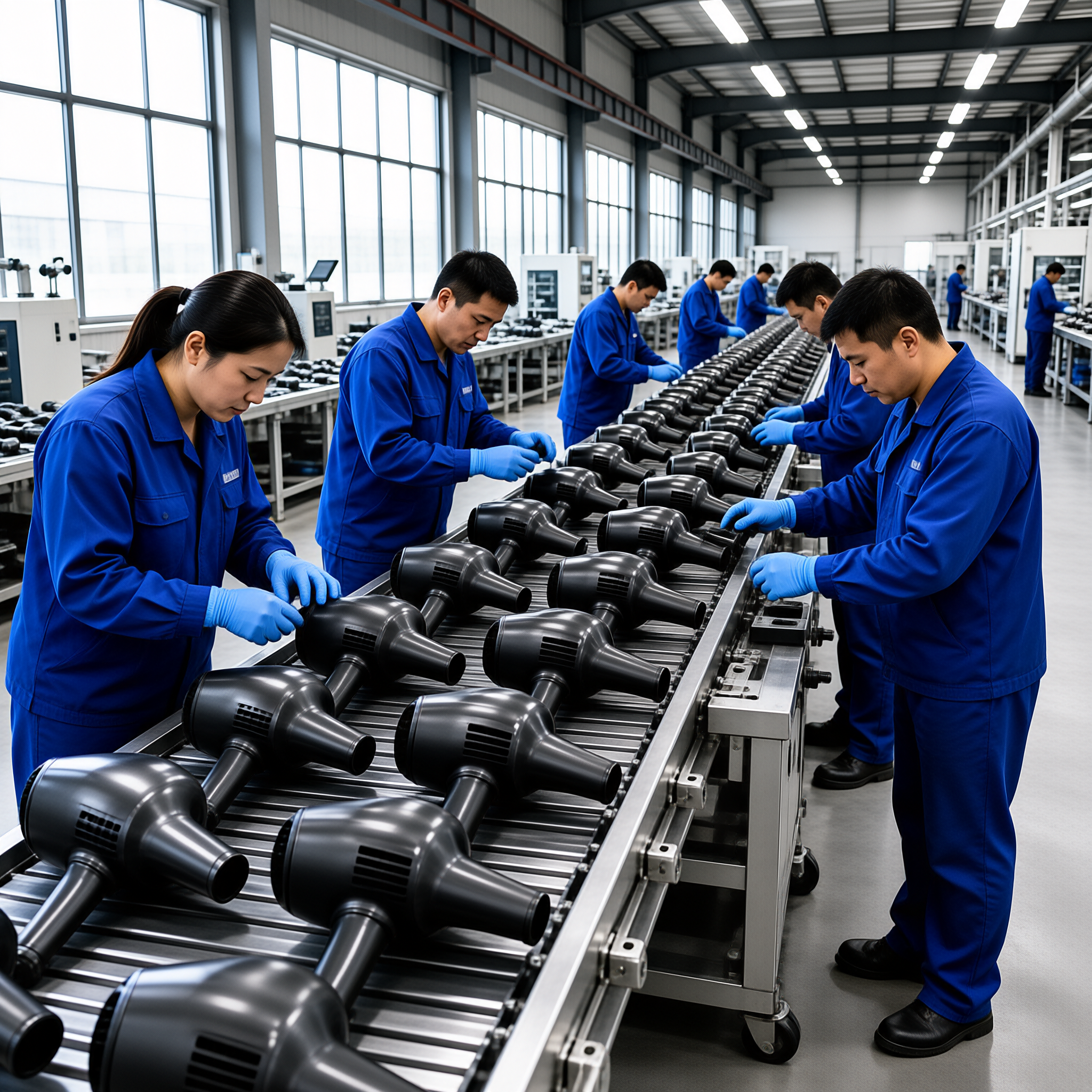
Look at line count, moulding ownership and in-house assembly of the heating element and controller board. Subcontracted heating assemblies lengthen every corrective loop, because the fix crosses a company boundary.
Engineering control shows up in paperwork: drawing revisions, DFM feedback and a change log. A factory without a revision history cannot tell you what changed between sample rounds.
Quality-Control Evidence
Ask for the inspection sequence rather than a pass rate: incoming component checks, in-line electrical tests, finished-goods sampling. Each stage needs a written acceptance criterion and a named owner.
Require a dielectric strength and continuity check on every unit where the design calls for it, plus a full functional test on units pulled from each finished lot. Put that requirement in the purchase order, not in conversation.
Commercial Fit and Communication
Test responsiveness before you commit. Send a written specification and ask for a line-by-line quotation; vague answers on cord length or packaging usually predict vague answers on corrective actions.
Confirm who owns your tooling and artwork files, and whether the mould can be transferred. Ownership language belongs in the quotation, not in a later email thread.
| Dimension | Weak signal | Strong signal |
|---|---|---|
| Quotation | One unit price, no configuration | Line-by-line cost against your spec sheet |
| Engineering | Photos of a showroom sample | Drawing revision log and DFM feedback |
| Quality | A stated pass rate | Written acceptance criteria per inspection stage |
| Compliance | Certificate names on a slide | Model list and markets mapped to documents |
| Communication | Replies after repeated reminders | Written answers with names and dates |
Validate Heating Performance, Controls, and Electrical Safety
A practical hair straightener quality inspection covers four areas: heat-up and recovery, plate alignment and surface condition, control accuracy with safety cutoffs, and electrical safety against the applicable appliance standard.
Hair straightener performance depends on sensor placement, not on the display. A thermistor reading the heater block instead of the plate surface lets the display hold steady while the working surface drifts. That drift is what damages hair and drives returns.
IEC 60335-2-23 governs safety for skin and hair care appliances, and EN 60335-1 supplies the general requirements behind the national versions. Ask which model version was tested, and whether the report matches the plate and control configuration you are ordering.
Record heat-up time to setpoint measured at the plate surface, not read from the display
Check plate alignment and gap consistency along the full working length
Run at maximum setting for 30 minutes and log overshoot and recovery
Confirm the automatic shutoff triggers after the stated idle period
Flex the cord at the strain relief and check plug temperature after a full heat cycle
Audit cosmetics: plating, seam lines, button feel and logo registration
A display that holds steady proves nothing if the thermistor reads the heater block instead of the plate.
Confirm EU Plug and Market-Ready Documentation
An EU plug hair straightener is a model built with the plug, cord set and documentation package its destination market requires. For European retail that means a Type C or Type F plug, an EU Declaration of Conformity, RoHS and REACH statements, WEEE registration, and certification names such as CE, CB, GS and UKCA.
Retail sockets in the EU commonly use Type C and earthed Type F configurations, so one cord set will not serve every market you ship to. Buyers who already source an EU Plug Hair Dryer for the same market usually find the cord-set and marking discipline transfers straight to straighteners. Mains-powered appliances fall under the Low Voltage Directive, and the controller electronics fall under EMC rules.
Screen the category before finalising a design by checking alerts on the EU Safety Gate and recalls listed by the U.S. Consumer Product Safety Commission. Both are public and searchable by product type. EU rules also require a responsible economic operator established in the Union to be named on the product or packaging.
Build a MOQ and Landed-Cost Budget That Accounts for Hidden Costs
Build the budget from landed cost per sellable unit. Tooling, samples, packaging, certification, inspection, freight, duty and VAT all sit between the quotation and the shelf.
Setup costs amortise across the order. A fixed sample, colour-matching and packaging setup charge spread over a 100-unit model run lands on every unit; spread over 1,000 units the same charge shrinks to a fraction of that. This is why small orders carry a higher per-unit price, and why the hair straightener manufacturer MOQ sets the floor for the whole cost model.
Take a quoted unit price of 18.00 with packaging at 1.20, freight at 0.90, duty at 3.5% and a one-off sample charge of 300 spread across 300 units: the landed figure lands near 21.70 per unit. If you can combine models and colours in one order, setup spreads and that gap narrows. If the housing needs new tooling, the commitment changes from a stock order into a manufacturing investment.
Tooling and mould amortisation where the housing is not an existing platform
Sample and courier charges, including revised rounds after comments
Colour matching plus silk-screen or laser logo setup
Packaging tooling: dieline, printing plates, foiling dies
Certification testing for the exact model version you are ordering
Third-party pre-shipment inspection and any re-inspection cost
Freight, insurance, import duty and destination VAT
Move from Sample Approval to Production with a Controlled Workflow
Release production only when four records exist: a signed specification, an approved golden sample, released artwork and a written inspection plan. Each record needs an owner and a date.
Sample Preparation and Approval
Order samples in the production configuration: plate type, cord set, colour, logo method and packaging. A sample assembled from showroom parts proves nothing about the line that will build your order.
Test it the way a customer will. Heat it, hold it, wrap the cord and read the controls without instructions. Note what fails and send photographs with written comments.
Approve a physical golden sample, sign it, and keep a copy with both parties. Hair straightener sample approval that lives only in a chat thread does not survive a dispute.
Production Release and In-Process Checks
Use a documented approval sequence: specification freeze, sample review, golden-sample sign-off, artwork approval, pre-production confirmation, in-process checks, and pre-shipment inspection. Each stage should have an owner, acceptance criteria, and a signed record.
Pre-production confirmation means the line holds the approved components, released artwork and the correct cord set before assembly starts. Without that confirmation, the schedule is a hope.
In-process checks cover the parameters that drift: temperature calibration, plate alignment, screw torque and logo registration. Check at the start, middle and end of the run, not just at the end.
Pre-Shipment Inspection and Shipment Control
Inspect against the golden sample, not against memory. Count cartons, verify markings, pull units from the finished lot and run the functional checks in the approved plan.
Seal the container only after the inspection report is accepted. Record carton counts, seal numbers and loading photos before the doors close; that record settles most freight disputes.
Recognize Warning Signs Before You Place a Bulk Order
The hair straightener supplier red flags that matter are documentary: a quotation with no specification, a sample with no build record, and a delivery date promised before artwork is approved.
Order release depends on inputs: final artwork, plug specification, packaging dielines and market documentation. When a supplier quotes a date without confirming those inputs, the date is an estimate presented as a commitment.
Treat final artwork, plug specification, packaging dielines, and market documentation as production-release dependencies. If any of these changes after approval, require a revised golden sample before releasing the affected order. A late dieline change alone forces new packaging plates and a fresh approval round.
Quotation sent without a written specification or configuration breakdown
Certification named but not mapped to the model you are ordering
Sample arrives with a different plug, cord length or finish than requested
Delivery date offered before artwork and dieline approval
No written change-control process for post-approval modifications
Pressure to pay a large deposit before any sample is signed off
Frequently Asked Questions About Private-Label Hair Straighteners
- What is the MOQ for private-label hair straighteners?
- MOQ starts from 100 units per model, and models and colours can be combined in one order. Bespoke housing or airflow changes are higher and tooling-dependent.
- How many samples should I order before approving a supplier?
- Order samples covering each model, plug, finish and packaging configuration in your plan. Then keep a signed golden sample as the production and inspection reference.
- Can the same supplier make straighteners with an EU plug?
- Confirm it in the quotation by specifying plug type, cord length and markings per destination. Then verify that the documentation supplied covers the exact model and market.
- Should I choose the supplier with the lowest quotation?
- No. Compare landed cost on an identical specification, and weigh documented capability and a signed golden sample before price.
- How long should samples and bulk production take?
- Samples ship in 7 days and bulk lead time is 25-35 days, counted from artwork and specification approval.
- What documents should I request from a hair appliance supplier?
- Request the product specification, certification names, test reports, packaging details and a signed golden-sample record. Check that each document names the model you are buying.
The framework is short: specification first, capability second, landed cost third, and a signed golden sample before any production release. A hair straightener manufacturer that can show a revision log, a golden sample and an inspection plan is a safer partner than one with the cheapest quote.
A signed golden sample plus a written inspection plan is the cheapest insurance in private-label sourcing.
About highdryer
highdryer is a high-speed hair dryer manufacturer based in Dongguan, China, established in 2009. Our 30,000 sqm facility runs 15 production lines with 300+ staff and a daily capacity of 20,000 units. We support OEM/ODM with logo, colour, packaging and manual customization. MOQ starts from 100 units per model, and models and colours can be combined in one order. Samples ship in 7 days; bulk lead time is 25-35 days. Payment terms: T/T, L/C, Western Union. Certifications: CE, FCC, RoHS, CB, UKCA, ETL, ISO 9001. Contact us for a quotation against your specification.