A dependable Hair Dryer Manufacturer for European Brands matches the destination market's voltage, frequency, plug configuration, documentation, branding, packaging, MOQ and quality-control requirements before price is discussed.
Separate electrical compliance, product performance, factory capability and order economics into four parallel checks. Then request a specification-based quotation and production samples, because comparing unit prices alone hides the costs that decide whether a launch ships on time.
A plug swap is not market readiness — voltage, frequency, motor, heating, labelling and manual must all match the destination market.
Key Takeaways
European retail runs on 230V/50Hz; confirm rated voltage, frequency and plug type before approving any quotation.
Standard MOQ starts from 100 units per model, and models and colours can be combined in one order.
Samples ship in 7 days; bulk lead time runs 25-35 days once specifications and approvals are frozen.
Freeze artwork, packaging and manual text before bulk production — late changes reopen approvals and can move the delivery date.
Ask for product-level evidence such as CE, RoHS, CB, UKCA, ETL and ISO 9001, then check what each one actually covers.
Hair Dryer Manufacturer for European Brands: How to Build a Sourcing Shortlist
A sourcing shortlist should be built on four filters: electrical configuration, product performance, factory capability and order economics. Screen every candidate against all four before price enters the conversation.
Plug, motor, heating element and documentation are locked at sample stage, so a mismatch inside any filter only surfaces at final inspection or at the border. By then tooling, artwork and deposits are already committed, which is why an early screen is cheaper than a late correction.
European market access for a hair dryer rests on the Low Voltage Directive (2014/35/EU), the EMC Directive (2014/30/EU) and the appliance-specific standard EN 60335-2-23, with RoHS (2011/65/EU) covering materials. A shortlist entry that cannot map documentation to those areas is not ready for a fixed launch date.
Electrical: 230V/50Hz rating, plug type, cable rating and cord length for the destination country.
Performance: airflow, heat and speed settings, noise and motor life matched to the retail price tier.
Documentation: declaration of conformity, test reports, RoHS declaration and an EU responsible person.
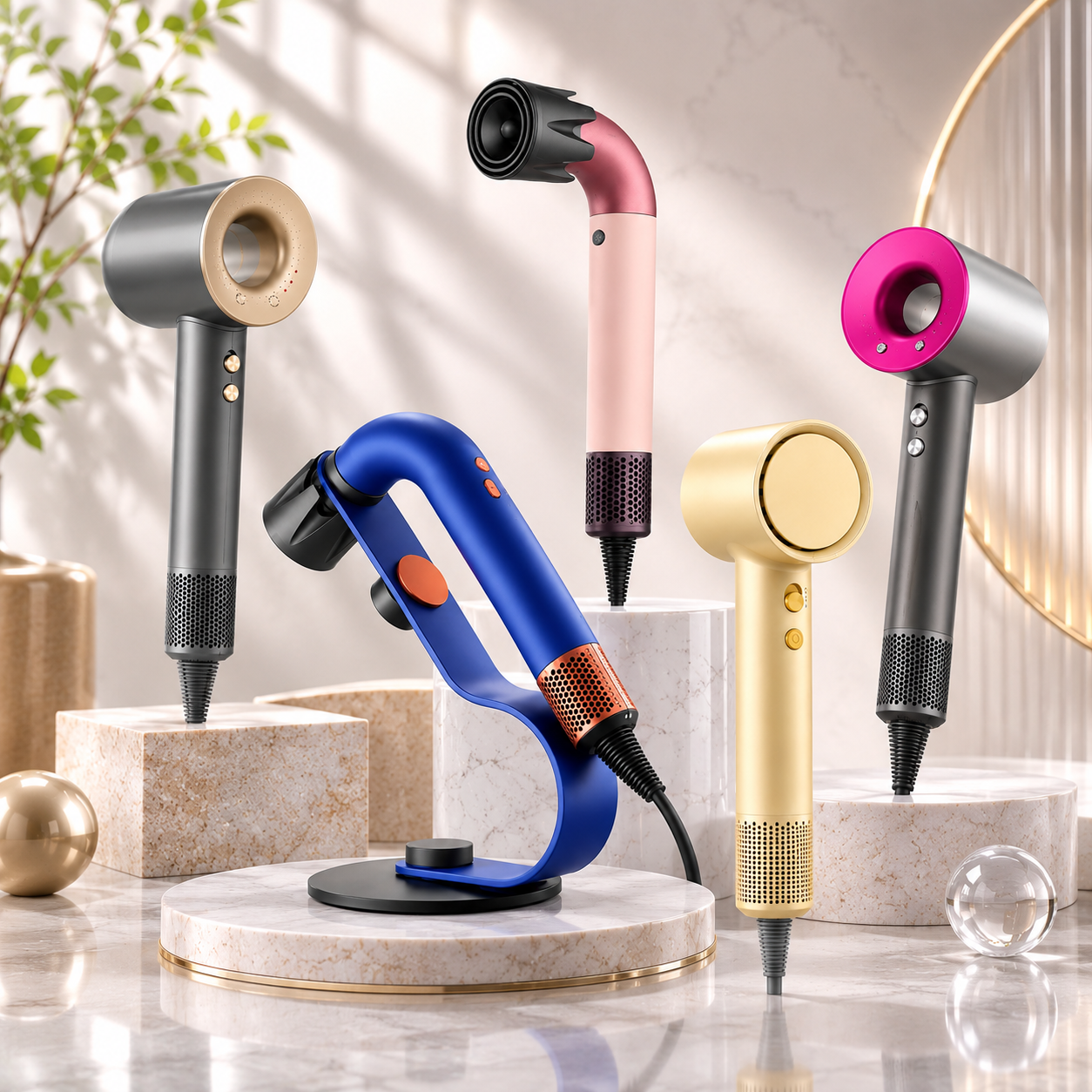
Customization: logo method, colour range, packaging format and manual language set.
Commercial: MOQ from 100 units per model, sample lead time, bulk lead time and payment terms.
China Supplier Versus European Manufacturer: Cost, Control, and Lead-Time Tradeoffs
A Hair Dryer Manufacturer in China wins on unit cost, customization depth and MOQ flexibility. A European manufacturer wins on oversight, short inbound freight and simpler compliance ownership.
Unit Cost and MOQ
Tooling, labour and component sourcing set the floor on unit cost, and volume spreads the fixed tooling charge across more units. At small order sizes the gap between origins is widest; as volume climbs, European overheads spread thinner and the gap narrows.
Standard MOQ starts from 100 units per model, and models and colours can be combined in one order, which suits a first-season test across several colourways. Housing or airflow development sits in a different category: higher MOQ and tooling-dependent.
Customization and Production Control
Customization depth tracks how many process steps the factory controls in-house: housing moulding, motor assembly, cable and plug assembly, printing and packaging. A partner that outsources the plug and cable stage holds less control over the final electrical build.
European manufacturing keeps engineering and the buyer in the same time zone and the same regulatory frame, which shortens approval loops. It also narrows the colour and packaging options available without a tooling charge, so brand freedom trades against schedule.
Lead Time and Logistics
Sample approval, component lead time and freight mode decide the calendar, not nominal capacity. Ocean freight adds weeks of transit that must sit inside the launch window, while air freight lifts the landed cost per unit.
A European supplier removes the ocean leg and the customs step, which matters most for replenishment orders. It rarely shortens the production run itself: moulding, assembly and inspection take the same order of time wherever they happen.
| Dimension | China-based manufacturing | European manufacturing |
|---|---|---|
| Unit cost at 100-500 units | Lower tooling and labour cost; setup weighted | Higher overhead spread over few units |
| Customization breadth | Wide: logo, colour, packaging, manual | Narrower without a tooling charge |
| MOQ | From 100 units per model; models and colours combinable | Project-based, higher commitment |
| Sample lead time | Ships in 7 days | Often several weeks |
| Bulk lead time | 25-35 days plus ocean transit | Comparable run time, shorter transit |
| Compliance ownership | Buyer verifies the documentation set | Supplier sits closer to EU regulation |
| Change flexibility | Low after specification freeze | Easier mid-project change |
EU Plug Hair Dryer Requirements: Voltage, Plug Type, and Product Matching
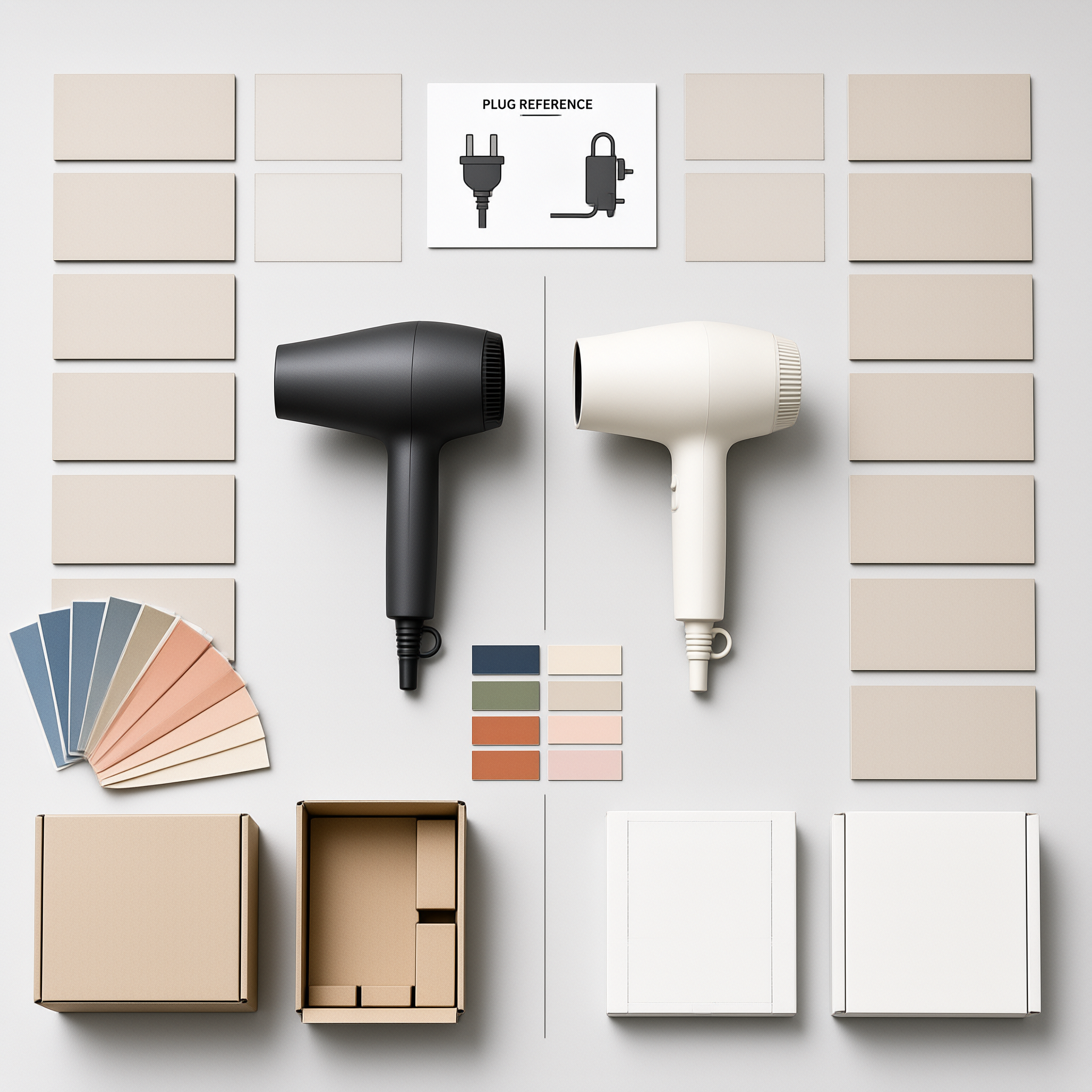
An EU Plug Hair Dryer is built for 230V/50Hz and fitted with a plug that matches the destination country: Type C, Type E, Type F or the earthed E/F hybrid.
The ungrounded Europlug (Type C) is rated to 2.5A under EN 50075, roughly 575W at 230V, well below the 1,200-2,200W a hair dryer draws. High-power models therefore ship with an earthed Type E, Type F or E/F plug that carries the full current and provides a protective earth path.
Switzerland (Type J), Italy (Type L) and the UK (Type G, also 230V/50Hz) sit outside the C/E/F set, so one SKU cannot serve all of Europe without adaptors or separate plug variants. Print rated voltage, frequency, wattage and the model reference on the rating plate, and mirror the same data in every manual language you ship.
A Type C Europlug carries only 2.5A, so a high-wattage hair dryer needs an earthed Type E, F or E/F plug.
Compliance Checklist: Documentation and Market-Access Questions to Ask
The most common failure is a shipment that clears factory inspection but stalls at the border because the technical file does not describe the product in the carton. The gap usually traces back to documentation prepared for a different model or plug variant.
A technical file is model-specific: it records the electrical build, the components used and the markings applied. When the plug, cable, motor or wattage changes, the supporting evidence no longer describes what ships, so the file has to be reissued rather than reused.
Build a European hair dryer compliance checklist in four blocks: safety (EN 60335-2-23 under the Low Voltage Directive), EMC (EN 55014-1 and EN 55014-2), materials (RoHS 2011/65/EU) and market obligations such as WEEE registration, packaging rules and an EU responsible person under the General Product Safety Regulation. Track EU Safety Gate product-safety alerts for withdrawal notices in the small-appliance category, and cross-check management-system references through ISO standards information when a buyer asks which framework sits behind a quality claim.
Declaration of conformity naming the exact model, rated voltage, frequency and plug variant.
Safety and EMC test reports that match the electrical build actually shipped.
RoHS material declaration covering housing, cable, plug and internal assemblies.
Rating-plate artwork plus multilingual manual showing the EU responsible person's contact details.
Certification status for CE, UKCA, CB, ETL, FCC and ISO 9001, with coverage of each confirmed per model.
WEEE and packaging registration evidence for the country of sale.
MOQ, Unit Price, and Hidden Cost: Build the Real Order Budget
Build the budget from landed cost, not unit price. Unit price covers the product alone; landed cost adds tooling, packaging, compliance work, freight, duty and inspection.
Tooling and setup are fixed charges, so per-unit cost falls as volume rises and reverses sharply at very small batches. If the first order is a market test, price the setup separately and keep the unit-price comparison on an identical configuration — otherwise two quotes look comparable when they are not.
A working hair dryer MOQ and landed cost model lines up four figures: quoted unit price, one-off tooling and artwork charges, freight plus duty per unit at the real carton volume, and inspection cost. Standard MOQ starts from 100 units per model with models and colours combinable, which keeps a multi-colour launch inside a single production run.
Sampling and Quality Assurance: A Practical Approval Workflow
Approve a sample against a written checklist, never against memory. The signed unit becomes the golden sample, and every production batch is judged against it.
Lock the electrical specification first, then record the approved finish, accessories and packaging materials. Test airflow and heating against the written brief, verify the plug and cable, inspect the packaging and manual, and issue a signed golden-sample reference before bulk production — this removes the argument that follows a subjective rejection.
A workable hair dryer sample approval process runs in five stages: specification review, sample submission, functional and cosmetic sign-off, production control, and pre-shipment inspection. Samples ship in 7 days, which leaves room for a second round if the first unit misses the brief on finish or noise.
Production Risk: Timelines, Color Consistency, Packaging, and Delay Control
Custom hair dryer production delays usually arrive from the buyer's side of the file: late artwork, a plug or voltage change, an unapproved packaging mock-up, or manual text still in review. A factory cannot close tooling on an open specification.
Freeze voltage, plug, motor, heating, colour, logo, packaging and manual requirements before the bulk window opens. If any of them changes afterwards, route the request through a written revision review, because a new colourway or logo method can reset inspection criteria and shift delivery scheduling.
Colour consistency is a process question, not a promise: ask which colour reference system is used, whether a physical standard is retained, and how the tolerance is documented for both the housing and the packaging print. Bulk lead time runs 25-35 days once specifications are frozen, so a change requested after day one lands directly on the ship date.
How to Choose a Hair Dryer Manufacturing Partner for European Orders
Knowing how to choose a hair dryer manufacturer comes down to three axes: technical and compliance capability, commercial and capacity fit, and quality system with communication. The strongest partner is the one whose weakest axis still clears your requirement.
Technical and Compliance Capability
Capability means in-house control of housing, motor, heating, cable and plug assembly, plus a document set that can be mapped model by model. A supplier that can build a 230V/50Hz variant with an E/F plug and issue matching declarations is technically ready; one that resells and rebadges is not.
Ask which standards the product is tested against and who owns the technical file. Certification names alone — CE, UKCA, CB, ETL, FCC, RoHS, ISO 9001 — say nothing about coverage; the model list behind each name does.
Commercial and Capacity Fit
Commercial fit covers MOQ, sample lead time, bulk lead time and payment terms. If the first order is 300 units across three models, a supplier quoting from 100 units per model with combinable colours fits better than one quoting a single-model minimum.
Capacity fit is the size of your order measured against the factory's daily output and line count. Ask what happens to the unit price at double volume and what the setup charge covers; a quote that separates tooling, artwork and packaging from the unit price is easier to compare than one bundled figure.
Quality System and Communication
Quality questions should produce documents, not assurances: incoming component checks, in-process inspection points, final inspection criteria, and the corrective-action route when a batch fails. ISO 9001 certification indicates a documented management system, not a specific product's conformity.
Communication is the cheapest risk control available. Confirm who answers technical questions, how revisions are confirmed in writing, and how quickly a change request is acknowledged; a partner that cannot describe the change path will expose that gap during production.
| Your situation | Primary priority | Recommended approach |
|---|---|---|
| First-season launch, 300 units, several colourways | Low inventory risk | Combine models and colours against a from-100-unit-per-model minimum |
| Fixed launch date roughly 12 weeks out | Schedule certainty | Freeze artwork, packaging and manual text before the bulk window; book inspection early |
| Premium price tier with own colour and logo | Customization depth | Confirm tooling cost and revision cycle before approving the sample |
| Regulated EU retail channel | Documentation depth | Request a model-specific declaration of conformity, test reports and an EU responsible person |
| Replenishment needed within weeks | Transit speed | Compare a European source for the fill-in volume |
| Choose a China-based partner if you need customization depth and a combinable low MOQ. Choose a European partner if you need same-timezone oversight and no ocean leg. Choose a partner with both footprints if the launch can absorb neither risk. |
European Brand Sourcing Questions: FAQ
- What is the minimum order for private-label hair dryers?
- MOQ starts from 100 units per model, and models and colours can be combined in one order. Customized housing, airflow or new tooling is higher and tooling-dependent.
- Can one supplier handle logos, colours, packaging and manuals?
- Yes, when all four are specified at quotation and locked at sample approval. Confirm artwork, print method, packaging format and manual language in writing before bulk production.
- How long do samples and bulk orders take?
- Samples ship in 7 days. Bulk lead time is 25-35 days after the specification, artwork and golden sample are approved.
- Which certifications should a European-brand supplier provide?
- Ask for CE, UKCA, CB, ETL, FCC, RoHS and ISO 9001 where applicable, plus the model list each one covers. A certificate name alone does not prove coverage of your build.
- Can one SKU cover the whole European market?
- No. Germany, France and the Netherlands use Type F, E and hybrid plugs, while the UK uses Type G and Switzerland Type J, so plug variants or adaptors are required.
- What causes custom hair dryer production delays most often?
- Late artwork, plug or voltage changes, an unapproved packaging mock-up and manual text still in review. Freezing these before the bulk window is the most effective delay control.
- What payment methods are available?
- T/T, L/C and Western Union.
Choosing a Hair Dryer Manufacturer for European Brands is a documentation exercise before it is a price negotiation. Write the electrical specification, the compliance list, the golden-sample criteria and the change-control rule first; the quotation then becomes a comparable number instead of a starting point for rework.
The cheapest quotation is rarely the lowest landed cost once tooling, compliance and freight are counted.
About highdryer
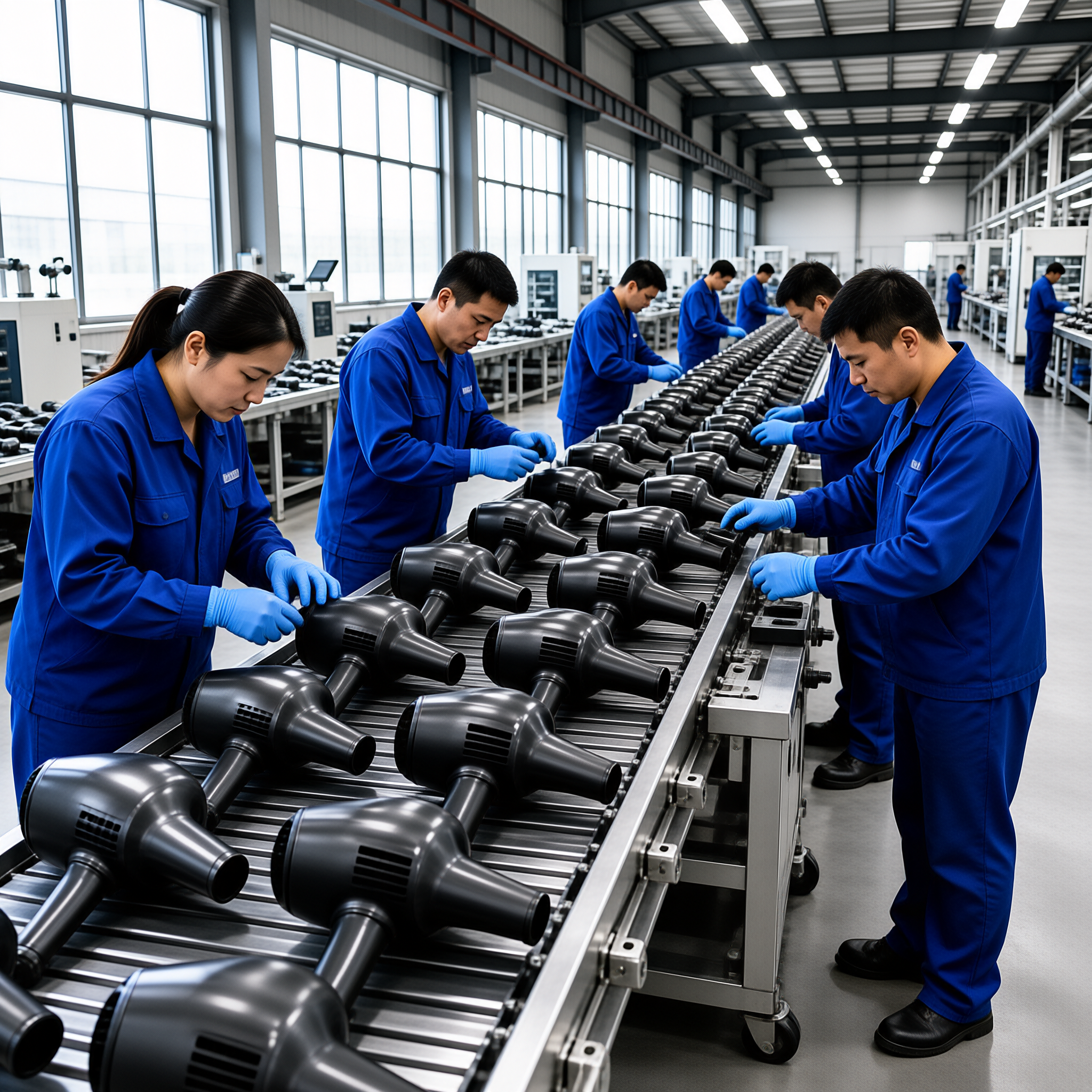
highdryer is a high-speed hair dryer manufacturer based in Dongguan, China, established in 2009. Our 30,000 sqm facility runs 15 production lines with 300+ staff and a daily capacity of 20,000 units. We support OEM/ODM with logo, colour, packaging and manual customization. MOQ starts from 100 units per model, and models and colours can be combined in one order. Samples ship in 7 days; bulk lead time is 25-35 days. Payment terms: T/T, L/C, Western Union. Certifications: CE, FCC, RoHS, CB, UKCA, ETL, ISO 9001. Contact us for a quotation against your specification.