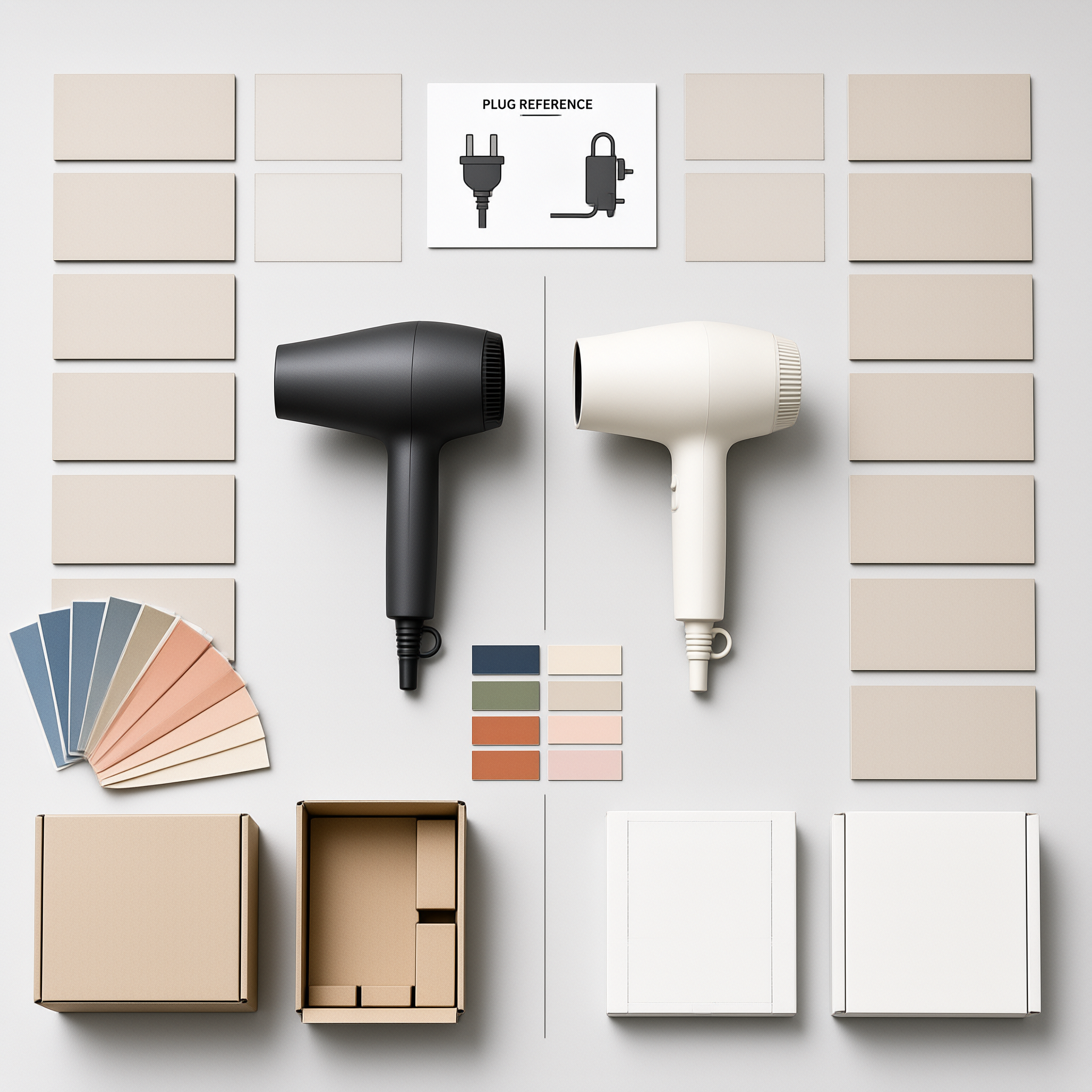
Choosing a hotel hair dryer supplier comes down to four verifiable checks: production capability, sample performance against a written specification, electrical compatibility for each destination market, and landed cost measured against your order volume.
Unit price is the weakest signal in hospitality sourcing. Durability, serviceability, plug and cord configuration, packaging approval and lead time decide whether a property opening stays on schedule — and whether housekeeping files warranty claims in year two.
Key Takeaways
MOQ starts from 100 units per model, and models and colours can be combined in one order.
Confirm plug, voltage and frequency per destination market; a matching plug alone does not prove compliance.
Samples ship in 7 days and bulk lead time is 25–35 days, subject to artwork and packaging approval.
Review samples in a fixed sequence: nameplate, plug, cord, controls, full heating cycle, then finish and packaging.
Bespoke housing or airflow redesign raises MOQ and depends on tooling, not catalogue volume pricing.
A hotel dryer fails from cord anchorage and brush wear long before its heating element burns out.
How to Choose a Hotel Hair Dryer Supplier: A Direct Answer
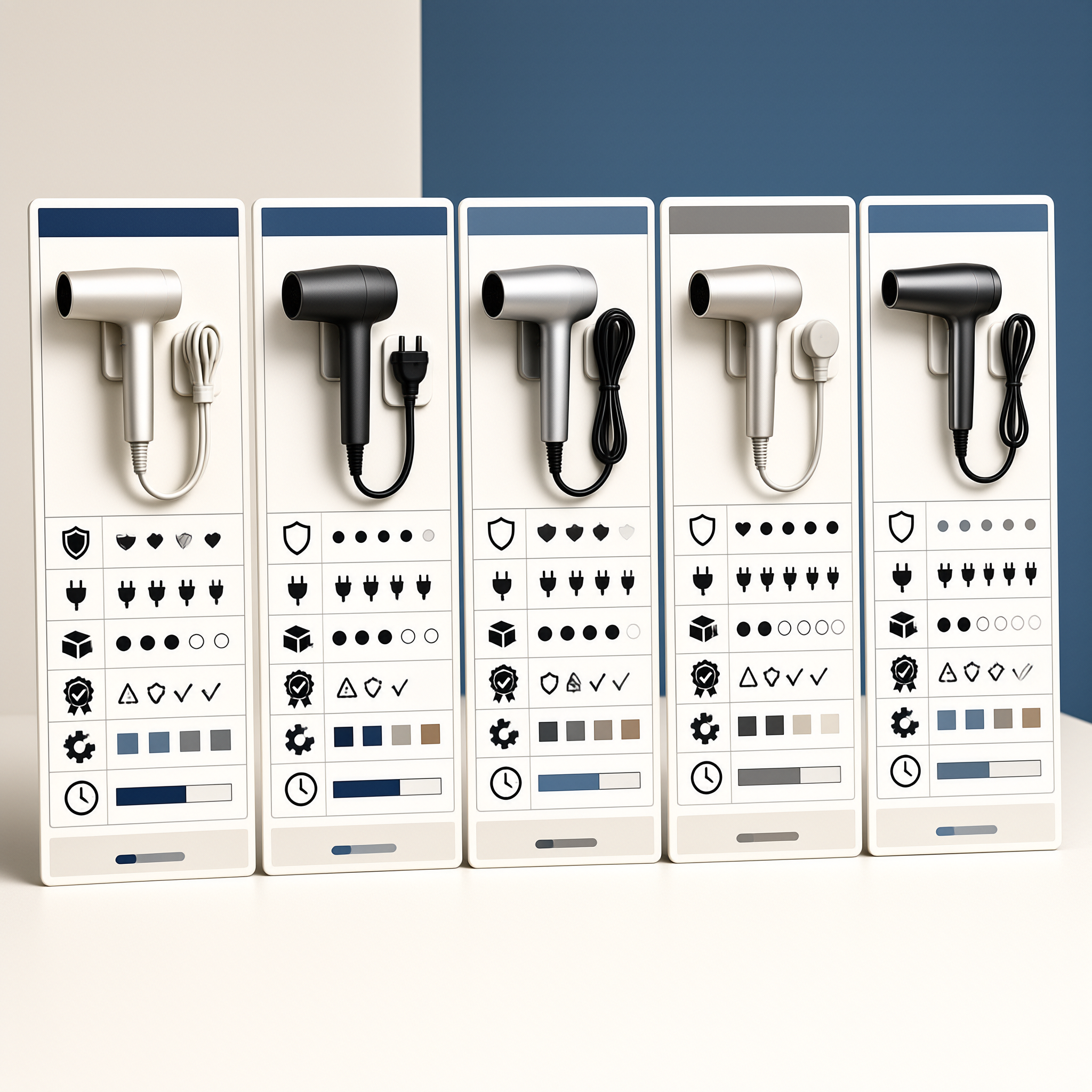
A shortlist of two or three factories that already build for hospitality buyers is usually enough. The commercial hotel hair dryer supplier worth keeping answers technical questions in writing and supplies certification names for the exact configuration you intend to buy.
Guest-room dryers face a duty cycle no domestic unit sees: short bursts, wet hands, dropped housings, and cords pulled from the socket by the cable rather than the plug. That pattern stresses cord anchorage and thermal cut-out behaviour long before the heating element reaches end of life.
The safety framework is already defined. IEC 60335-2-23 sets particular requirements for appliances for skin and hair care, covering abnormal operation and thermal protection. Ask which standard the declaration of conformity cites for the exact model, voltage and plug you are ordering.
Verify Manufacturing Capability Before Requesting a Quote
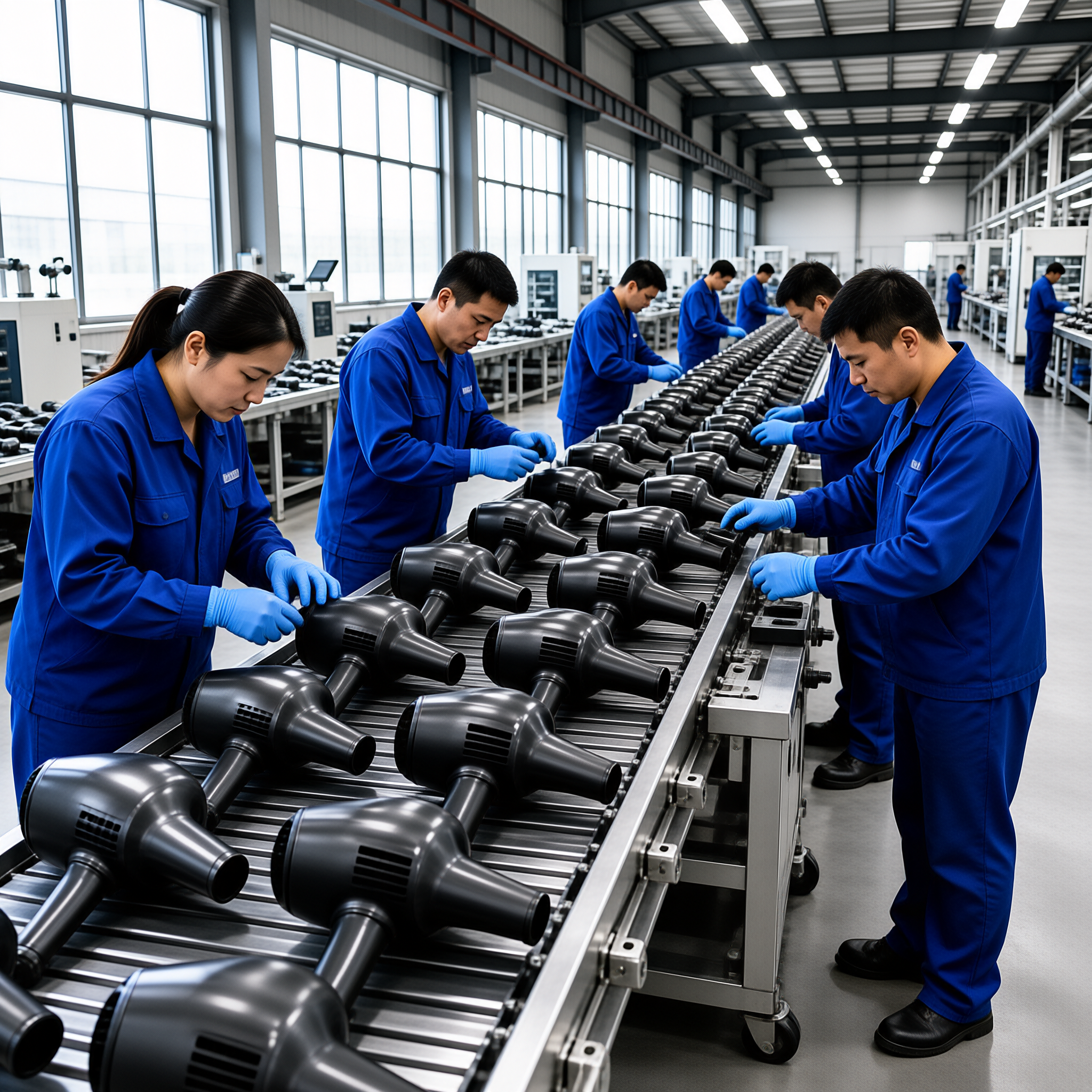
Before requesting a quote, ask any hotel hair dryer manufacturer for line count, daily output, in-house motor and housing production, and who signs the pre-shipment inspection record.
Choose a factory with in-house assembly if you need tolerance held across repeat orders — motor winding, switch fitting and cord assembly under one roof means a component substitution cannot happen unnoticed. Choose a trading intermediary only if you need a very wide catalogue and accept less visibility into component changes.
Management-system certification is the cheapest independent signal available. A hotel hair dryer manufacturer holding ISO 9001 has a documented process rather than a proven product, so request the scope statement — it shows whether the audited site actually covers dryer assembly. See ISO quality management standards for what that certificate family covers.
Line count and daily output, stated in units per day rather than units per month.
Whether motors, heating elements and housings are produced in-house or subcontracted.
The audited scope on the ISO 9001 certificate, not just the certificate image.
A named technical contact and a written response time for specification questions.
Certification names covering the exact model, voltage and plug configuration you are ordering.
Two hospitality references with property type and room count, so you can judge relevance.
Match Dryer Construction to Hotel Use
AC or brushless motors, sealed housings, replaceable cords and a tested thermal cut-out matter more than a wattage badge. For most hotels, a 2200 W unit with a 1.8–3 m cord and a stable stand covers the requirement.
Brushed DC motors wear at the carbon brushes, and that wear — not a burned element — is what eventually stops a dryer. Removing the brush path through an AC or brushless design removes the dominant failure mode in high-cycle guest-room use.
Current draw is the number that decides cord and plug specification. At 230 V a 2200 W dryer draws about 9.6 A, which makes cord gauge and plug rating a safety decision rather than a styling one. IEC 60335-2-23 requires abnormal operation to be assessed with airflow restricted — precisely the condition a blocked guest-room inlet filter creates.
| Construction choice | Motor | Cord and plug | Thermal protection | Best fit |
|---|---|---|---|---|
| Standard domestic unit | Brushed DC | Coiled 1.2–1.8 m, moulded plug | Single thermal fuse | Low-occupancy or budget rooms |
| Hospitality-grade unit | AC or brushless | Straight or coiled 1.8–3 m, anchored cord | Auto-reset cut-out plus fuse | High-use guest rooms |
| Compact or wall-mounted | DC, lower airflow | Fixed or short cord | Auto-reset cut-out | Space-constrained bathrooms |
| Premium concealed unit | AC | Long cord, concealed housing | Dual thermal protection | Premium suites and branded floors |
For High-Use Guest Rooms
High-use rooms — resort properties, airport hotels, serviced apartments — justify AC motors, an auto-reset thermal cut-out and a cord that can be replaced without replacing the dryer. Serviceability beats the specification sheet here.
Buyers reviewing hotel hair dryer wholesale terms usually compare unit price first, but replacement frequency is the larger line item over a fit-out cycle. If a cheaper unit needs replacing before the refurbishment cycle ends, the saving disappears into freight, labour and guest complaints.
For Premium and Limited-Service Hotels
Premium properties tend to specify quieter motors, concealed housings and finish-matched bodies. Limited-service and midscale properties usually get more value from a durable standard unit with a clean white housing and simple controls.
Matching construction to tier prevents two opposite errors: paying for styling where guests only notice noise, or under-specifying a high-traffic property where the same unit runs dozens of times a day.
For Accessible or Space-Constrained Rooms
Accessible rooms need controls reachable from a seated position, a cord long enough to reach from the wall socket to the mirror without tension, and a stand that does not tip when pulled.
Wall-mounted or compact units save counter space but trade airflow and cord flexibility. If the bathroom is small, confirm the mounting position sits within reach of the socket and outside the wet zone required by local wiring rules.
At 230 V a 2200 W dryer draws about 9.6 A, so cord gauge and plug rating are safety decisions, not styling ones.
Compare Plug, Voltage and Airflow Options for Each Market
Confirm plug shape, voltage, frequency and cord set for each destination market before ordering. An EU plug hair dryer built for 230 V is not interchangeable with a 120 V unit, even when the body looks identical.
Resistive heating output scales with the square of supply voltage. A 2200 W element designed for 230 V produces roughly 600 W at 120 V, so airflow stays similar while heat collapses — the dryer runs cold and long, which guests read as a broken unit.
European compliance is layered: the Low Voltage Directive 2014/35/EU covers electrical safety, the EMC Directive 2014/30/EU covers interference, and RoHS 2011/65/EU restricts hazardous substances. Cross-check destination markets on the EU Safety Gate alert system before finalising a purchase order.
EU and United Kingdom Requirements
Most EU markets run 230 V at 50 Hz with CEE 7/7-type plugs, while the UK uses BS 1363 three-pin plugs at the same voltage. Both need a cord long enough to reach the socket without strain, and both need a moulded, cord-anchored plug rather than an adapter.
Wet-zone wiring rules differ by country, so confirm where the socket sits relative to the bathroom. In the UK, bathroom socket restrictions under BS 7671 mean the dryer is normally used outside the wet zone — cord length, not plug type, becomes the limiting specification.
North American Requirements
North American properties use 120 V at 60 Hz with NEMA 5-15 plugs, which caps practical dryer output around 1500–1875 W on a 15 A circuit. Expect lower heat and longer drying time than the same model sold in Europe.
Bathroom receptacles in the United States require GFCI protection under NFPA 70 (NEC) 210.8. Specify UL or ETL listing names for the exact model instead of assuming a CE-marked unit covers the market.
Airflow, Heating and Cord-Length Choices
Airflow and heat are separate specifications. A high-wattage unit with a restricted inlet dries slowly, while a moderate unit with a clean airflow path and a well-shaped concentrator often performs better in guest hands.
Cord length of 1.8–3 m covers most room layouts: coiled cords add reach without clutter, straight cords survive rough handling. On an EU plug hair dryer wholesale order, put cord and plug specifications in the written quotation rather than the catalogue photo.
| Market | Typical supply | Plug or connector | Practical max output | Compliance names to confirm |
|---|---|---|---|---|
| EU (most markets) | 230 V, 50 Hz | CEE 7/7 type | 2000–2200 W | CE, RoHS, CB |
| United Kingdom | 230 V, 50 Hz | BS 1363 three-pin | 2000–2200 W | UKCA, CE |
| United States | 120 V, 60 Hz | NEMA 5-15 | 1500–1875 W | UL or ETL, FCC |
| Canada | 120 V, 60 Hz | NEMA 5-15 | 1500–1875 W | cUL or cETL |
| Multi-market hotel group | Mixed per property | Interchangeable cord set | Model-specific | All destination names, per SKU |
A 2200 W element rated for 230 V produces roughly 600 W on a 120 V supply, so voltage matching is a performance requirement, not a formality.
Compare Supplier Commercial Terms and Order Economics
MOQ starts from 100 units per model, and models and colours can be combined in one order. Housing or airflow redesign is higher and tooling-dependent.
Tooling, print plates and packaging die-cutting carry fixed setup costs. Combining models and colours inside one purchase order spreads those costs across a single production run, so a mixed order can meet the 100-unit-per-model threshold without splitting it into several separate purchase orders.
Supplier commercial terms are the reference point: 100 units per model as the starting MOQ, model and colour combination permitted within one order, and bespoke development quoted separately because it is tooling-dependent. Compare quotations on the same configuration and the same Incoterm, or the unit prices are not comparable.
| Order type | Starting MOQ | Tooling | Sample timing | Bulk lead time | Best fit |
|---|---|---|---|---|---|
| Catalogue model, standard colour | 100 units per model | None | Samples ship in 7 days | 25–35 days | First property or pilot order |
| Custom colour and logo, standard housing | 100 units per model, models and colours combined | Logo setup only | 7 days plus artwork approval | 25–35 days after approval | Brand consistency across a small group |
| Custom packaging and manual | 100 units per model | Print and die-cut setup | 7 days plus proof approval | 25–35 days after proof sign-off | Private-label hospitality programmes |
| New housing or airflow design | Higher, tooling-dependent | New tooling required | Quoted per project | Quoted per project | Multi-property rollouts with a fixed specification |
Landed cost per unit: ex-works price plus freight, duty and insurance.
Whether packaging, manuals and accessories are inside the quoted unit price.
Payment terms and the production milestone each payment is tied to.
Who bears the cost of a reprint if artwork is approved incorrectly.
Spare-part availability for cords, inlet filters and switches over the unit's service life.
Run a Structured Sample and Quality Review
Order the sample against a written specification and review it in a fixed sequence: nameplate and plug first, then cord and controls, then a full heating-and-airflow cycle, then surface finish, stand stability, noise and packaging.
Visual approval fails because the real failure modes are invisible in a photograph. Thermal cut-out behaviour only appears under a restricted inlet, cord anchorage only shows under pull force, and switch wear only appears after repeated cycling. A review that never exercises those conditions approves nothing but the paint.
A workable hotel hair dryer sample inspection sequence is documented rather than improvised: verify electrical identification, run the operating cycle, then record findings against the specification. Buying from a hair dryer manufacturer in China makes that record more valuable, because it becomes the reference document for bulk approval and for any later dispute.
Nameplate: rated voltage, frequency, wattage and model code match the purchase specification.
Plug and cord: moulded plug correct for the destination, anchorage firm under pull force.
Controls: switches operate cleanly, no looseness, markings legible after handling.
Heating cycle: full heat for several minutes, steady airflow, no odour or housing softening.
Thermal protection: restricting the inlet triggers the cut-out and the unit resets correctly.
Construction: housing seams closed, stand stable on a wet tile, inlet filter removable for cleaning.
Packaging: carton print, barcode, manual language and private-label artwork match the approved proof.
Plan Customization, Packaging and Approval Timelines
Samples ship in 7 days; bulk lead time is 25–35 days, subject to the final production scope and approval timing. On a hotel hair dryer manufacturer OEM ODM project, packaging and manuals run on a separate approval clock.
Each approval round is sequential: artwork proofing produces a dieline, the dieline produces a printed sample, and the printed sample produces the approved specification. Compressing that sequence is what causes reprints — a carton corrected after mass production starts is scrap, not a revision.
Treat the signed sample as the specification baseline: lock logo artwork, colour reference, packaging dieline and manual content before bulk approval, because each revision affects both production timing and the approval record. If only logo and colour change, you stay on standard tooling and the 25–35 day window holds. If the housing or airflow path changes, tooling is quoted first and the schedule is rebuilt around it.
Avoid Common Supplier-Selection Mistakes
The expensive mistakes are predictable: buying on unit price alone, assuming a plug equals compliance, treating certification names as interchangeable, and booking a custom timeline with no approval buffer.
These errors share one cause — a specification that was never written down. When the purchase order lists a model number only, there is no reference point for plug type, cord length, carton language or voltage, so a shipment can be both correct to the invoice and wrong for the property.
Certification names are not interchangeable. CE, FCC, RoHS, CB, UKCA, ETL and ISO 9001 describe different frameworks — electrical safety, electromagnetic compatibility, substance restriction, quality management — and none alone proves a specific configuration meets a specific market. Match the name to the market and the model, not to the catalogue.
Symptom: units fail within the first year. Cause: brushed motor and untested cord anchorage. Fix: specify motor type and cord pull test on the purchase order.
Symptom: guests report the dryer never gets hot. Cause: a 230 V model supplied to a 120 V property. Fix: print voltage and frequency on the order.
Symptom: shipment held at customs. Cause: certification names on file do not cover the ordered configuration. Fix: verify documents against model, voltage and plug before production.
Symptom: opening date missed. Cause: packaging proof approved after production started. Fix: approve artwork and dieline before the bulk deposit.
Final Supplier Comparison Checklist
Score suppliers on five weighted criteria — electrical compatibility, sample performance, MOQ fit, approval timing and serviceability — and treat unit price as a tiebreaker rather than a driver.
If you are furnishing one property with a fixed opening date, choose the supplier with confirmed standard models, written lead time and a short approval path. If you are outfitting a group across two or more voltage regions, choose the supplier that can build the same housing into two electrical configurations and hold one approved specification across both.
Take a mixed-property project: one hotel hair dryer supplier must cover several regional plug and voltage requirements, a 100-unit-per-model starting MOQ, combined models and colours on a single order, and private-label packaging. Separating destination-specific electrical configurations during specification approval keeps the SKU list short and the certification set accurate.
| Your situation | Priority criterion | Recommended configuration |
|---|---|---|
| Single property, fixed opening date | Lead time and standard stock | Catalogue model with logo, standard packaging, 25–35 day window |
| Multi-property group, several voltage regions | Electrical configuration control | Same housing, destination-specific voltage, plug and cord per SKU |
| Premium suites, guest-visible branding | Finish and packaging | Custom colour, branded carton, printed manual |
| Pilot order before a wider rollout | MOQ flexibility | Models and colours combined from 100 units per model |
| New design or airflow change | Tooling and development | Quoted separately; MOQ higher and tooling-dependent |
| If none of those rows describes your project, the specification is not finished yet. Write the requirement down before shortlisting anything. |
Frequently Asked Questions
- What is the minimum order quantity for hotel hair dryers?
- MOQ starts from 100 units per model, and models and colours can be combined in one order. Housing, airflow or fully bespoke development is higher and tooling-dependent.
- Should European hotel projects use an EU plug hair dryer?
- Yes, where the property supplies 230 V at 50 Hz — but confirm plug type, cord length and the applicable compliance names for that destination, because a two-pin plug alone does not establish suitability.
- Do all hotel hair dryer certifications provide the same assurance?
- No. CE, FCC, RoHS, CB, UKCA, ETL and ISO 9001 cover different frameworks, so match the certification name to the destination market and to the exact model, voltage and plug configuration you are buying.
- How much does a hotel hair dryer sample cost and ship?
- Request sample pricing, shipping terms and the dispatch date in writing, since cost depends on model, destination and whether customization is included. Samples ship in 7 days once the specification is agreed.
- Can hotel hair dryers be customized with a logo and custom packaging?
- Logo, colour, packaging and manual customization are all supported. Artwork and proof approval add time before bulk production, so approve them before the deposit stage.
- What is the production lead time for an order?
- Samples ship in 7 days and bulk lead time is 25–35 days, subject to the final specification and any outstanding artwork or packaging approvals.
- How do I check a supplier's factory capability?
- Ask for line count, daily output, whether motors and housings are made in-house, the audited scope on the ISO 9001 certificate, and a named technical contact who answers specification questions in writing.
Supplier selection is a document trail, not a conversation. Write the specification, keep the approved sample, confirm the certification names for each destination, and revisit the hotel hair dryer supplier comparison before every repeat order — configurations drift more often than factories change.
Approved samples, written specifications and market-matched certification names prevent more disputes than any price negotiation.
About highdryer
highdryer is a high-speed hair dryer manufacturer based in Dongguan, China, established in 2009. Our 30,000 sqm facility runs 15 production lines with 300+ staff and a daily capacity of 20,000 units. We support OEM/ODM with logo, colour, packaging and manual customization. MOQ starts from 100 units per model, and models and colours can be combined in one order. Samples ship in 7 days; bulk lead time is 25-35 days. Payment terms: T/T, L/C, Western Union. Certifications: CE, FCC, RoHS, CB, UKCA, ETL, ISO 9001. Contact us for a quotation against your specification.