Direct Answer: How to Verify a Chinese Hair Dryer Manufacturer in 7 Audit Steps
A reliable hair dryer factory audit checklist has seven steps: verify the legal entity, confirm factory ownership, inspect production lines, confirm in-house processes, review QC, verify certificates, and run an on-site or remote audit. Buyers who skip any step often discover problems after the deposit is paid.
A seven-step audit catches the most common supplier risks before money moves.
Start with documents, then move to the floor, then test the controls. That order matters because paper can be clean while the factory is only a showroom. A structured hair dryer factory audit checklist turns supplier verification into a repeatable due diligence process.
Key Takeaways
Verify the legal entity, the factory site, and the certificate scope before discussing price.
A trading company can be acceptable if it discloses the real OEM factory and allows audit access.
For trial orders under 500 units, a structured video audit is often enough if followed by pre-shipment inspection.
Certificates matter only when the report ID, applicant, and exact model all match the order.
The strongest audit combines documents, live walkthroughs, QC records, and a written red-flag log.
Verify the Legal Entity, Business License, and Factory Ownership vs Trading Company
The common failure is simple: the business card says factory, but the legal papers point to a different company. To verify how to verify hair dryer manufacturer claims, match the business license, PI, bank account name, factory address, and VAT invoice title.
This problem usually happens when a supplier brokers production through a separate entity or a subcontractor. The fix is to compare three documents line by line and then confirm the site address during a live walkthrough. In our audit experience, the fastest way to separate a real factory from a trading company is the VAT invoice (fapiao) title — if it is issued by a different entity than the one on the business license and the PI, the supplier is brokering production.
Under a factory vs trading company China how to tell review, look for land-use rights, a valid manufacturing scope, and a production address that matches the site you will inspect. A trading company is not automatically risky, but opacity is. If the entity cannot show who owns the line, assume you have not verified the supplier yet.
When On-Site Audit Is Worth the Cost
Use an on-site audit when the order is large, the product is customized, or the supplier hides key documents. Physical visits are better at exposing rented showrooms, shared warehouses, and subcontracted assembly.
The reason is operational. A site visit lets you see whether the legal entity actually controls the equipment, staff, and stock. You can also compare the license address with the production address and ask the warehouse team who owns the WIP.
If the deposit exceeds 30% or the first order is above 500 units, on-site review is the safer choice. That threshold is not a law, but it is a practical tradeoff many buyers use when the cost of a mistake is high.
When a Remote Video Audit Is Sufficient
A remote audit is enough for a small trial order when the supplier is already document-clean and accepts live camera control. It works best for basic verification, not hidden subcontracting.
Video is weaker on depth, but strong on speed. You can confirm the license, view the line layout, ask for live label reading, and request a walk to raw material storage. The tradeoff is that the camera can only show what the operator chooses to show.
For a trial run under 500 units, a remote audit plus third-party pre-shipment inspection is often enough. That combination reduces travel cost while still checking the real shipment before export.
Step-by-Step Remote Video Audit Checklist
Ask for a live call, not a recorded tour. Then request the business license, production entrance, line run, QC desk, warehouse, and certificate files in one session.
Control the pace of the tour. Ask the operator to move from the office to the floor, then to the warehouse, then to the packing area. A good remote video factory audit checklist should let you verify each stop against the documents.
Log every gap in real time. If the camera freezes, skips a room, or avoids the warehouse, treat that as evidence, not a technical problem.
Inspect Production Lines, Capacity Claims, and In-House vs Outsourced Processes
The main risk is a capacity claim that sounds large but cannot be proven on the floor. A proper china hair dryer factory inspection checks line count, shift pattern, bottleneck stations, and which steps are actually done inside the plant.
Capacity is not just machine count. It depends on labor, test time, component availability, and how much work is outsourced. Injection molding, SMT, assembly, and burn-in each change the real output picture.
In many projects, the hidden issue is not the line itself but the outsourced step. If housing molding or PCB assembly is subcontracted, lead time and defect responsibility both shift. That is why buyers should ask where each process happens, not just how many lines exist.
A common misconception is that more machines always mean more capacity. The real limit is usually the slowest step, often burn-in or final test. If that station is shared across models, the promised monthly output can be overstated.
Ask for a line map, shift schedule, and recent output log. Then compare the claimed capacity with the number of operators, test fixtures, and packaging stations you can see live.
If the plant says it can ship 50,000 units a month, request proof from the past three months: work orders, daily output sheets, and finished-goods stock movement. Claims without records are only marketing.
Audit the Quality Control System: IQC, First-Article, IPQC, OQC
A weak QC system usually shows up as repeat defects, missing traceability, or no first-article approval. The core hair dryer factory audit checklist should confirm IQC, first-article, IPQC, and OQC are all documented and used.
IQC blocks bad incoming parts. First-article inspection locks the setup before full production. IPQC catches drift during the run, and OQC checks the packed lot before shipment. Together, these controls stop one bad batch from becoming a full shipment failure.
Reference threshold: AQL 2.5 / 4.0 is the most commonly used sampling plan in small-appliance final inspection (ISO 2859-1, attribute sampling). Reference threshold: ISO 9001 clauses 7.5 and 8.5 require documented first-article and traceability controls (ISO 9001:2015).
The process fails when records exist but are not used. If the factory cannot show signed first-article sheets, defect logs, or lot traceability, then the QC system is not operational.
Ask to see one recent lot from incoming parts to finished goods. A real system can trace a motor, a heater element, and a packed carton back to the same batch record.
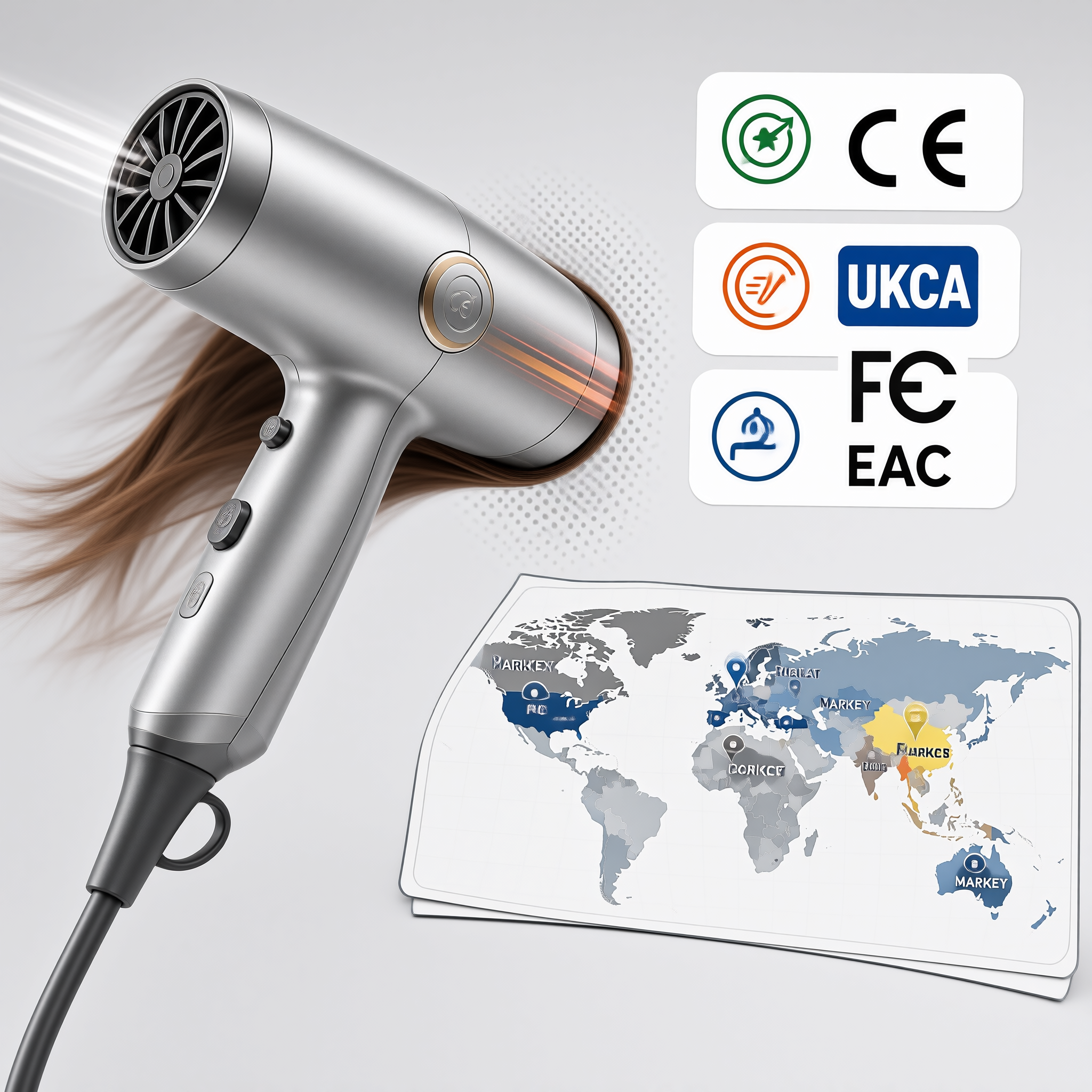
Verify Certifications: CE, FCC, RoHS, CB, UKCA, ETL, ISO 9001 — Report ID and Model Scope
Certificates matter only when the report ID, applicant, standard, and model scope all match the order. A certificate without the exact SKU or family scope is not enough for B2B import due diligence.
The mechanism is simple. Compliance documents are issued for specific test conditions and product variants, so a model change can break coverage even when the logo looks valid. Buyers should verify CE, FCC, RoHS, CB, UKCA, ETL, and ISO 9001 through the issuing body and the model list.
When verifying CE/FCC reports, we cross-check the report ID, applicant name, and model number on the issuing body's public database; if the model is missing or the report is a family certificate that does not list the exact SKU, the certificate is treated as not covering the order. Reviewed 200+ certificates, public database lookup on issuing body portal.
| Certificate | What to Match | Common Red Flag | Buyer Action |
|---|---|---|---|
| CE | Report ID, applicant, model, test standard | Only a logo image with no report | Request the full report and database record |
| FCC | FCC ID or test report, applicant, exact model | Family report without your SKU | Check the public record and scope |
| RoHS | Material declaration and test basis | No product traceability | Ask for BOM-level evidence |
| ISO 9001 | Certificate issuer, scope, validity | Scope excludes electrical appliance manufacturing | Verify scope on ISO 9001 quality management standard |
| Recall history | Market safety history | Repeated complaints or recalls | Cross-check EU Safety Gate (RAPEX) alerts |
A certificate without your exact model is a document, not proof of compliance.
The tradeoff is scope versus convenience. A broad family report is useful for a product platform, but it only helps if your SKU stays inside the tested configuration. If you change wattage, plug type, or housing, ask for a fresh review before shipping.
Do not treat ISO 9001 as a product certificate. It shows a quality system, not automatic product approval. Use it to judge process discipline, then verify the product reports separately.
On-Site vs Video Audit: Which Method Fits Your Order, and How to Run a Remote Video Walkthrough
On-site audits are better for hidden-process verification, while remote video audits are better for speed and early screening. A remote video factory audit checklist works well when the supplier is cooperative and the order risk is limited.
The difference is control. On-site lets you move freely and inspect details up close. Video lets you ask fast questions, but the supplier still controls the camera path.
Use on-site review for complex OEM programs, new factories, or deposits above 30%. Use video when you need a quick supplier screen, a trial order, or a second look before booking travel.
| Dimension | On-Site Audit | Remote Video Audit |
|---|---|---|
| Hidden subcontracting | Stronger detection | Weaker detection |
| Speed | Slower | Faster |
| Travel cost | Higher | Lower |
| Best use case | Large or risky orders | Trial orders and early screening |
| Control of evidence | High | Medium |
When On-Site Audit Is Worth the Cost
Choose on-site if the order is customized, the supplier is new, or the factory has never been audited before. That is the safer path when the cost of a missed defect is higher than the audit trip.
A physical visit is also better when you need to verify multiple subcontractors, warehouse flow, or mixed production lines. The camera can miss what a floor walk catches in seconds.
If the order is above 1,000 units or the product will ship into a strict retail channel, on-site review usually pays for itself in avoided risk.
When a Remote Video Audit Is Sufficient
Choose video if the supplier already passed document review and you mainly need to confirm layout, QC habits, and live operation. It is the faster option for shortlisting.
A remote audit is enough when you can direct the tour, pause for document close-ups, and request live serial or batch readings. It is not enough when the supplier refuses camera control or avoids the warehouse.
For a first order under 500 units, video plus a third-party pre-shipment check is often the practical middle ground.
Step-by-Step Remote Video Audit Checklist
Send the agenda before the call and require live camera control. Then verify the license, floor layout, production line, QC desk, warehouse, and certificate copies in that order.
Ask the operator to show date-stamped records, not just machines. If the team can only show polished rooms, the audit is incomplete.
Save screenshots and note every refusal. A clean audit trail is useful if you later need to compare suppliers or escalate a dispute.
Questions to Ask on a Live Video Tour + Step-by-Step Remote Audit Checklist
Ask direct questions, then force the answers onto camera. The best script covers ownership, line count, shift output, outsourced steps, QC records, and shipping traceability.
Choose a tighter script if the supplier is new or the hair dryer OEM MOQ sampling lead time is long. Choose a broader script if the factory already passed document review and you only need confirmation.
The practical rule is this: if the supplier cannot answer in one live session, request documents before the next call. That is faster than debating vague claims for a week.
Questions to Ask During the Live Walkthrough
Who owns this production site, and does the business license match the address on camera?
Which steps are in-house, and which steps are outsourced to subcontractors?
How many lines, shifts, and operators are running today, and what is the daily output target?
Can you show one recent lot from IQC to OQC with batch traceability?
Which certificate report ID covers this exact model, and where is the public record?
Ask for answers that can be checked later. If the operator gives only broad claims, log them as unverified and move on.
A strong answer names the room, the batch, and the record. A weak answer names only the department.
Documents to Request Before and After the Call
Before the call, request the business license, product spec sheet, QC SOP, and certificate copies. After the call, request screenshots, the line video file, and any batch records shown live.
If the supplier delays the documents for more than 48 hours, treat that as a process risk. Fast document delivery usually reflects better internal control.
Keep one folder per supplier so you can compare claims across factories. That makes sourcing decisions easier when you are reviewing several quotes at once.
Red Flags to Log Immediately
Log any mismatch between the license, the PI, and the warehouse name. Also log missing model numbers, camera cuts, and refusal to show the QC desk.
A common mistake is waiting until the end to write down concerns. Immediate logging gives you a cleaner comparison and prevents the supplier from reshaping the story later.
If three red flags appear in one call, stop the review and escalate to a document-only hold. That is usually the point where the risk outweighs the convenience.
FAQ: Hair Dryer Factory Audit — 6 Buyer Questions Answered
How long does a hair dryer factory audit take?
On-site audits usually take one full day. A remote video audit often takes 2 to 3 hours across two sessions, plus one day for pre-shipment inspection if needed.
Can a trading company be a legitimate hair dryer supplier?
Yes. It is acceptable if the company discloses the real OEM factory, allows audit access there, and signs documents in a traceable way.
How do I verify a CE or FCC certificate is real?
Request the report ID, applicant name, exact model, and standard. Then verify the record on the issuing body’s public database before accepting the document.
What is the single biggest red flag during an audit?
A certificate that has no report ID, no model number, or a scope that does not match the hair dryer you are ordering.
Do I need an on-site audit if I only place a small trial order?
Not always. For a trial order under 500 units, a structured video audit plus third-party pre-shipment inspection is often enough.
What is AQL and why does it matter in a hair dryer audit?
AQL is the sampling threshold used in final inspection. For small appliances, buyers often document AQL 2.5 for major defects and 4.0 for minor defects under ISO 2859-1.
Use this hair dryer factory audit checklist as a working file, not a one-time form. The best results come from combining document review, live verification, and a final shipment check before the order closes.