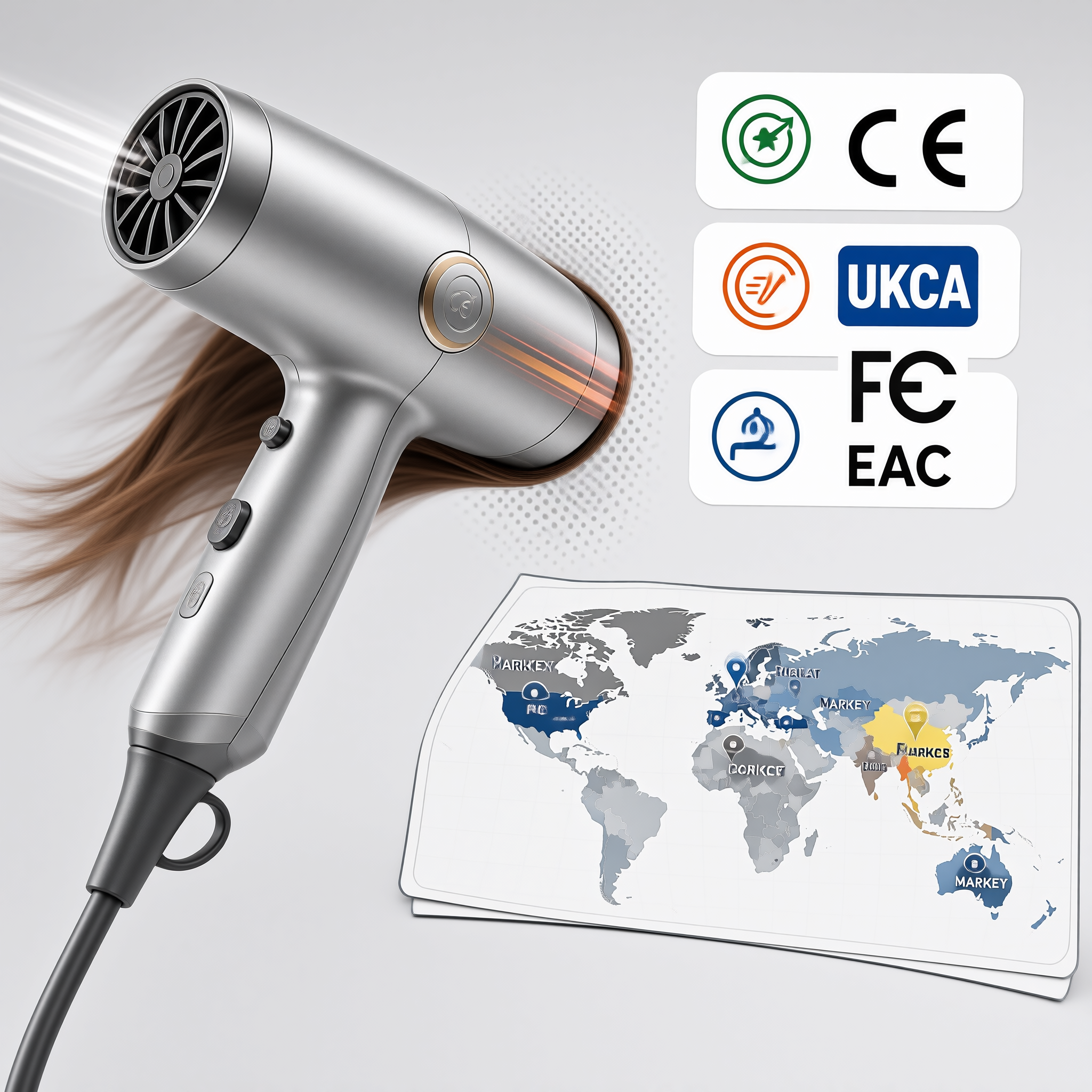
Hair dryer certification requirements are market-specific and model-specific. Importers need CE under LVD, EMC, and RoHS for the EU; UKCA for Great Britain; FCC plus an NRTL safety listing such as ETL or UL for the US; and EAC for Russia and the EAEU.
A certificate for one model does not automatically cover another. The scope must match the exact model number, rated voltage, wattage, PCB build, and safety-critical parts before shipment.
One certificate rarely covers every hair dryer variant in a product family.
Key Takeaways
CE, UKCA, FCC, and EAC are not interchangeable; each market needs its own conformity path.
A model change in voltage, wattage, PCB, or motor usually triggers retesting.
Importers should verify report ID, issuing lab, and exact model scope before shipping.
A clean file needs both documents and product evidence, not just a logo on the carton.
What Hair Dryer Certifications Do Importers Actually Need
The short answer is: use the certificate set required by the destination market, not the origin factory. For most hair dryers, that means CE for the EU, UKCA for Great Britain, FCC plus NRTL evidence for the US, and EAC for Russia and the EAEU.
The reason is that each regime checks a different risk. Electrical safety, EMC, and restricted substances are handled under different legal frameworks, so one document rarely satisfies all four markets.
A 1,600W ionic dryer is a good example. The same unit can be saleable in one market file and blocked in another if the voltage, plug, labeling, or report scope does not match the target country.
EU Market: CE Marking Under LVD, EMC, and RoHS
CE marking hair dryer compliance in the EU usually rests on three pillars: LVD for electrical safety, EMC for electromagnetic emissions and immunity, and RoHS for restricted substances. The importer must keep the technical file, Declaration of Conformity, and test evidence aligned with the exact product configuration.
Low-voltage appliances are checked for shock and fire risk, while EMC confirms the dryer does not disturb nearby equipment. RoHS hair dryer compliance adds a materials check for restricted substances in homogeneous parts, which is why PCB, cord, and plastic compounds all matter.
Hair dryers fall under LVD 2014/35/EU scope when rated between 50–1000V AC or 75–1500V DC (Directive 2014/35/EU, Article 1). RoHS limits under Directive 2011/65/EU Annex II set lead at 0.1% and cadmium at 0.01% in homogeneous materials, with IEC 62321 methods used for screening.
UK Market: UKCA After Brexit — What Changed
UKCA hair dryer compliance is separate from CE for Great Britain. CE may still matter for the EU, but UKCA is the mark buyers should plan around for UK market placement.
The tradeoff is simple: CE and UKCA often use similar technical content, but they are not the same legal route. Buyers who split EU and UK programs early avoid relabeling, document rework, and late-stage packaging changes.
Choose a shared test strategy if the same model will ship to both markets and the standards mapping is already clear. Choose separate files if the product line changes often, since a label or plug revision can force a new review cycle.
US Market: FCC + NRTL Listing (ETL/UL)
FCC EMC Compliance (Part 15 / SDoC)
For a standard dryer, FCC hair dryer importer checks usually focus on Part 15 emissions. Most units are unintentional radiators, so the file often relies on Supplier's Declaration of Conformity unless the product includes a wireless module.
The mechanism is straightforward: motors, switching electronics, and heaters can generate conducted and radiated noise, so emissions testing confirms the appliance stays within limits. If the dryer adds Bluetooth or another intentional radiator, the compliance path changes.
Hair dryers are typically classified under 47 CFR Part 15 Subpart B for unintentional radiators, with functional checks under ANSI C63.4. If the product has no wireless module, the file is usually simpler than a connected appliance.
NRTL Safety Listing (ETL, UL, or Equivalent)
NRTL listing covers electrical safety for fire and shock risk. ETL vs UL hair dryer NRTL choices are usually commercial acceptance questions, not a difference in the underlying safety principle.
The safety listing matters because retailers, marketplaces, and some buyers ask for a recognized third-party mark before listing. The product must match the tested construction, including cord type, insulation class, thermal cutoffs, and rated power.
For U.S. projects, the practical file often combines FCC Part 15 evidence with a recognized NRTL listing and product labeling review. According to the U.S. Consumer Product Safety Commission (CPSC), importers should keep safety documentation ready for market surveillance and retailer checks.
Russia & EAEU: EAC Mark and TR CU 004/2011, 020/2011
EAC hair dryer compliance for Russia and the EAEU usually requires the EAC mark plus conformity under TR CU 004/2011 and TR CU 020/2011. TR CU 004/2011 hair dryer files address low-voltage safety, while TR CU 020/2011 covers electromagnetic compatibility.
The reason both are needed is that the customs union separates electrical safety from EMC. A product can pass one regulation and still fail the other if its insulation, heating behavior, or emissions profile is outside the allowed range.
EAC certificates under TR CU 004/2011 and TR CU 020/2011 are typically issued for 1-year or 3-year cycles, so the expiry date must be checked before shipping. The certificate should also match the exact series, plug type, and rated electrical parameters.
Certification Requirements by Market (Comparison Table)
For import planning, the EU and UK are similar on technical testing, while the US adds a separate safety-listing question and Russia/EAEU requires a distinct customs-union file. The best choice depends on where the first shipment will land and how often the SKU will change.
| Market | Required certification | What it covers | Typical documents | Notes |
|---|---|---|---|---|
| EU | CE under LVD, EMC, RoHS | Safety, EMC, restricted substances | DoC, test report, technical file | Model-specific; keep the exact configuration on file |
| UK | UKCA | Great Britain market access | UK DoC, test report, labeling file | Separate from CE for GB placement |
| US | FCC + NRTL listing such as ETL or UL | Emissions plus electrical safety | FCC SDoC or file, NRTL report/listing, labels | Retailers may ask for both |
| Russia & EAEU | EAC under TR CU 004/2011 and 020/2011 | Safety and EMC under customs-union rules | EAC certificate, test report, application file | Check validity cycle and product scope |
| EU Safety Gate (SafetyGate) recalls database is useful when checking whether a similar appliance has already been flagged in the destination market. That review does not replace certification, but it helps spot recurring safety issues before launch. |
Why a Certificate for One Model Does Not Cover Another
A certificate for one model does not cover another if the tested scope changed. The usual failure mode is a one-letter model mismatch, a higher wattage, or a different PCB that was never included in the test report.
The certificate model scope mismatch happens because test results are tied to the exact build that was sampled. If the heating element, motor, insulation, or rated power changes, the original evidence may no longer represent the shipped unit.
In our sampling reviews across multiple production runs, certificate mismatches most often involve two failures: the model number printed on the test report differs by one letter from the production label, or the rated wattage on the rating plate was raised without a new LVD test. Both void the certificate for the as-shipped unit.
How to Verify a Certificate Before You Ship (Checklist)
Document-Level Checks
Start with the report ID, issuing lab, and certificate holder name. Then confirm the lab is accredited for the relevant standard and that the document date, issue date, and expiry date are all visible.
The key question is whether the paperwork can stand on its own. If the report ID is missing, the issuing lab cannot be traced, or the standard number is absent, the file is weak before product inspection even begins.
Before you ship, verify hair dryer certificate details against the customs entry file, carton label, and factory invoice. If any one of those shows a different model or voltage, stop and resolve it first.
Product-Level Cross-Checks
Next, compare photos, PCB images, power rating, plug type, and safety components against the test report. This is where many files fail, especially when a sample was tested at 1,600W but production was later changed to 1,800W.
The fix is to match the as-shipped unit to the tested unit, not to the sales sample. If the housing, insulation class, thermal cutoff, or mains rating changed, the old report no longer proves conformity.
Use a side-by-side review of the test report photos, the production rating plate, and the final BOM. That simple check catches most scope errors before the freight booking is confirmed.
Check the report ID and certificate holder name.
Match the exact model number, voltage, and wattage.
Compare the test photos with the production PCB and rating plate.
Confirm the issuing lab can be traced to the stated standard.
Stop shipment if the production unit differs from the tested sample.
Importer Tradeoffs: Cost, Lead Time, and Testing Risk
The main tradeoff is not certificate price alone. Hair dryer import compliance cost rises when a model change triggers retesting, a second market file, or a retailer-specific safety review.
Choose one shared test plan if the SKU is stable and the EU, UK, and US launch dates are aligned. Choose separate market files if the model will change during ramp-up, since the cheapest first report can become the most expensive rework.
A recent importer program we reviewed tried to ship a 1,600W ionic hair dryer into Russia using only an EU CE file; customs held the shipment because the EAC certificate under TR CU 004/2011 was missing, and the cost of expedited testing plus demurrage exceeded the original lab budget.
Frequently Asked Questions
What certifications are required to import hair dryers?
EU needs CE under LVD, EMC, and RoHS. Great Britain needs UKCA, the US needs FCC plus NRTL safety evidence, and Russia/EAEU needs EAC under TR CU 004/2011 and 020/2011.
Does a CE certificate cover all models of a hair dryer?
No. The certificate only covers the exact model and tested configuration listed in the report, including voltage, wattage, PCB, and safety-critical parts.
Is UKCA the same as CE?
No. UKCA is the Great Britain regime after Brexit, while CE applies to the EU. They may use similar technical tests, but the legal marks are separate.
Do hair dryers need FCC certification in the US?
Most standard dryers need FCC emissions compliance under Part 15, and many buyers also require an NRTL listing such as ETL or UL for safety acceptance.
How do I verify if a hair dryer certificate is real?
Check the report ID, issuing lab, exact model number, and whether the photos, PCB, and power rating match the tested sample. If those do not align, stop the shipment.
Can I use the same lab report for a 120V and 220V hair dryer variant?
Usually no. Different mains ratings often change the test conditions, so a separate report or a clearly scoped family report is needed.
The safest next step is to build a market-by-market file map before production starts. For hair dryer certification requirements, the winning process is always the same: match the market, match the model, and match the test evidence before goods leave the factory.