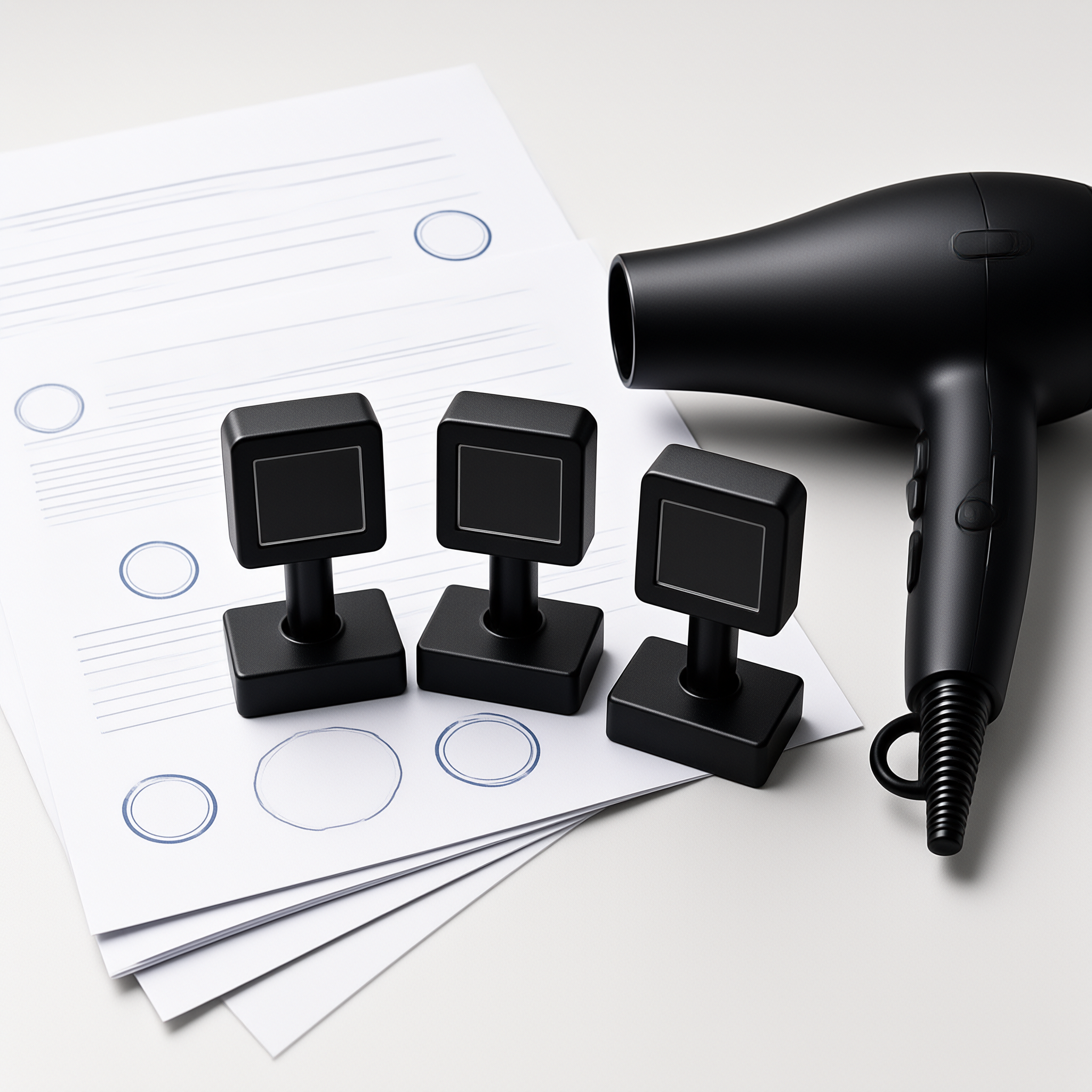
Hair dryer sample approval is the structured inspection and sign-off process a buyer runs on a factory prototype before authorizing bulk production. It combines a physical checklist, functional testing, and a signed record that both parties keep.
The checklist covers appearance, finish, colour match against the approved swatch, logo printing position and sharpness, material and hand feel, weight and balance, packaging and inner protection, accessories, labelling with voltage and plug markings, and compliance marks. Function tests run on the same unit and are recorded on the same sheet. What you sign becomes the reference every production unit is measured against.
Key Takeaways
Correcting a defect at the sample stage costs a fraction of correcting it after tooling and packaging are committed.
Approve only after holding and operating the unit; photos hide surface finish, switch feel, and noise.
Retain a signed golden sample on both sides, or bulk drift becomes undetectable until it reaches customers.
Every specification change needs a change number, a cost note, and a new signed version.
When a sample fails, name the process parameter behind the fault before re-sampling.
Correcting a defect at the sample stage costs a fraction of correcting it after tooling and packaging are committed.
What Is Hair Dryer Sample Approval and Why Does It Matter Before Bulk Production?
Sample approval matters because it is the last point where a defect can be corrected with a file edit instead of a tooling change.
Tooling is cut to the dimensions of the approved sample, and packaging artwork goes to print from the approved layout. Once those assets exist, a change touches something physical: a mould insert, a print plate, a filled packaging order. The same defect therefore costs far more to correct after the sample gate. However, the gate only works when the unit is held and operated, not judged from a photo.
Across multiple OEM sampling programs in hair tools and adjacent consumer-electronics categories, corrective work at the sample stage has run at a single-digit percentage of the cost of the same correction after tooling lock (internal sampling economics model; comparison of sample-stage rework against post-tooling rework). The comparison counts tooling modification, artwork reprint, and re-worked units as separate cost lines.
What Should a Hair Dryer Sample Checklist Cover Before You Sign Approval?
A hair dryer sample checklist should cover appearance and finish, colour match to the approved swatch, logo printing, material and feel, weight and balance, packaging, accessories, labelling, function, and compliance marks.
Most sample rejections are not electrical failures. They are brand-visible issues: a colour that reads differently in daylight, a logo printed two millimetres off centre, a switch that feels loose, a gift box that lets the nozzle rattle. These items sit outside any electrical safety test, so only a written checklist with pass criteria catches them before tooling and packaging are committed.
In sample rounds logged at sign-off of OEM hair tools, recurring failure categories clustered around colour match, logo printing sharpness, packaging protection, and switch tactile feel (internal sampling observation log; failure categories recorded at sign-off across multiple sample rounds). Electrical function was checked on the same units and rarely produced the blocking defect.
Appearance and finish — no flow marks, sink marks, scratches, or uneven texture under 500 lux inspection light.
Colour — body, grille, cord, and trim matched to the approved swatch under D65 daylight.
Logo printing — position inside the artwork tolerance, sharp edges, no smear or halo.
Material and feel — housing and handle match the approved resin and surface gloss.
Weight and balance — total unit weight within tolerance, handle balanced in the working hand.
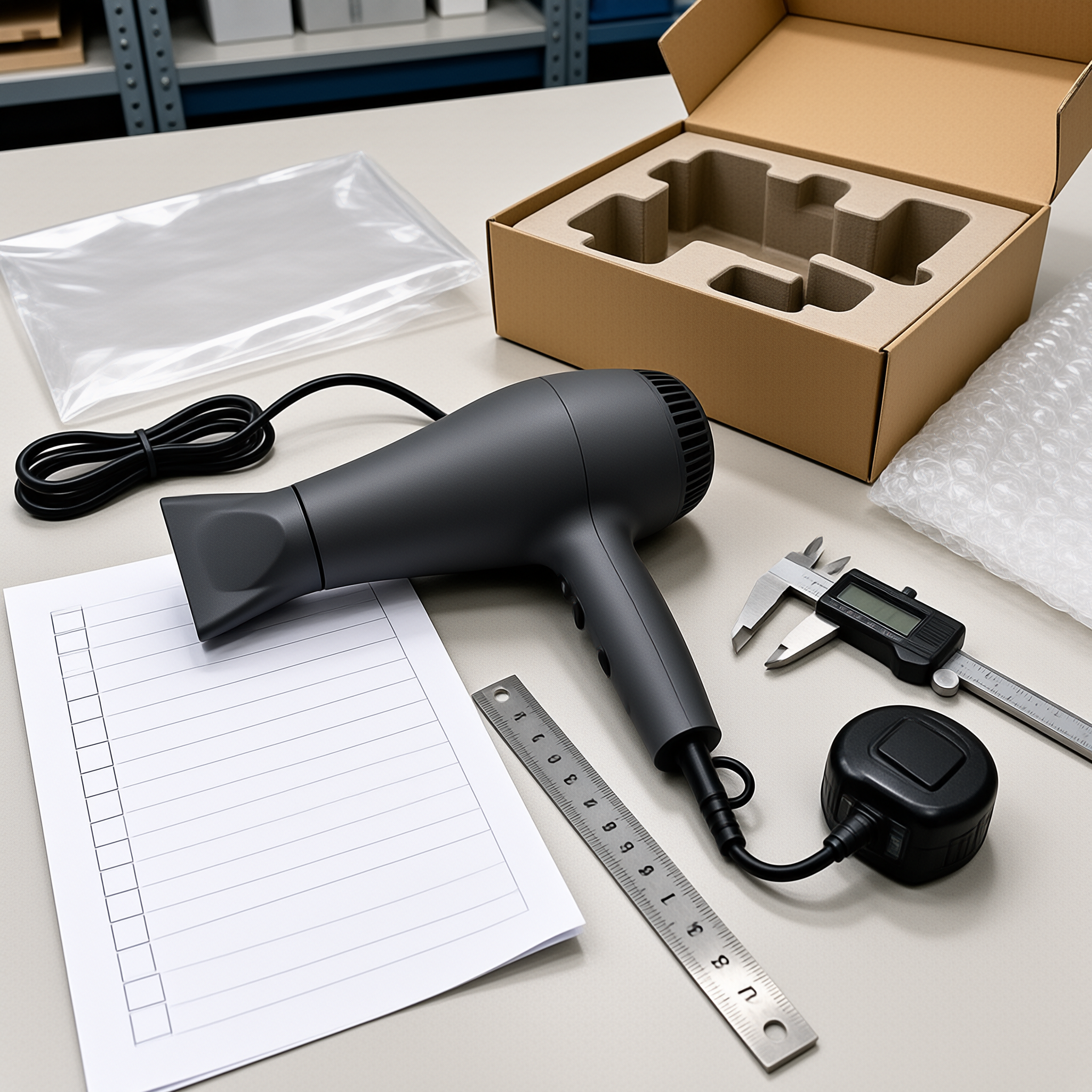
Packaging and inner protection — box print and cut accuracy correct, no rattle in a shake test.
Accessories — every concentrator, diffuser, or comb present and fitting the barrel without wobble.
Labelling — rating label fields (voltage, frequency, wattage, model, batch) printed and durable.
Function — speed settings, heat settings, cold shot, and ionic function behave as specified.
Compliance marks — the conformity marks and warnings required by the destination market, placed and legible.
Appearance, Finish, and Color Match
Inspect appearance under controlled light rather than office lighting. A neutral 500 lux source at about one arm's length exposes flow marks, polish swirls, and uneven gloss that disappear under warm indoor light.
Colour causes more rework than any other single item. Compare body, grille, cord, and any painted trim against the approved swatch under D65 daylight, and confirm the factory used one masterbatch lot for every part sharing that colour.
Two parts of the same colour from different lots will read as two different products on a shelf.
Logos, Labelling, and Compliance Marks
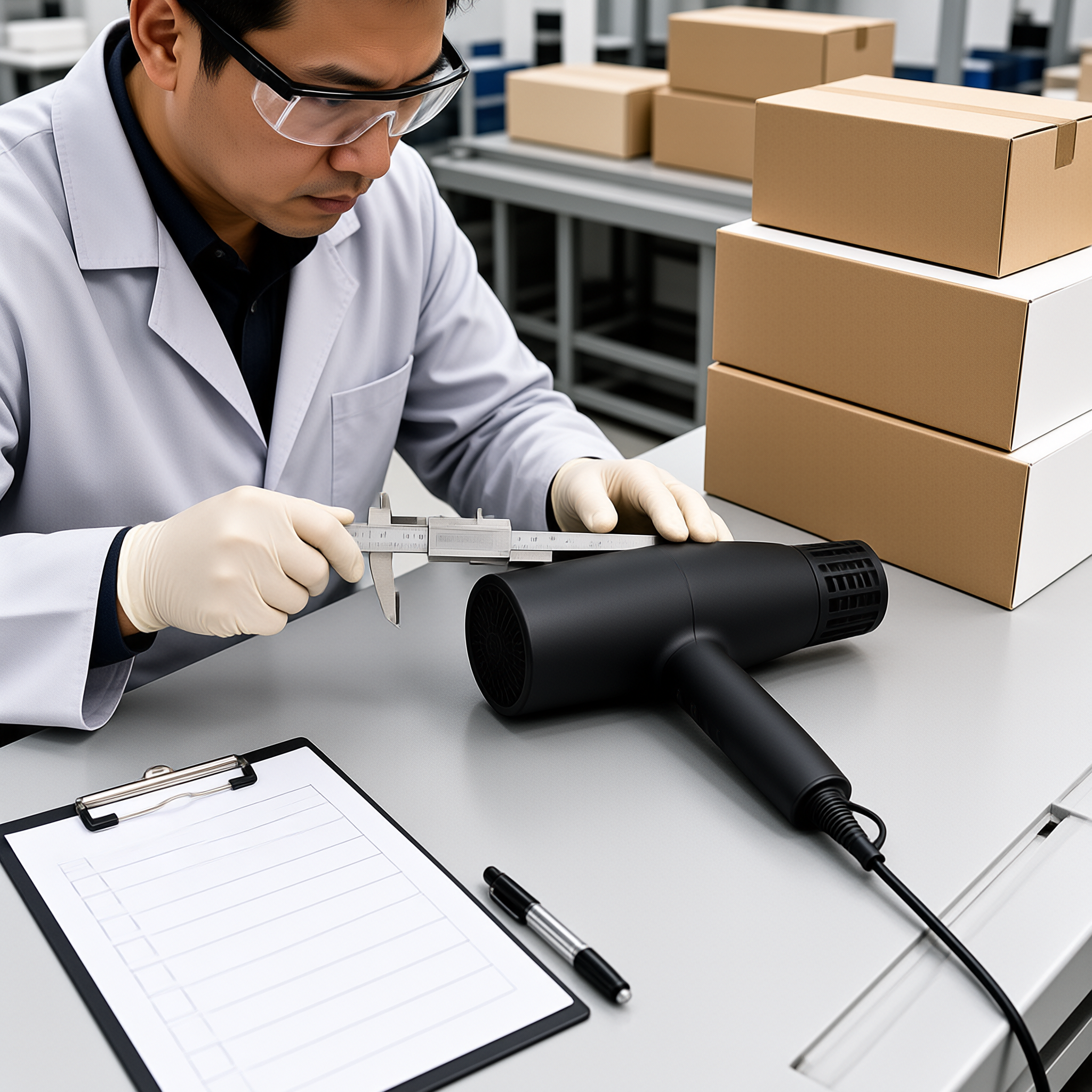
Logo printing has to be measured, not eyeballed. Barrel position, print size, ink coverage, and edge sharpness each need a written tolerance, because pad printing and laser etching drift between setups.
Rating labels carry voltage, frequency, wattage, and plug type for the destination market. Check print durability with an abrasion rub and confirm the conformity marks match the market the units ship to. Two reference points help here: ISO standards for product evaluation for inspection method, and EU Safety Gate product alerts for the labelling and marking failures that trigger recalls.
A wrong voltage mark is a market-access problem, not a cosmetic one. It can stop a shipment at the border.
How to Run Functional Tests on a Pre-Production Hair Dryer Sample
Run six functional checks on every pre-production sample hair dryer: airflow at each speed, temperature stability, noise at the highest setting, cord length and strain relief, switch feel, and attachment fit. Set the pass limits before the unit arrives.
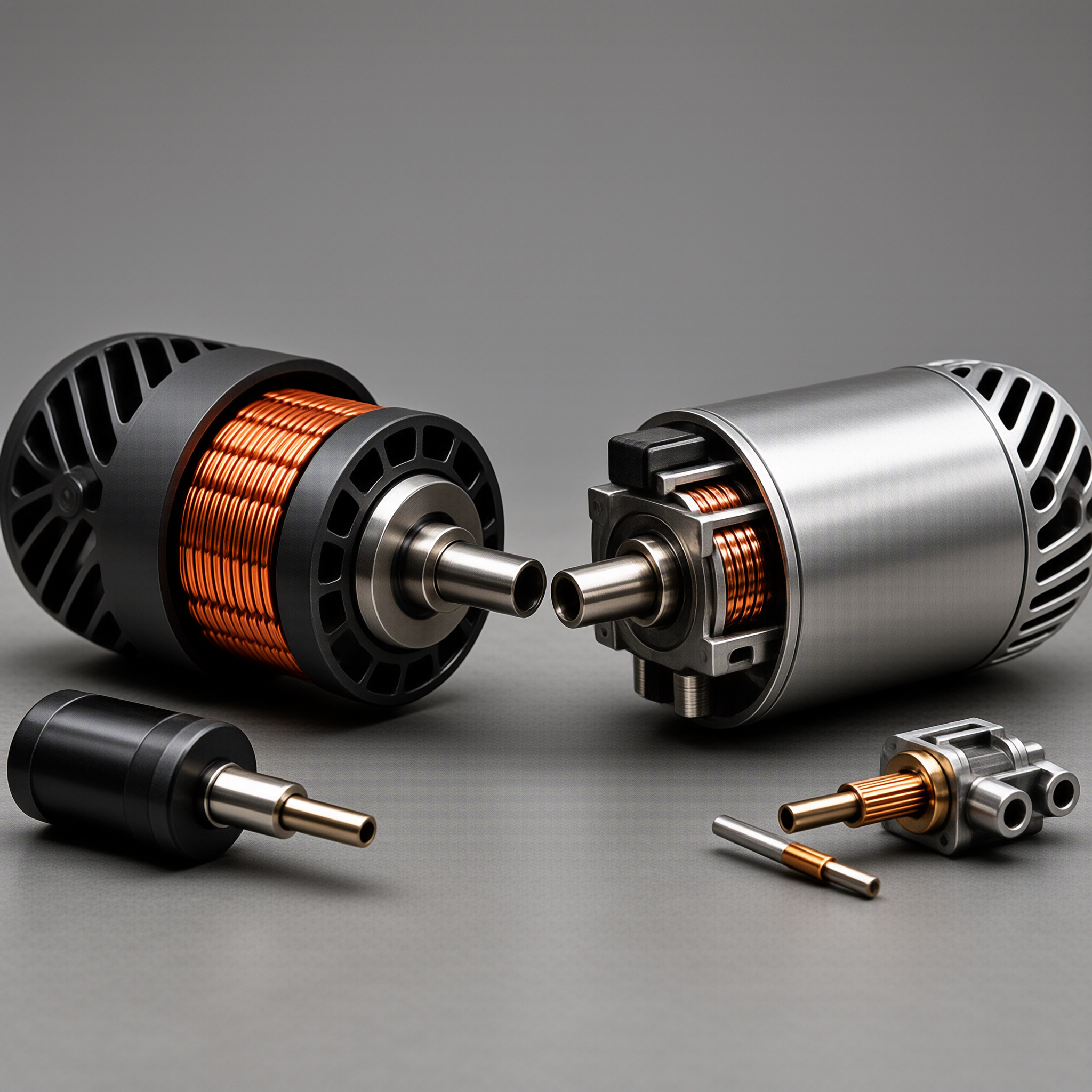
Static inspection cannot show how a motor behaves under load or how a housing expands as it heats. Rising temperature softens polymer and shifts internal airflow, which changes both output and tone. Running the unit continuously for several minutes before measuring is what makes the readings repeatable across rounds.
Our sample evaluation runs a five-minute continuous high-heat cycle to check temperature stability, a noise reading at the highest speed setting measured at one metre, and a cord pull test on the strain relief (method: continuous high-heat run, peak noise in dB(A) at 1 m, strain relief pull; applied to every pre-production sample entering the lab). These three checks repeatedly surface faults a static unit does not show.
Airflow, Temperature, and Noise
Measure airflow at the nozzle with a handheld anemometer at every speed setting, and record the reading rather than a pass or fail word. Compare low and high settings; an unusually narrow spread usually points to a restricted air path or an underperforming motor.
Temperature stability means the outlet temperature holds steady during a continuous run instead of climbing. Hold a thermocouple in the airstream at a fixed distance and log the value every 30 seconds.
Noise at the top setting is what customers notice first. Measure it instead of describing it.
Switch Feel, Cord, and Attachment Fit
Switch feel is a tactile specification. Each slider or button should move with consistent resistance, seat firmly at every detent, and make the same click across all settings.
Measure cord length from the housing exit to the plug face and confirm it against the approved drawing. A pull test on the strain relief shows whether the internal clamp grips the jacket or only the conductors.
Attachments should slide on with light pressure and lock without wobble. A concentrator that rattles will be reported as a quality fault even when airflow is correct.
Sample Approval Workflow: Golden Sample, Signed Sheet, Photo Record, Version Control
A sample approval workflow has five steps: log the sample, inspect it against the checklist, run functional tests, sign the approval sheet with any deviations, and retain a hair dryer golden sample on both sides under version control.
A signature and a retained unit create two references at once. The signed sheet fixes the written specification; the golden unit fixes the physical result, including colour and feel that no drawing captures. When a later shipment is questioned, both sides compare the same object instead of arguing from memory.
In our sampling workflow, every hair dryer prototype is logged with a unique sample ID, a timestamped photo set covering front, back, logo close-up, accessories and packaging, and a version number before it enters the inspection queue (method: photo log, sample ID, and versioned approval sheet; applied to every unit entering the queue). Nothing reaches the inspection bench without that record.
| Stage | What to Check | Pass Criteria | Record |
|---|---|---|---|
| 1. Receipt | Sample ID, version number, quantity, transit condition | ID matches the approval sheet version; unit undamaged | Log entry plus timestamped photo set |
| 2. Visual inspection | Appearance, finish, colour against swatch, logo position and sharpness | No visible defect; colour inside swatch tolerance under D65 | Completed checklist page |
| 3. Physical checks | Weight, balance, material feel, accessory fit | Within the tolerances on the approved drawing | Measured values written down |
| 4. Functional tests | Airflow, temperature stability, noise, cord, switch feel, attachments | Each reading meets the written acceptance limit | Test log with readings and units |
| 5. Packaging check | Retail box, inner protection, manual, accessory tray | No rattle in a shake test; print matches artwork | Photo of the packed unit |
| 6. Labelling and marks | Rating label, voltage and plug markings, conformity marks, warnings | Matches destination market requirements; print durable | Label photo plus checklist tick |
| 7. Sign-off | Deviation list and corrective notes | Both parties sign the approval sheet | Signed sheet plus revision log |
| 8. Golden sample | Retained approved unit, sealed and labelled | Unit matches the signed sheet exactly | Dual retention record with date and ID |
A hair dryer golden sample must be sealed, labelled with its version, and signed by both parties before bulk release.
Common Mistakes Importers Make When Approving a Hair Dryer Sample
The four expensive mistakes are approving from photos alone, keeping no golden sample, allowing silent changes after sign-off, and leaving specifications in email threads instead of on a signed sheet.
Photos compress colour and flatten surface texture, so a unit that looks right on screen can feel wrong in hand. Email splits one specification into many versions with no clear owner, and a factory working from the newest message may build to a spec the buyer never signed. Without a retained unit, neither side can prove what was approved.
In one OEM program, three consecutive sample rounds failed because the factory kept printing the logo in the position given in chat rather than on the signed approval sheet (method: comparison of signed sheet against printed position on each received unit; three sample rounds, one program). One change log resolved it: one document, one version number, one signature.
How to Document Sample Revisions and Quantify Their Cost Impact
Document every revision in a numbered change log that records what changed, why, who requested it, what it costs, what it delays, and which version it produces.
Each change lands in one of four cost buckets: drawing or print file work, tooling or fixture modification, re-sampling and freight, and obsolete packaging or components. Sorting changes into buckets before agreeing to them makes the tradeoff visible. A logo shift may cost only a plate revision; a housing or air-path change can require mould work.
Record hair dryer OEM sample revision cost by line item, then apply two rules. If a change touches artwork or a label, one extra sample round is usually enough. If it touches a mould, an internal component, or the air path, plan for two rounds plus a full functional re-test (internal observation across OEM hair tool sampling rounds). Tracking hair dryer OEM sample revision cost this way turns schedule risk into something a buyer can weigh before approving.
Change number and date raised
Affected part, drawing, or print file
Reason for the change: defect, compliance, or marketing
Requested by and approved by, on both sides
Cost bucket: artwork, tooling, materials, or re-sampling
Timeline impact expressed in sample rounds
New version number, countersignature, and date
What to Do When a Hair Dryer Sample Fails the Approval Test
Hair dryer sample failure handling runs in five steps: quarantine the unit, record the deviation against the checklist, request a written root cause, re-sample against the corrected specification, and re-assess the timeline before bulk is released.
A re-sample only helps when the fix attaches to a named process parameter. If colour drifted because a different masterbatch lot was used, the fix is a locked lot code in the specification. If a switch felt loose because housing tolerances stacked, the fix is a dimension change. Without a named parameter, the next sample can fail the same way.
Treat hair dryer sample failure handling as a specification update, not a reshoot. One colour failure traced to a substituted masterbatch lot closed in a single round after the lot code and supplier were written into the signed spec and re-verified on the next unit (internal observation, hair tool sample evaluations).
Quarantine and label the failed unit, and photograph the deviation with a scale in frame.
Compare the deviation against the signed sheet and classify it as cosmetic, functional, labelling, or packaging.
Request a written root cause that names the process parameter and the corrective action.
Approve the corrective action before a new sample is built.
Re-sample against the updated version and repeat the affected tests plus a full functional pass.
Update the approval sheet and revision log; release bulk only after the re-sample passes.
Hair Dryer Sample Approval: Quick Answers for B2B Importers
Judge a hair dryer sample on three criteria: the type of defect, how many specification lines it touches, and whether the fix requires tooling work.
A cosmetic or printing deviation usually closes with an artwork change or a setup adjustment, so a revision round is proportionate. A functional or labelling deviation stops the release, because the unit cannot legally or safely ship as it stands. When the fix reaches a mould or an internal component, the schedule changes and re-sampling is the only safe route.
In sign-offs of OEM hair tool samples, decisions fall into three bands. Release when every checklist line passes and the markings match the destination market. Request a revision when the deviations are cosmetic, labelling, or packaging and the function tests pass. Reject and re-sample when airflow, temperature stability, switch function, or conformity marks fail (internal observation, OEM hair tool sample sign-offs).
| Condition | Decision | Next Step |
|---|---|---|
| All checklist lines pass; function readings inside limits | Release bulk | Sign the approval sheet and seal the golden sample |
| Cosmetic, label, or packaging deviation only | Request revision | Raise a numbered change and rebuild one sample |
| Airflow, temperature stability, or switch function fails | Reject and re-sample | Require a written root cause before a new sample is built |
| Voltage, plug, or conformity marking mismatch | Reject and re-sample | Correct the label file and confirm the mark for the destination market |
| Fix requires mould or internal component change | Reject and re-sample | Re-plan the schedule for two sample rounds plus a full re-test |
| How many sample rounds should I expect before approving a hair dryer? |
There is no fixed number. Colour, logo position, and switch feel drive most repeat rounds, and any change that touches tooling or an internal component usually adds another.
- Should I approve a hair dryer sample based on photos only?
- No. Photos hide surface finish, switch feel, and noise, so approval should follow a physical inspection with measured readings against written pass criteria.
- Who keeps the golden sample after approval?
- Both parties. The buyer keeps a sealed reference unit and the factory keeps a matching one, each labelled with the sample ID, version number, and date.
- What documents prove a sample was signed off?
- A signed approval sheet, a timestamped photo set, a revision log, and version-controlled specifications that all carry the same version number.
- Can the factory change approved specs after sign-off?
- Only through written change control: a change number, a cost and timeline note, and a newly signed version before production starts.
- What is the cheapest place in a project to catch a defect?
- The sample stage. Correction there happens on one unit, while correction after tooling and packaging are committed affects moulds, print plates, and already-built stock.
Version control turns a stack of approval emails into one document both parties can defend.
Hair dryer sample approval is a document discipline as much as an inspection task. Buyers who keep a signed sheet, a photo record, and a sealed reference unit can compare every later shipment against a fixed standard. The next useful step is to map each checklist line to the inspection method your supplier already uses, so the same sheet doubles as an incoming quality template.