The bldc vs dc hair dryer decision comes down to how the rotor is switched. BLDC (brushless DC) designs use electronic commutation and rotor magnets, while brushed DC designs rely on carbon brushes pressing against a rotating commutator to reverse current direction mechanically. That single difference drives everything else buyers care about: speed ceiling, noise, weight, service life and factory cost.
Both motor types are mature, and both can pass the same safety certifications. The choice is commercial: what RPM your market expects, how long the product must survive, and what the landed cost envelope allows.
Brush friction and commutator contact make brush wear the dominant end-of-life mode in brushed DC hair dryer motors.
Key Takeaways
BLDC motors reach far higher RPM than brushed DC motors of the same stator size, inside a smaller and lighter housing.
Brushed DC wins on simplicity and factory unit cost; BLDC wins on speed, noise, weight and service life.
On BLDC, the wear-out mode shifts from brushes to bearings and driver electronics — warranty exposure moves, it does not disappear.
Verify motor type by teardown and loaded test data, never by the spec sheet's peak RPM figure alone.
BLDC vs Brushed DC Hair Dryer Motors: Direct Answer for Buyers
For new mid-tier and premium hair dryer programs, BLDC is the sensible default. Specify brushed DC only when the target retail band, the duty cycle or the local replacement culture genuinely cannot carry the extra motor, driver and control cost.
Electronic commutation removes the mechanical contact that caps brushed motor speed. Because nothing rubs inside the motor, the rotor can spin faster and longer in the same volume, and the heat that brush contact would generate stays out of the airstream.
Typical no-load ratings for brushed motors in compact hair dryer housings cluster well below the 100,000 RPM band, while BLDC units of comparable stator diameter are routinely specified above it (internal observation; comparison of manufacturer-rated no-load speed at rated voltage for similar stator sizes). Confidence: observational.
How Brushed DC and BLDC Motors Work at a High Level
Both motor types create a rotating magnetic field and produce shaft torque from it. They differ in how that field is switched — mechanically in one case, electronically in the other.
Brushed DC Motor: Carbon Brushes and Mechanical Commutation
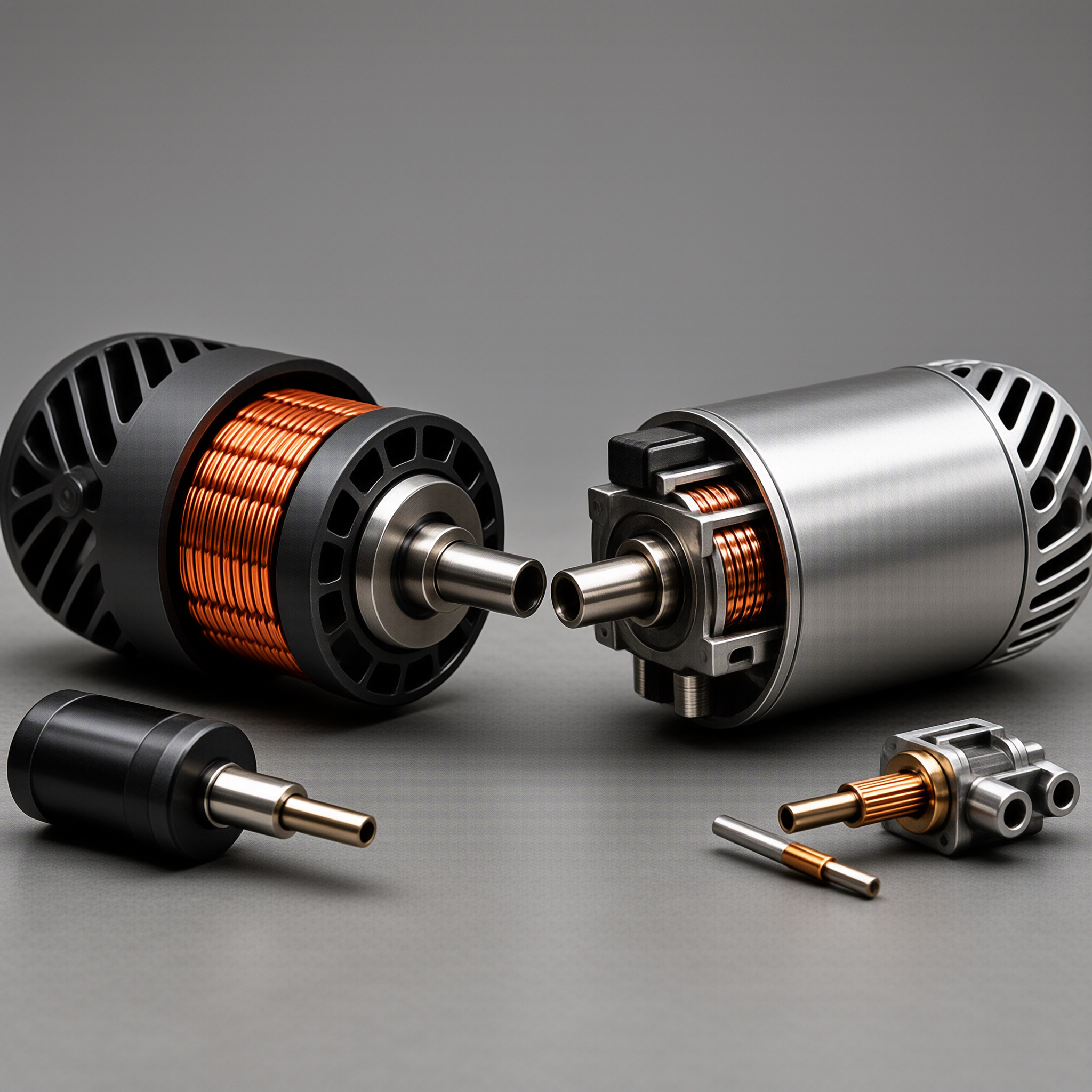
Two carbon blocks press against a segmented copper commutator mounted on the rotor shaft. As the rotor turns, segments pass under the brushes and the current path through the armature coils reverses twice per revolution. The rotor carries the windings; the stator supplies a fixed magnetic field.
The arrangement is robust and cheap to build. Its weakness is the contact itself: friction, electrical arcing and carbon dust all originate at the same interface, and all three scale up as speed rises.
BLDC Motor: Electronic Commutation and Rotor Magnets
In a BLDC motor the windings sit on the stator and the rotor carries permanent magnets. A motor driver PCB — with Hall sensors or sensorless back-EMF sensing — switches current through the stator phases in sequence so the rotor keeps chasing the field.
Nothing rubs. Rotor position is read electrically, so the controller can run the motor at whatever speed the firmware permits, limited by bearings, rotor balance and heat removal rather than by contact wear.
The driver board is the single most reliable structural marker of a genuine brushless design. In teardown reviews, a brushless unit shows a phase-switching power stage plus position feedback circuitry; a brushed unit shows only a simple rectifier, switch and suppression components.
Performance Comparison: RPM, Airflow, Size, Noise, Heat
BLDC wins on speed ceiling, airflow per unit volume, weight, noise and motor-level efficiency. Brushed DC wins on simplicity, tolerance of dusty environments and low acquisition cost at modest performance.
A hair dryer moves air with a centrifugal or mixed-flow impeller, and impeller output rises steeply with rotational speed. Because nothing contacts the rotor, a brushless unit can be run far faster before wear becomes the limit — so a smaller impeller turning faster can match a larger, slower one. That is the core of any hair dryer motor comparison.
| Aspect | Brushed DC Motor | BLDC Motor | Why It Matters |
|---|---|---|---|
| RPM ceiling | Capped by brush and commutator contact; no-load ratings typically below the 100,000 RPM band | Routinely specified above 100,000 RPM in compact housings | Determines whether a small, light impeller can deliver salon-level airflow |
| Airflow per unit volume | Needs a larger impeller or more current to match high-speed output | Small impeller at high RPM moves comparable air | Directly drives product size and hand weight |
| Size and weight | Rotor carries the windings; heavier rotating mass, longer body | Magnets on rotor, windings on stator; lighter rotor, shorter body | Affects user comfort, packaging volume and shipping cost |
| Noise | Brush friction and arcing add broadband hiss, worst at high speed | No brush noise; tonal quality set by impeller, bearings and driver switching | Noise is a primary consumer complaint and a review driver |
| Motor-level efficiency | Brush and commutator losses convert part of input power into heat | Lower electrical and friction losses; more input power becomes airflow | Affects heat build-up inside the housing, not necessarily total energy use |
| Heat generation at the motor | Concentrated at the brush and commutator interface | Spread across stator and driver electronics | Determines which components set the thermal design margin |
| Service life (motor) | Ends when brushes or commutator wear out | Ends when bearings or driver electronics fail | Shifts warranty exposure to different components and different suppliers |
Loaded output is what matters. A no-load RPM figure describes the speed envelope; it does not describe airflow at the operating point, and the two diverge once the impeller is loaded against real resistance (internal observation; rated no-load speed compared against loaded bench airflow). Request an airflow-versus-static-pressure curve instead of a headline number.
A smaller impeller spinning faster can beat a larger impeller spinning slowly — which is exactly why brushless motors shrink hair dryers.
Why High-Speed Hair Dryers Need BLDC Motors to Reach 100,000+ RPM
Above roughly 100,000 RPM, only electronic commutation stays practical. A brushless hair dryer motor has no contact interface to erode, so the speed limit shifts from wear to rotor dynamics and heat removal.
A brushed motor at that speed would destroy its own commutator inside a short operating window, and the arcing would be electrically noisy and thermally severe. The compact form factor also forces a small, precisely balanced rotor — which pairs naturally with a controller that can ramp start-up current and cap speed.
High-speed designs also relocate the failure risk. Bearings, shaft balance and driver thermal management become the binding design constraints, and the acoustic signature is set by the impeller and the driver's switching frequency rather than by brush contact. That is why high-speed handheld platforms are built around a brushless hair dryer motor rather than a brushed one.
Reliability, Brush Wear, Dust, and Service Life
Brushed DC motors fail mainly through brush and commutator wear. BLDC motors fail mainly through bearing wear or driver electronics failure. Comparing brushed vs brushless hair dryer reliability therefore means asking which failure mode fits your warranty model.
Carbon brushes are a consumable by design — they are meant to erode. Dust, humidity and repeated thermal cycling accelerate that erosion, and once a brush shortens past a threshold, contact becomes intermittent before it fails outright. A brushless design deletes that consumable but adds a PCB whose capacitors and power devices have their own ageing mechanisms.
In sampling programs for entry-tier SKUs, we have seen brushed DC units sustain specified airflow at rated load for several hundred hours before measurable brush wear; high-speed BLDC units in the same enclosure class typically outlast them, with bearings and driver components becoming the limiting factors instead (entry-tier and mid-tier sampling batches; bench endurance testing under controlled duty cycles). Importers should also review U.S. Consumer Product Safety Commission guidance on personal care appliances before finalising a warranty term.
Factory-Level Cost Differences: What Drives the Price Gap
A BLDC platform costs more at the factory for three reasons: the rotor uses permanent magnets, the motor needs a driver PCB plus control firmware, and the rotor and bearings must be balanced to tighter tolerances.
Brushed motors are a mature, high-volume commodity with few electronic parts and generous mechanical tolerance. Any hair dryer motor comparison at BOM level shows the same pattern: the brushless version adds magnets, power semiconductors, a microcontroller and firmware, each of which must be amortised across the program. Tooling and test fixtures are also more demanding — balancing equipment, driver programming and end-of-line functional test.
Rotor magnets and their bonding process
Driver PCB, microcontroller and firmware development
Precision rotor balancing and tighter bearing specification
End-of-line functional test and driver programming fixtures
Supplier qualification and second-source effort for the electronics
Consider a 20,000-unit program targeting a mid-tier launch. The brushed variant usually quotes lower at the motor line item, but the picture shifts once you add the impeller, housing and cord set, and again once you model warranty returns across a two-year term. Understanding bldc hair dryer factory cost means separating motor and driver BOM from tooling, firmware and test overhead — the tooling and firmware share does not shrink proportionally with volume, so a small first order carries a disproportionate premium.
How to Verify What Motor Your Supplier Actually Uses
The question of how to verify hair dryer motor type usually appears once a supplier quotes a premium for 'brushless'. Verify by teardown and loaded test data, not by the product photo. A genuine brushless unit shows a driver PCB and phase windings on the stator; a brushed unit shows brushes, a commutator and a two-wire motor connection.
Suppliers can describe a product as 'high-speed' or 'DC' without ever naming the commutation method. Because the words brushless and BLDC carry a price premium, the strongest evidence is physical: open one unit from the bulk sample and identify the motor's electrical interface. Two leads to the motor with no control board indicate brushed; three phase leads plus a control board with position sensing indicate brushless.
In our teardown reviews across sampling batches, the clearest marker of a genuine BLDC hair dryer is a dedicated motor driver PCB with Hall sensors or sensorless back-EMF circuitry mounted near the motor housing (multiple sampling batches across supplier evaluations; physical teardown and PCB inspection). Buyers who want a documented method for writing reliability and performance protocols can reference ISO motor testing standards as a starting framework.
The spec sheet describes the product; the teardown describes the motor.
When a Brushed DC Motor Still Makes Sense
Specify a brushed DC motor when the product is a low-cost, low-duty-cycle unit where replacement cost is low and performance expectations are modest.
Knowing when to choose brushed DC hair dryer motor designs is a duty-cycle question, not a quality judgement. A dryer used for a few minutes a day in a market where the unit is treated as semi-disposable does not benefit from a 100,000 RPM platform — the buyer pays for capability the end user will never exercise.
A practical rule: if expected daily runtime is under two minutes and the warranty term is 12 months, brushed DC is usually sufficient. If routine use exceeds five minutes a day, or the warranty runs 24 months or longer, BLDC is the safer specification. However, the lower motor cost does not automatically produce a lower total cost — once returns, refurbishment and marketplace ratings are counted, a brushed unit that fails early inside warranty can cost more than the BLDC premium.
Buyer Evaluation Checklist Before Placing the Order
Treat motor type as a specification item, not a marketing claim. Put it in the purchase agreement with test criteria, and verify it at sample stage before tooling is released.
Spec Sheet and Documentation Checks
Ask for the motor datasheet separately from the product brochure. It should state rated voltage, no-load speed, loaded operating point, rated current, insulation class and expected brush or bearing service life.
Watch for a single peak RPM figure with no load condition stated. Also check whether airflow is given as a curve (airflow versus static pressure) or as one headline number — curves can be verified, headline numbers cannot. Ionic generators and other add-on features sit downstream of motor choice and should not be allowed to substitute for it.
Sample and Teardown Checks
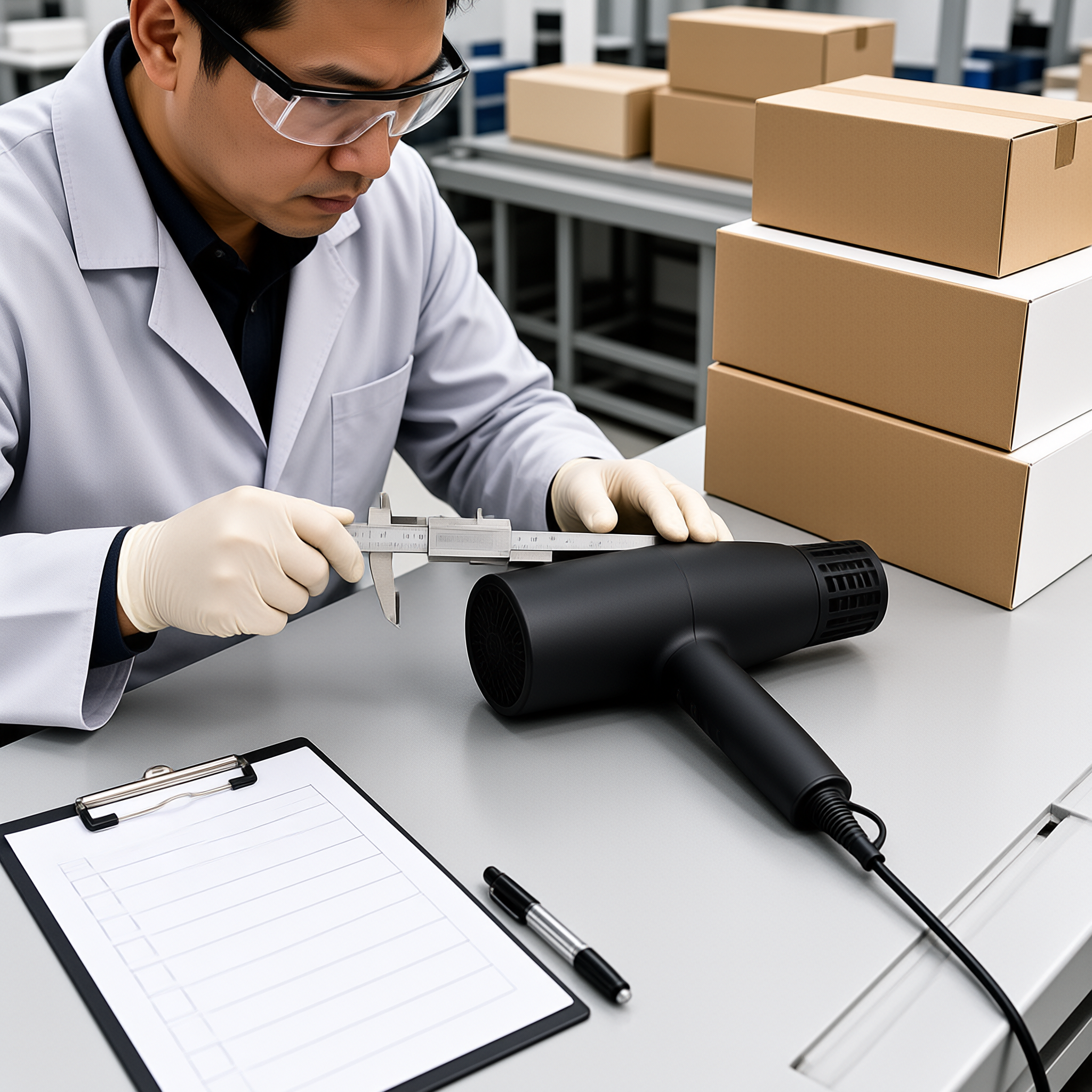
Order at least three units from the first bulk sample and open one. Photograph the motor, the driver board and the wiring before reassembly so the evidence survives the review meeting.
Run a loaded airflow test, a noise measurement at a fixed distance, and a thermal soak at the intended duty cycle. Log results against datasheet values so deviations are visible before tooling is committed.
Commercial and Warranty Checks
Confirm which certifications apply to your destination market — CE, UKCA, ETL, FCC, RoHS and CB are the usual set for personal care appliances — and confirm that ISO 9001 quality management documentation is available for the assembly site. Ask whether the certificate scope covers the specific product family you are ordering, and keep that answer in writing.
Match the warranty term to the motor's wear-out mode. A 24-month term on a brushed motor carries different risk than the same term on a brushless unit, because the failure distribution peaks at a different point in the service window.
Motor datasheet states rated voltage, no-load speed and loaded operating point
Airflow specified as a curve, not a single peak number
Teardown photo of motor, driver board and wiring retained on file
Loaded airflow, noise and thermal soak results logged against datasheet values
Certification scope confirmed for the destination market
Warranty term matched to the motor's dominant wear-out mode
Replacement motor assembly availability confirmed for the warranty period
Each of these checks costs a few days at sample stage. Each one prevents a problem that would otherwise surface only after tooling is paid for.
Frequently Asked Questions About BLDC vs Brushed DC Hair Dryers
- What is the difference between BLDC and DC motors in hair dryers?
- Brushed DC motors use carbon brushes pressing on a mechanical commutator to reverse current in the rotor. BLDC motors replace that contact with a driver circuit that switches stator phases electronically, using rotor magnets and position feedback.
- Why can BLDC hair dryers spin so much faster than brushed ones?
- There is no brush-to-commutator contact to erode, so the speed limit is set by bearings, rotor balance and heat removal instead of wear. That allows sustained operation well above 100,000 RPM inside a compact housing.
- Do BLDC hair dryers really last longer than brushed ones?
- Typically yes, but the failure mode changes rather than disappears. Brushed motors end with brush or commutator wear; brushless motors end with bearing wear or driver electronics failure.
- How can a buyer verify what motor a supplier actually uses?
- Open one unit from the bulk sample and inspect the motor wiring and control board. Two motor leads with no control board indicate brushed; three phase leads plus a driver PCB with position sensing indicate brushless.
- Are BLDC hair dryers more energy efficient?
- At the motor level, yes — electronic commutation avoids brush friction and commutator losses, so more input power becomes airflow instead of heat. Total energy use still depends on heater power and runtime.
- When is a brushed DC motor still a reasonable choice?
- When the target retail band is low, daily runtime is short, the market replaces rather than repairs, and the warranty term is short enough that brush wear will not generate returns inside the coverage window.
Motor type should be a verified line item in the purchase agreement, not a marketing adjective.
For buyers weighing a bldc vs dc hair dryer platform, the sequence is straightforward: define the duty cycle and warranty term first, then select the motor that survives that specification at the lowest total cost. Everything else — colour, packaging, cord length — is far easier to change later.