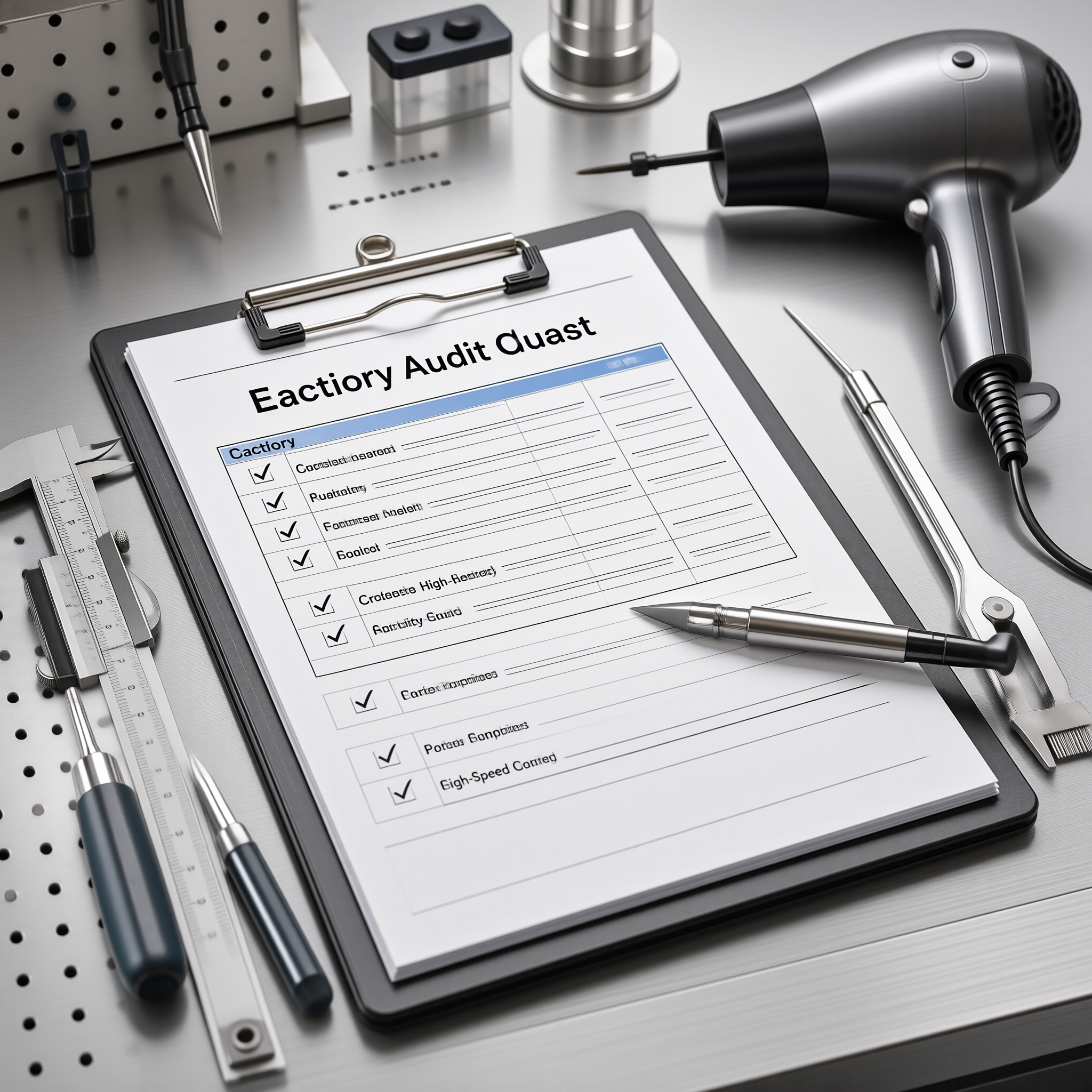
To verify a hair dryer certificate, request the underlying test report under NDA, then check five items: report ID, lab accreditation, model list, test standards, and test date. A certificate alone is a conformity statement — only the linked report proves your model was tested.
A certificate is a conformity statement; the linked test report is the only document that proves a specific model was actually tested.
Verification failures usually start with scope, not fraud. A buyer accepts a PDF certificate at sampling, pays the deposit, then finds before shipment that the listed model differs in wattage from the PO line, or that the lab's accreditation covers a different product category. Fixing that costs weeks, and sometimes a blocked customs entry.
Key Takeaways
Request both the certificate and its underlying test report — the certificate alone never proves model-specific testing.
Match the model list on the report against your PO line; unlisted variants are not covered.
Confirm the issuing lab's accreditation scope covers electrical appliances and your market's requirements.
Voltage-specific testing applies: a 220–240V report does not cover 110V units, even with the same model number.
Resolve report IDs on the issuing lab's own register, never on a PDF the supplier emailed you.
How to Verify a Hair Dryer Certificate: Direct Answer
Verification is a document check with five gates: report ID, issuing lab, model list, standards, and date. All five must line up before you release a deposit.
Certificates are issued either by the manufacturer or a certification body, and each one references the report ID that generated it. That identifier is what makes the chain auditable, since a report ID resolves to a single lab record with its own sample description and measurements. When the identifier is missing or unresolvable, the certificate has no verifiable basis behind it.
A 5,000-unit order bound for the EU and UK needs CE and UKCA coverage confirmed before the deposit moves. The factory may hold CE, UKCA, CB, ETL, FCC, RoHS and ISO 9001 documents; the buyer's job is to match each certificate to the exact model on the purchase order and to the destination market. Documents naming other models prove nothing about this order.
Certificate vs Test Report: What Each Document Actually Proves
A test report is the laboratory's raw record of testing; a certificate is a short conformity statement that cites it. The difference between a certificate and a test report comes down to proof: the report shows measurements, the certificate shows a claim.
Reports record the sample description, test conditions, measured values and photographs, which is why they can be audited line by line. A certificate compresses all of that into a declaration, so a reader cannot see how the conclusion was reached. Because summaries are easy to copy, a certificate travelling alone is where most verification problems begin.
European market surveillance authorities request the technical file — the report and its supporting data — when a product is questioned, not the certificate page. Under EU market surveillance rules, the responsible economic operator must keep that technical documentation available and produce it on request. In North America, the equivalent demand comes from customs brokers, retailers and product-liability insurers.
| Dimension | Test Report | Certificate / Declaration |
|---|---|---|
| Issued by | Accredited third-party laboratory | Manufacturer or certification body |
| What it proves | The submitted sample was tested to named methods | The supplier declares conformity |
| Detail level | Measured values, conditions, sample photographs | Summary statement referencing a report ID |
| Model coverage | Only models listed on the report | Only models named on the certificate |
| Best used for | Customs, market surveillance, importer due diligence | Quick supplier screening and retail listings |
Anatomy of a Valid Hair Dryer Test Report
Required Header Fields (Report ID, Lab, Date)
A valid hair dryer test report opens with a complete header block: unique report ID, the laboratory's legal name and address, date of issue, sample receipt date, and a total page count.
The page count matters more than it looks. Reports are paginated and initialled so that a removed page is detectable; an unnumbered PDF that ends mid-sentence usually means the model list or the conclusion page has been stripped out. Ask for the full file, not a screenshot of page one.
Test Standards and Product Description
The standards clause names each test method applied, with the edition year. For electrical appliances it typically covers safety testing, electromagnetic compatibility testing, and where applicable, hazardous-substance testing such as RoHS.
The product description must match the physical appliance: rated voltage, frequency, input power, plug type, and a photograph of the tested sample. Any mismatch between the described sample and the shipping unit weakens the report's relevance to your order.
If the voltage on the report differs from the unit you are importing, the report does not cover your product — even when the model number matches.
Model List and Variant Coverage
The model list is the commercially decisive page. It names every model identifier the report covers, and often includes a variant table linking each identifier to a wattage or configuration.
Labs accept a family listing only when the variants share the same safety-critical construction — motor, heating element, housing and electronics. A different wattage or a different plug assembly usually falls outside the tested family, which means a new evaluation rather than a copied certificate.
Model Scope: Why a Certificate Is Only Valid for Listed Models
A certificate covers only the models printed on it. If your SKU is absent from the model list on the certificate, you hold no compliance evidence for the units you are buying.
Labs test a submitted sample and describe its construction in the report. Variants qualify for the same listing when they share the tested safety-critical components; when the heater rating, motor or control board changes, the tested construction no longer matches the shipping unit. That is why an added SKU needs either a new evaluation or explicit inclusion in a family report.
Picture a buyer ordering the 1,800W variant of a dryer whose report lists 1,200W and 2,000W models. The middle SKU sits outside the tested family, so the certificate on file will not support a customs query or a retailer's compliance review. Checking the list page before the deposit costs nothing; discovering the gap after production costs a re-test and a schedule slip.
How to Check Lab Accreditation and Report ID Traceability
How to check lab accreditation: take the laboratory name from the report, search it on the accreditation body's public register, and confirm two things — the lab is accredited, and its scope covers electrical appliances.
Accreditation registers publish a scope statement listing the standards and product categories a lab may test. A lab accredited for textile testing cannot issue accredited results for a hair dryer, and ISO 17025 accreditation is the reference framework that makes this scope check possible under ISO (International Organization for Standardization) conformity practice. Report ID traceability follows the same logic: the identifier should resolve to a record the laboratory itself confirms.
Our compliance team runs a five-step release protocol: buyer signs the NDA; the report ID is matched against the issuing lab's register; the model list is cross-checked against the buyer's SKU; voltage and standards clauses are checked against the destination market; and the file is released with a watermark carrying the buyer's name. Applied across 30+ buyer verification requests (NDA-based release with dual confirmation), the protocol catches scope mismatches before they reach a purchase order. For destination-market checks, the EU Safety Gate database lists notified product risks that can contradict an otherwise clean certificate file.
Red Flags of Fake or Borrowed Hair Dryer Certificates
Document-Level Red Flags
Document tampering is visible in the file itself. Blurred or duplicated logos, inconsistent fonts between header and body, missing page numbers, and a signature block with no printed name are the usual signatures of an edited PDF.
Check the file metadata where it is available. A file created last month and presented as a two-year-old report, or a scan whose background tone shifts between pages, deserves a direct written question to the supplier.
Lab- and Scope-Level Red Flags
Scope problems are harder to spot because the document looks clean. Watch for a laboratory that appears on no accreditation register, a report ID nobody can resolve, or results shown without an accredited-lab mark.
Then compare the product details. The typical fake certificate hair dryer case is not a forgery at all — the document is often genuine but issued for a different model, a different voltage, or an entirely different product category. A 110V rating on a file intended for a 220–240V market is a scope failure, not a typo.
In sampling programs, 4 of 30 third-party certificates initially provided by suppliers failed our internal scope check — either the report ID did not resolve on the lab's public register, or the listed model number did not match the buyer's PO line. Sample: n=30 certificates across 18 buyers; method: report-ID lookup on issuing-lab registers plus SKU cross-check against PO lines; conditions: EU and US destination markets, 2024–2025.
| Check Item | What to Look For | Red Flag |
|---|---|---|
| Report ID | Resolves on the issuing lab's register | ID cannot be found, or lab has no public register |
| Lab identity | Named laboratory with address and accreditation scope | No lab name, or lab absent from accreditation listings |
| Model list | Your exact SKU code printed on the report | Generic series wording with no identifiers |
| Voltage / frequency | Matches your market, e.g. 220–240V 50Hz or 110–120V 60Hz | Market voltage missing from the report |
| Product description | Wattage, plug type and photo match the appliance | Photo shows a different appliance |
| Dates | Issue date and sample receipt date present and consistent | Dates missing or inconsistent with the supplier's story |
| Document integrity | Numbered pages, clear logos, complete file | Blurred logo, missing page numbers, cropped signature |
Why Certificates Cannot Be Shared Publicly — The NDA Workflow
Certificates and reports are shared under NDA because they carry the applicant's name, order details and, in some cases, proprietary construction information.
Reports are issued to a named applicant. Publishing one puts that commercial relationship on record and lets a competitor cite a test that was never performed on their own model. Laboratories also place usage restrictions on how their reports may be reproduced or displayed.
The exchange is routine: the buyer signs an NDA, the supplier releases the file with a watermark carrying the buyer's name, and the document is used only for that buyer's compliance file. A supplier unwilling to let a serious buyer request the certificate under NDA for a live order deserves closer questioning about what the document actually covers.
Buyer Due-Diligence Checklist and What to Ask the Supplier
Ask for four things in writing: which certificates, for which model identifiers, from which laboratory, and against which standards. Vague answers are the first signal that the file was never tested for your order.
The documentation you need depends on where the units will be sold. CE and UKCA documents apply to EU and UK distribution; ETL or FCC documents to North America; CB test data is useful when the same platform ships to several regions, but only where the destination certifier accepts CB results. Confirm that acceptance in writing before you count on the savings.
Choose a single-market path if your SKUs are locked to one region and volume is modest — one evaluation, one document set, less coordination. Choose a multi-market path if the same platform ships to two or more regions and the destination certifier accepts shared test data, since duplicated testing is the larger cost. Voltage splits are where the decision gets expensive: dual-voltage programs need reports for each variant, not one reused file.
Your exact model identifiers, matched line by line against the purchase order
The complete test report — all numbered pages — not a screenshot or a photo of page one
The issuing laboratory's legal name, address and accreditation registration
The standards applied, with edition years, mapped to each destination market
Issue date, sample receipt date, and the tested sample's rated voltage and frequency
Written confirmation that the file is released to you under NDA and may be used for your compliance records
| Your Situation | Request This | Watch For |
|---|---|---|
| Single market, first order | CE or UKCA certificate plus full test report per SKU | Report listing a different wattage or model code |
| EU and UK in one order | Separate CE and UKCA documentation per model | One certificate presented as covering both markets |
| North America | ETL listing or equivalent plus FCC documentation | EU-only reports presented as globally valid |
| Multi-region platform | CB test data plus written confirmation the destination certifier accepts it | Assumed acceptance that was never confirmed |
| Dual-voltage SKUs | Voltage-specific report for each variant | One report reused across 110V and 220–240V units |
Two certificates naming the wrong model are worth less than one report that names your exact SKU and voltage.
FAQ: Hair Dryer Certificate Verification
- What is the difference between a hair dryer certificate and a test report?
- The test report is the laboratory's record of measurements on a submitted sample; the certificate is a conformity statement citing it. Request both, because only the report shows the model was actually tested.
- How do I confirm a hair dryer test report is real?
- Take the report ID and the laboratory name, then resolve both on the issuing lab's public register. If the laboratory cannot confirm the ID itself, treat the document as unverified.
- Can one certificate cover several hair dryer models?
- Only when every model identifier is printed on the report, usually as a family listing. Variants with a different motor, heater rating or plug configuration sit outside that listing.
- Why will my supplier only send documents under NDA?
- Reports name the applicant and contain order-specific data. An NDA plus a watermarked copy limits that exposure, and the practice is standard in supplier compliance.
- Which certificates should I request before importing hair dryers?
- CE and UKCA documentation for Europe, ETL or FCC for North America, CB data when several regions are involved, and the factory's ISO 9001. Confirm each one names your exact model.
- What if the voltage on the certificate does not match my market?
- The testing is voltage-specific, so a 220–240V report does not cover 110V units. Request the correct variant report or one explicitly covering both voltages.
To verify a hair dryer certificate properly, treat the report — not the certificate page — as the source of truth: resolve the report ID, match the model list, and confirm the standards for your destination market. Start with the accreditation body's register for the issuing laboratory, then cross-check the market's own surveillance database before the order ships.