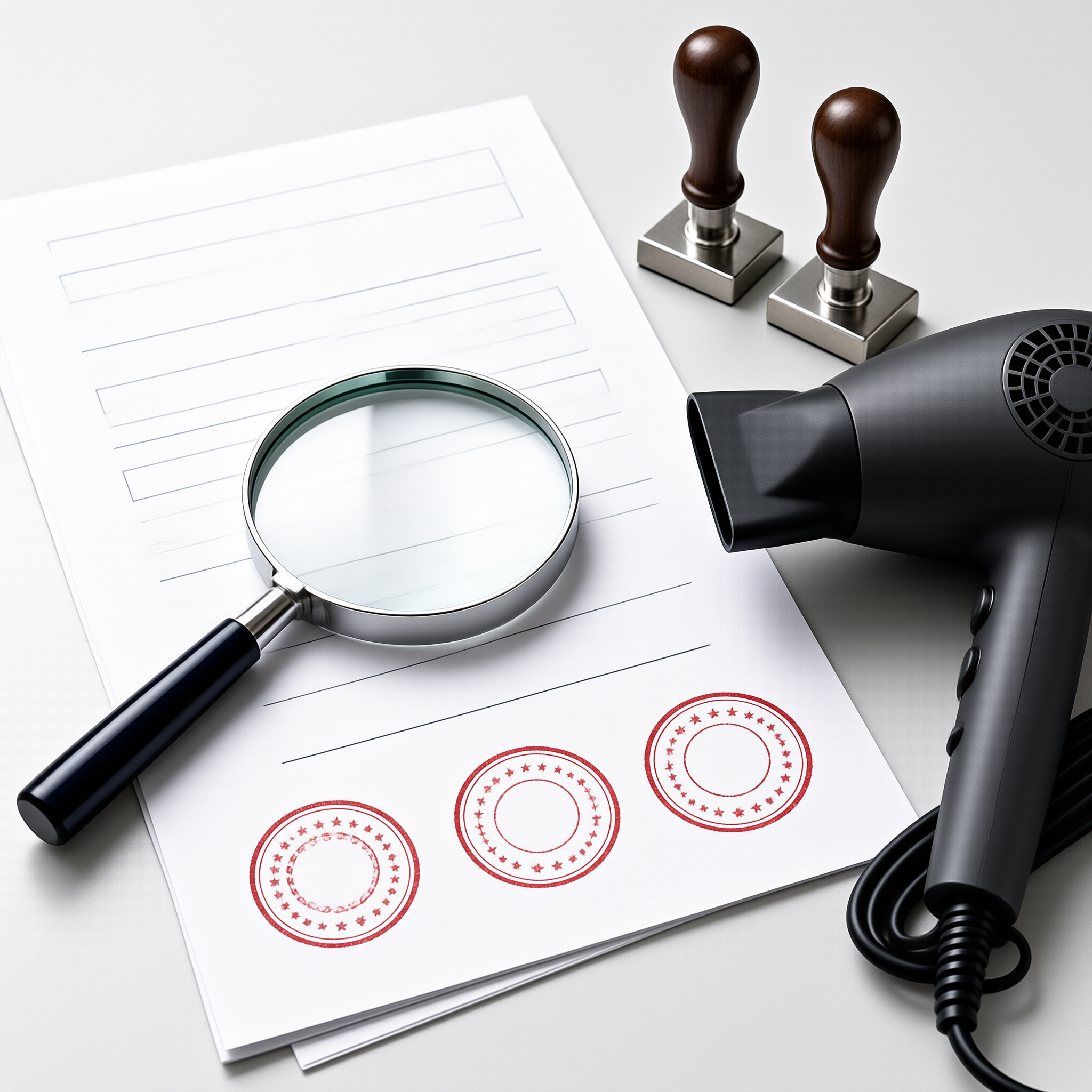
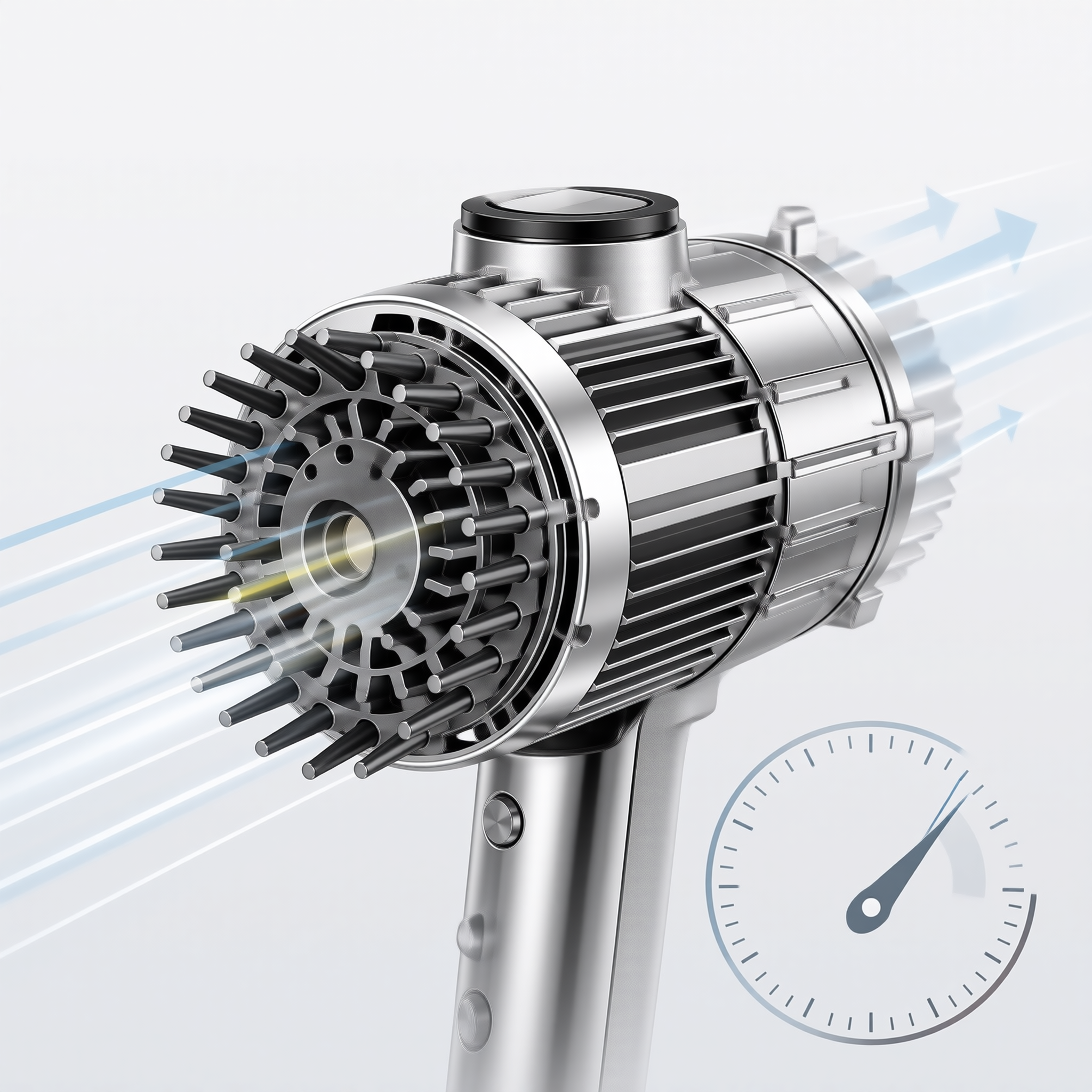
An AQL inspection for hair dryer shipments is a statistically valid pre-shipment check that decides whether a finished lot is fit to ship. This AQL inspection hair dryer guide follows ISO 2859-1: an inspector draws a random sample, grades every unit against appearance, electrical, functional and safety criteria, and classifies each defect as critical, major or minor.
A lot passes only when defects in every class stay at or below its acceptance number: critical 0, major 2.5, minor 4.0 at General Inspection Level II.
The check is run by an independent third-party QC agency, not by the factory's own QC team. That separation is deliberate: an outside inspector applies the same accept/reject rule to every lot, so a batch cannot pass on the strength of a good relationship with the production manager.
Key Takeaways
ISO 2859-1 sampling at General Inspection Level II is the default convention for consumer electrical appliances.
Critical defects use AQL 0 — a single safety failure rejects the whole lot.
A 501–1,200 unit lot is inspected with 80 units (code letter J), not the full order.
Re-inspection after rework requires a fresh AQL draw, never an extension of the failed report.
The tradeoff is residual risk. Sampling verifies a lot; it never certifies every unit. Buyers accept that gap because the alternative — inspecting 100% of the container — is slower and costlier.
What Is AQL Inspection and Why Importers Use It for Hair Dryers
AQL stands for Acceptance Quality Limit — the maximum percentage of defective units that still makes a lot acceptable. ISO 2859-1 defines the sampling plans and tables that convert that limit into a pass or fail decision for a specific lot size.
Attribute sampling replaces full inspection with statistics. A random sample of 80 units drawn from 1,000 gives a known probability of accepting a lot at a defined quality level, so buyer and supplier negotiate from the same table rather than from opinions about what "looks fine".
ISO 2859-1:1999 is the international standard for inspection by attributes, and it is written into buyer-supplier contracts across consumer electronics. Importers rely on it for three practical reasons: the sample size is defined mathematically, defect classes are fixed before production starts, and the resulting third-party report is defensible in a claim.
Standard AQL Levels and Acceptance Numbers for Consumer Electricals
General Inspection Level II is the default for consumer electrical appliances, and the convention used for hair dryer quality inspection is critical 0, major 2.5, minor 4.0. Those values are an industry convention rather than a regulatory requirement — the purchase order is what binds both sides.
Most importers default to the general inspection level ii electrical appliances convention instead of commissioning a bespoke plan. Level I reduces the sample (about 50 units instead of 80 for a 1,000-unit lot) and weakens protection against a defective lot; Level III increases both. Products with heating elements and skin contact usually stay at Level II.
The acceptance numbers that make a hair dryer quality inspection binary follow directly from the AQL value and the sample size. For code letter J (n = 80), normal single sampling gives Ac = 5 and Re = 6 at AQL 2.5, and Ac = 7 and Re = 8 at AQL 4.0. AQL 0 has no acceptance number at all: one critical defect rejects the lot.
| Parameter | Industry convention | What it means on the line |
|---|---|---|
| Inspection level | General Inspection Level II, normal, single sampling | Code letter J for a 501–1,200 unit lot |
| Critical (AQL 0) | Ac = 0, Re = 1 | One critical defect rejects the entire lot |
| Major (AQL 2.5) | Ac = 5, Re = 6 at n = 80 | Six or more major defects → lot fails |
| Minor (AQL 4.0) | Ac = 7, Re = 8 at n = 80 | Eight or more minor defects → lot fails |
How Sample Size Is Determined from Lot Quantity (ISO 2859-1)
Sample size is read from a two-step lookup, never calculated on the fly. Lot quantity selects a code letter; the code letter and the inspection level select the sample size.
Sampling risk depends on lot size only up to a point. ISO 2859-1 compresses lot quantities into ranges — 501 to 1,200 units share code letter J — because a sample of 80 protects a 600-unit lot about as well as an 1,100-unit lot. Above the range, both the code letter and the sample size step up.
Lot 501–1,200 maps to code letter J and a sample of 80 units under General Inspection Level II.
ISO 2859-1:1999, Table I-A gives the numbers for a single sampling plan under normal inspection: 501–1,200 units → code letter J → 80 units; 2,001–3,200 → code letter K → 125 units; 10,001–35,000 → code letter M → 315 units. The same two-step lookup underpins every ISO 2859-1 sampling procedures for inspection by attributes plan used on consumer electronics. A 1,200-unit EU-bound OEM order therefore samples 80 units, not the container.
Hair Dryer Inspection Checklist: Area-by-Area Defect Classification
Appearance, Finish, and Branding
Cosmetic checks anchor the hair dryer qc checklist. Inspectors compare housing colour and gloss to the golden sample, then look for scratches, sprue marks, flash and burrs around the air inlet grille and the switch opening.
A misspelled logo is never minor. It moves straight to major, because the packed carton becomes unsellable in the destination market.
Branding faults are the most expensive to fix after packing. Once the housing is printed and the gift box glued, a colour mismatch between shell and box cannot be reworked at the bench — the affected units are scrapped instead.
Electrical Rating, Plug, and Functional Performance
This block carries the critical defects. The inspector checks the rating label against the spec sheet: voltage (110 V or 220–240 V), wattage, frequency, model number, and the certification marks required in the destination market.
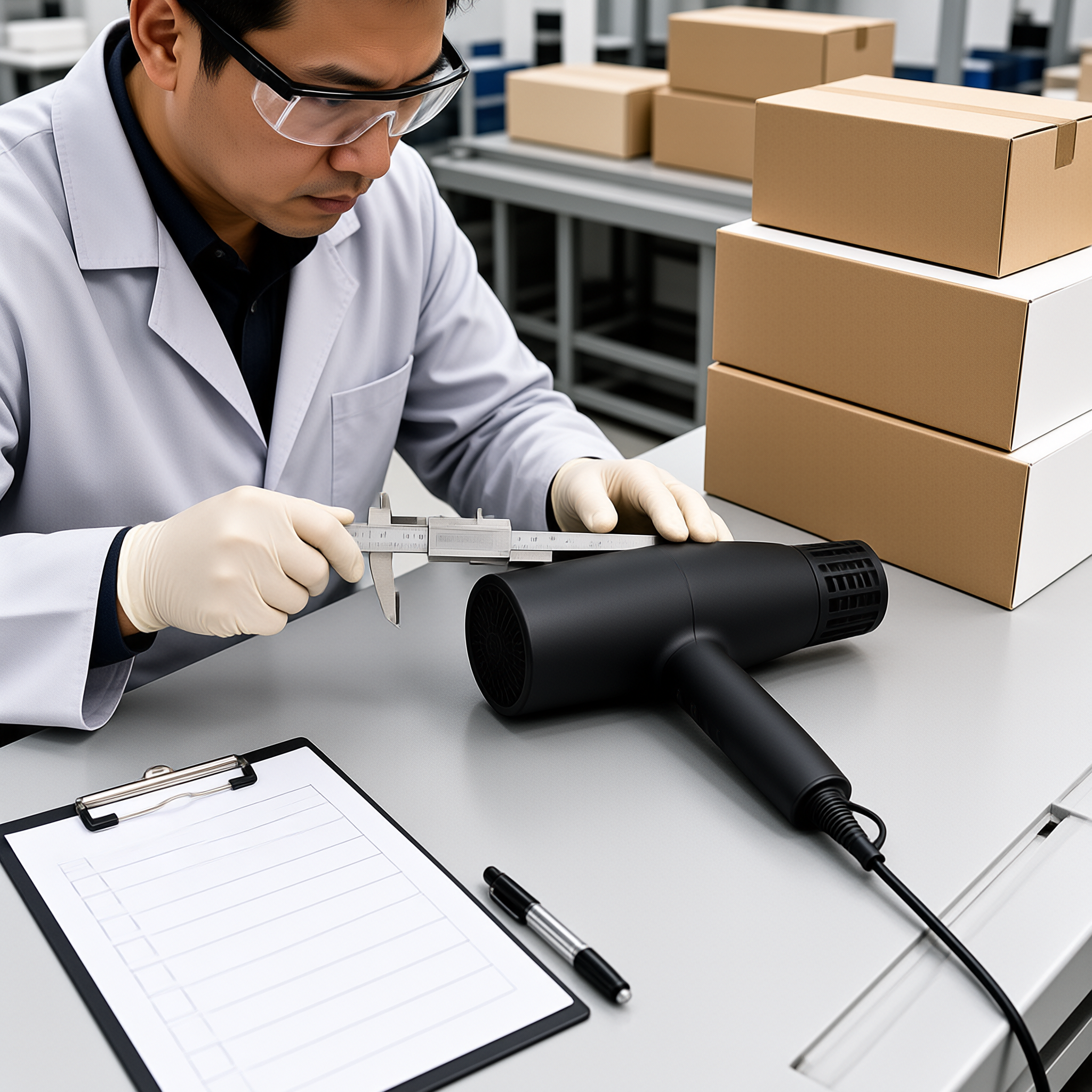
Function tests run in a fixed sequence. The unit is plugged in, every speed and heat setting is cycled, airflow and noise are compared with the golden sample, and the heater runs long enough to confirm the thermostat cuts out at overheat.
For electrical-safety checks we combine a 1-minute running test at rated voltage with a hi-pot and earth continuity check on the sampled units, plus a 30-second temperature-rise check at the air outlet; any reading outside the spec sheet tolerance is logged as a critical defect under the hair dryer qc checklist (method: running test + hi-pot + earth continuity + 30-second temperature rise at rated voltage, applied per shipment).
Packaging, Labelling, and Accessories
Packaging is where small errors turn into expensive returns. Inspectors verify carton board grade, print colour and registration against the artwork file, insert fit, barcode scan result, and every label: country of origin, warning text, importer address, recycling marks.
Accessory counts are checked per unit, not per carton.
In our sampling programs for personal-care appliances (method: defect-class tally from PSI reports, sorted by frequency), the four most common defect classes are voltage or wattage label mismatch, plug type mismatch on destination-market units, cosmetic scratches on the housing, and missing or under-packed accessories such as concentrator nozzles or diffusers.
| Inspection Area | What to Check | Defect Class |
|---|---|---|
| Appearance and finish | Housing colour and gloss vs golden sample, scratches, sprue marks, burrs on grille | Minor |
| Logo and branding | Logo spelling, font weight, colour, placement, print sharpness vs golden sample | Major |
| Packaging and gift box | Carton board grade, print registration, insert fit, barcode scan, artwork match | Major |
| Voltage and power rating | Label voltage, wattage at rated voltage, frequency, model number vs spec sheet | Critical |
| Plug type | Pin configuration and cord set for the destination market (EU Type C/F, UK Type G) | Critical |
| Motor, noise and airflow | Start-up, speed and heat switch function, airflow and noise level vs golden sample | Major |
| Heating and temperature control | Heat output, 30-second outlet temperature rise, thermostat cut-out at overheat | Critical |
| Accessories completeness | Concentrator nozzle, diffuser, manual, warranty card, cord wrap, bag | Minor |
| Safety items | Hi-pot, earth continuity, cord anchorage, thermal fuse, no exposed live parts | Critical |
Critical vs Major vs Minor Defects for Hair Dryers
Defect class is decided by consequence, not by visibility. Critical defects create a safety hazard or legal non-compliance; major defects break function or saleability; minor defects are cosmetic deviations tolerated up to a defined rate.
Classification drives the economics of the inspection. One critical defect rejects a 1,000-unit lot however good the rest looks, while six minor defects in an 80-unit sample still pass at AQL 4.0. Fixing the classes in the purchase order before production removes the argument later.
Regulators treat hair dryers as high-risk goods because of heat and mains voltage. Public recall notices — including EU Safety Gate (formerly RAPEX) weekly product-recall notices — repeatedly cite overheating, electric shock and non-compliant plugs. That pattern is why the critical defects hair dryer AQL plans treat as non-negotiable are electrical, not cosmetic.
| Severity | Definition | Hair dryer examples | Typical AQL |
|---|---|---|---|
| Critical | Safety hazard or legal non-compliance | Exposed live parts, hi-pot failure, missing thermal fuse, wrong plug for market, wrong voltage label | 0 |
| Major | Breaks function or saleability; buyer rejects | Logo error, packaging artwork mismatch, dead heat setting, excessive noise, scratched housing | 2.5 |
| Minor | Cosmetic or low-impact deviation | Light scuff on hidden surface, small sprue mark, accessory bag colour variation | 4.0 |
Preparing Documents and a Golden Sample for the Inspection Agency
An agency can only measure what you define. Send the spec sheet, the approved golden sample, the final packaging artwork, the electrical test standard, and the purchase order before the visit is booked.
Choose a full functional protocol if the product carries heating elements or mains voltage, or if this lot repeats a previously failed order. Choose a visual-and-packing protocol only for reorders with a clean history and unaltered tooling. The rule: if anything changed — mould, motor supplier, label text, plug supplier — run the full protocol.
A common misconception is that the spec sheet alone is enough. Subjective items such as gloss level, plastic odour, logo spacing and accessory bag colour cannot be measured against written text; without a golden sample the inspector either skips them or applies personal judgement, and rework disputes follow.
Spec sheet: model, voltage, wattage, airflow, noise limit, accessory list, packaging configuration.
Golden sample: signed and dated, showing approved gloss, logo placement, cord length and accessory set.
Packaging artwork: print-ready files for gift box, carton, labels and barcode, with colour references.
Test standard: the IEC/EN or destination-market standard your electrical checks reference, plus hi-pot values.
Purchase order and AQL instruction: inspection level, AQL values, and the defect classes to apply.
Logistics details: inspection address, carton count per SKU, and the lot definition if the shipment mixes models.
What to Do When a Hair Dryer Batch Fails AQL
Hold the shipment, segregate the failed lot, and decide between rework with re-inspection or 100% screening. Goods should not leave the factory while the defect class is still unresolved.
A failure usually traces to one process step, not the whole line. A plug-type mismatch means the assembly station ran the wrong cord set; a hi-pot failure points to a wiring or insulation fault at a single bench. Sorting the report by defect class tells you whether the fix is rework or replacement.
Write the aql failed batch rework protocol before anyone touches the goods.
Segregate and freeze the lot; photograph defects by class as evidence.
Trace each defect class to its process step and confirm the root cause with the factory.
Choose rework or replacement, and set a written completion deadline.
Re-inspect the reworked lot with a fresh ISO 2859-1 draw — the original report does not cover it.
For critical defects only, consider 100% screening by the factory, verified by a re-inspection sample under the agreed aql failed batch rework protocol.
Frequently Asked Questions on Hair Dryer AQL Inspection
- What AQL standard is most commonly used for hair dryers?
- ISO 2859-1 at General Inspection Level II, with the industry convention of critical 0, major 2.5 and minor 4.0 for consumer electrical appliances.
- How many hair dryers are sampled for a 1,000-unit order?
- A lot of 501–1,200 units maps to code letter J and a sample size of 80 units under General Inspection Level II; a 2,001–3,200 unit lot becomes code letter K and 125 units.
- Which hair dryer defects are treated as critical?
- Anything presenting a safety hazard: electric shock risk, hi-pot failure, a missing or broken thermal fuse, exposed live parts, thermostat failure, or a non-compliant plug for the destination market.
- Can a failed batch be re-inspected after rework?
- Yes, but the reworked goods must be presented as a new lot under a fresh AQL draw; the original inspection report is never extended to cover reworked units.
- Do I need a golden sample if I only buy one SKU?
- Yes. The golden sample is the physical reference for colour, gloss, logo placement and accessory completeness; without it, inspectors fall back on the spec sheet and leave subjective items undefined.
- How long does a pre-shipment inspection usually take?
- Typically one working day for lots under about 2,000 units. Larger lots or detailed functional protocols such as hi-pot, drop and aging tests can extend to 2–3 days.
Sampling does not guarantee zero defects — it guarantees a documented, defensible decision at a known risk level.
A repeatable AQL inspection hair dryer routine needs only three documents to start: the spec sheet, a signed golden sample, and a written defect-class list. The ISO 2859-1 tables published by ISO cover every lot size you will meet, and the inspection report becomes the record that protects both sides of the order.